
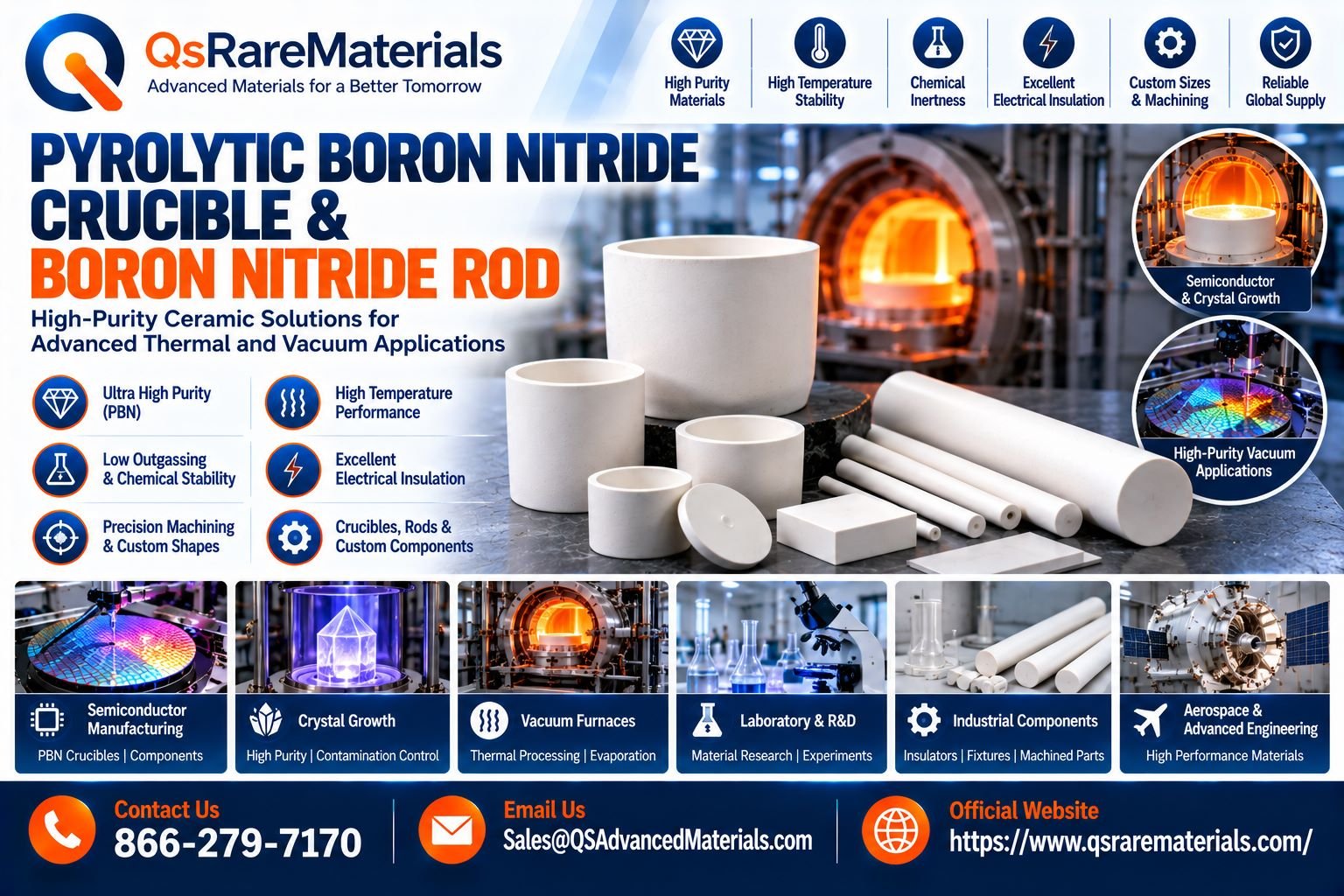
The expansion of crystal growth, semiconductor research, vacuum processing, and advanced material development is placing new demands on high-temperature containment systems. Engineers are increasingly examining how crucible geometry, thermal behavior, purity, and supporting ceramic components affect the stability of an entire process.
Within this changing environment, the Pyrolytic Boron Nitride Crucible is gaining relevance for selected applications where controlled processing and material cleanliness are priorities. Alongside it, Boron Nitride Rod provides a practical material format for producing custom fixtures, insulators, supports, and other components used around sensitive thermal zones.
The latest engineering focus is shifting toward process reproducibility: creating component specifications that can move reliably from laboratory trials to pilot production and eventually repeat manufacturing.
Pyrolytic Boron Nitride Crucible Supports Controlled Material Processing
A Pyrolytic Boron Nitride Crucible is manufactured from pyrolytic boron nitride, commonly known as PBN. The material is generally produced using chemical vapor deposition rather than conventional powder-pressing methods.
This manufacturing route gives PBN distinctive characteristics that can make it relevant to selected high-purity and technically demanding environments.
Potential applications include crystal-growth equipment, semiconductor-related processes, compound semiconductor development, vacuum technology, and specialized research systems.
Material suitability remains application-dependent. Temperature, atmosphere, process chemistry, component geometry, thermal cycling, and mechanical conditions should all be evaluated.
Crystal Growth Makes Crucible Design More Critical
Crystal-growth processes can require carefully controlled thermal conditions and close management of materials within the processing zone.
The crucible therefore performs more than a simple containment function.
A Pyrolytic Boron Nitride Crucible may be considered when the characteristics of PBN align with the requirements of a particular crystal-growth process.
Its dimensions can also become part of equipment design. Internal diameter, depth, wall configuration, base geometry, and overall size may influence fit, material capacity, and thermal-system integration.
Instead of selecting a standard crucible first, engineers can define the functional requirements of the process and then determine an appropriate component configuration.
Thermal Directionality Requires Purposeful Design
PBN exhibits anisotropic characteristics, meaning some material properties vary depending on direction.
This is particularly important when engineers evaluate thermal behavior.
For a Pyrolytic Boron Nitride Crucible, component orientation and geometry can therefore be considered alongside the surrounding heat source and process configuration.
Understanding this characteristic can help designers evaluate PBN as part of a complete thermal system rather than as an isolated ceramic container.
Purity Must Be Supported by Clean Handling
The high-purity potential of PBN can be valuable in sensitive processing environments, but material purity is only one element of contamination control.
A crucible can pass through packaging, transportation, storage, inspection, and installation before it reaches the processing chamber.
Organizations using a Pyrolytic Boron Nitride Crucible in contamination-sensitive applications should therefore consider handling practices appropriate to their process.
Unnecessary surface contact, unsuitable storage, or contamination during installation could undermine the purpose of specifying a high-purity component.
Boron Nitride Rod Helps Build the Supporting System
A thermal system may require numerous ceramic components around its primary processing container.
A Boron Nitride Rod can serve as stock for producing application-specific parts such as sleeves, spacers, supports, fixtures, bushings, positioning elements, and electrical insulators.
Certain boron nitride grades offer useful machinability compared with many other technical ceramics.
This can provide engineering teams with flexibility when developing specialized equipment or modifying an existing system.
Instead of searching for a standard component that approximately fits, designers may create a part based on actual functional requirements.
Prototype Development Benefits From Machinable Ceramics
Research equipment often changes during development.
Testing may reveal that a spacer requires a different length, a support needs greater clearance, or an insulating component requires a revised geometry.
Using Boron Nitride Rod can support this iterative design process when the selected grade is appropriate for the application.
Engineers can manufacture prototype components, test them within the equipment, and refine dimensions before creating the final production specification.
This approach can be particularly valuable in low-volume research and specialized equipment where dedicated tooling may not be practical.
Dimensional Repeatability Becomes Important During Scale-Up
A component that works once in a laboratory is not automatically ready for repeat manufacturing.
As a process moves toward production, critical dimensions need to be identified and controlled.
For a Pyrolytic Boron Nitride Crucible, this may involve documenting internal and external dimensions, wall configuration, material requirements, and other functionally important characteristics.
Components produced from Boron Nitride Rod should likewise have controlled drawings where repeatability is required.
The objective is to distinguish dimensions that affect performance from those that do not require unnecessarily restrictive tolerances.
Inspection Connects Procurement With Engineering
Incoming inspection can help confirm that specialized components match their documented requirements before installation.
Depending on the application, inspection may involve dimensional verification, visual surface assessment, documentation review, or other appropriate checks.
This creates an important connection between procurement, engineering, and quality teams.
When a Pyrolytic Boron Nitride Crucible or custom ceramic component becomes essential to a validated process, clearly defined acceptance requirements can simplify repeat orders.
It can also help teams identify unexpected changes before components enter production equipment.
Frequently Asked Questions
What is a Pyrolytic Boron Nitride Crucible?
A Pyrolytic Boron Nitride Crucible is a specialized ceramic containment component made from PBN for selected high-purity, vacuum, semiconductor-related, crystal-growth, and thermal applications.
How is pyrolytic boron nitride typically produced?
PBN is generally manufactured through a chemical vapor deposition process.
Why is PBN considered for crystal-growth applications?
Its high-purity potential and distinctive thermal and electrical characteristics can make it relevant to selected crystal-growth processes.
What does anisotropic mean for PBN?
It means certain material properties vary according to direction within the material structure.
What is a Boron Nitride Rod?
A Boron Nitride Rod is cylindrical boron nitride stock that can be used to manufacture customized technical ceramic parts.
What parts can be machined from Boron Nitride Rod?
Potential components include spacers, sleeves, supports, bushings, fixtures, positioning parts, and electrical insulators.
Can boron nitride rod support prototype development?
Yes, suitable grades can be useful when engineers need custom machined components during prototype and equipment-development stages.
Is a PBN crucible appropriate for every high-temperature process?
No. Suitability depends on process chemistry, temperature, atmosphere, geometry, thermal cycling, and other operating conditions.
Why are controlled drawings important for ceramic components?
They document critical dimensions, geometry, tolerances, and revision information so successful components can be reproduced more consistently.
What should a technical material enquiry include?
Useful information includes drawings, dimensions, quantity, tolerances, operating temperature, atmosphere, process materials, electrical requirements, and intended application.
Media Contact
Advanced Materials Sales & Technical Enquiries
Phone: 866-279-7170
Email: Sales@QSAdvancedMaterials.com
Official Website: qsrarematerials.com
