
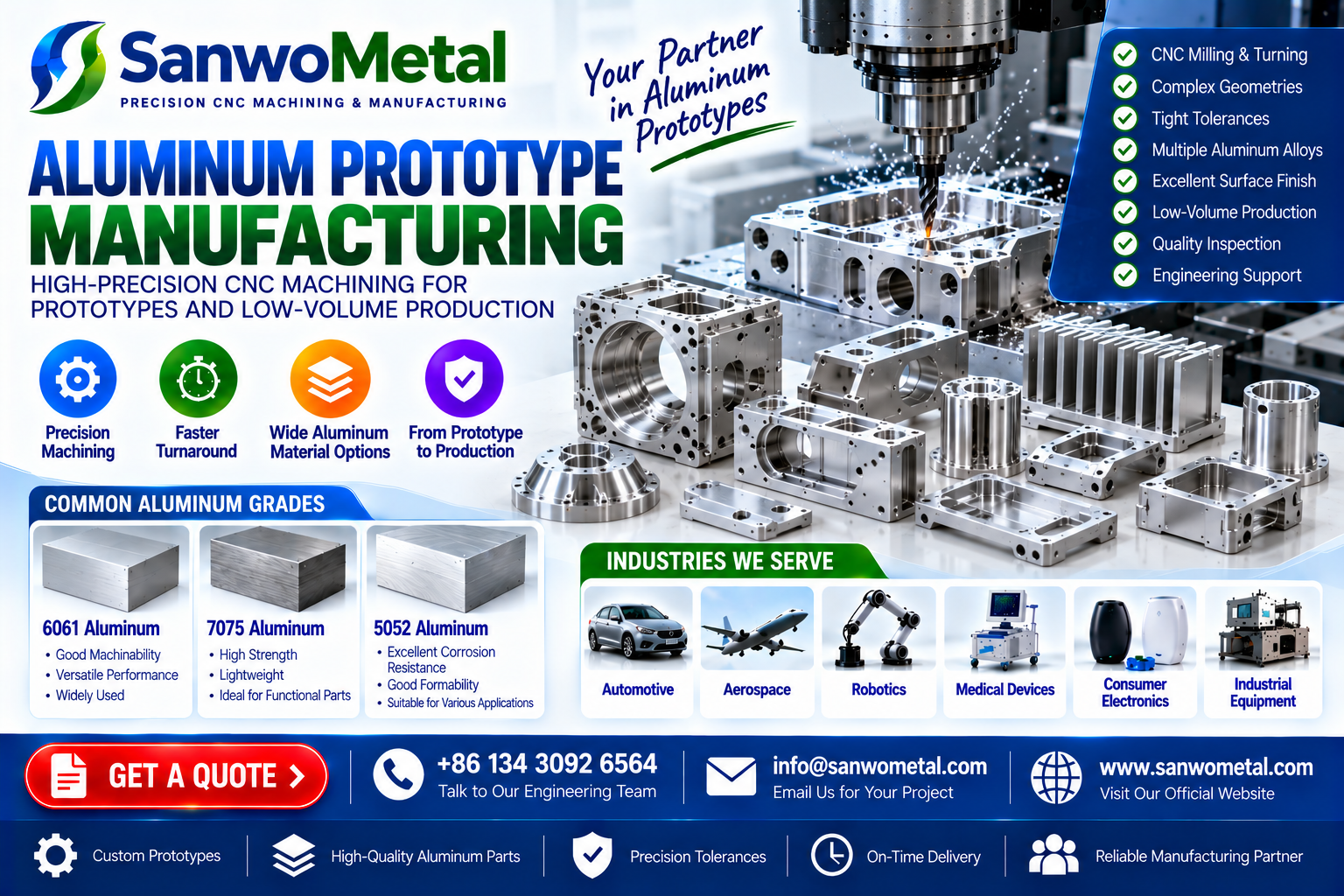
Aluminum prototype manufacturing provides an effective approach for transforming digital engineering concepts into physical metal components that can be examined, assembled, and tested.
Meanwhile, aluminum prototype machining enables manufacturers to create precision parts with controlled dimensions, detailed features, and application-specific surface finishes.
From electronic enclosures and automotive systems to robotics, aerospace engineering, and industrial equipment, aluminum prototypes help engineers identify potential improvements before finalizing product designs.
Why Aluminum Prototypes Matter in Product Development
A digital design can demonstrate how a component should look and function, but physical testing often reveals challenges that computer models cannot fully capture.
Components may require adjustments to mounting holes, wall thickness, joining surfaces, or mechanical clearances.
Aluminum prototypes allow developers to examine these practical requirements using actual metal components.
This process can reduce uncertainty and support more informed manufacturing decisions.
What Is Aluminum Prototype Manufacturing?
Aluminum prototype manufacturing is the process of creating sample aluminum components for engineering evaluation, product testing, and design verification.
These prototypes can represent individual mechanical parts or components intended for larger assemblies.
Depending on project requirements, manufacturers may use CNC machining, additive manufacturing, casting, or other suitable fabrication methods.
Key Benefits
- Lightweight Components: Aluminum offers useful strength-to-weight characteristics.
- Design Verification: Physical parts help confirm dimensions and assembly compatibility.
- Material Evaluation: Engineers can examine selected aluminum alloy characteristics.
- Manufacturing Flexibility: Different component geometries can be produced.
- Functional Testing: Prototypes support mechanical and thermal assessments.
- Design Improvement: Engineering adjustments can be made before production approval.
Results depend on the selected manufacturing process, alloy, and product specifications.
How Aluminum Prototype Machining Works
Aluminum prototype machining commonly uses computer numerical control equipment to remove material from aluminum stock.
The manufacturing process begins with an approved CAD model and suitable machining instructions.
CNC milling and turning can create detailed mechanical features, including holes, slots, pockets, threads, and curved surfaces.
Typical Manufacturing Activities
- Reviewing the engineering design.
- Selecting an appropriate aluminum alloy.
- Preparing machining programs.
- Securing the material.
- Performing cutting operations.
- Applying required finishing processes.
- Inspecting the completed component.
Accurate programming, suitable cutting tools, and effective workholding contribute to manufacturing quality.
Choosing the Right Aluminum Alloy
Not all aluminum materials offer identical mechanical properties.
Different alloys provide different combinations of strength, corrosion resistance, machinability, and thermal behavior.
| Aluminum Alloy | Main Characteristic | Typical Prototype Application |
| 6061 | Balanced strength and machinability | Mechanical brackets and housings |
| 7075 | High strength | Demanding structural components |
| 5052 | Good formability and corrosion resistance | Sheet-metal enclosures |
| 6082 | Suitable mechanical strength | Structural engineering parts |
The appropriate alloy depends on the intended application and manufacturing method.
Engineers should evaluate material specifications rather than selecting an alloy based exclusively on popularity.
Why Thermal Performance Is Important
Aluminum’s thermal conductivity makes it useful for selected electronic and mechanical components.
For example, aluminum housings and heat sinks can help transfer heat away from electronic equipment.
However, thermal performance depends on more than material selection.
Component geometry, surface area, airflow, thermal interfaces, and operating conditions all influence heat transfer.
Through aluminum prototype manufacturing, engineers can physically evaluate heat-management designs before approving the final component.
This is particularly relevant for electronics, power systems, and industrial equipment.
Surface Finishing and Prototype Performance
Surface finishing can influence appearance, corrosion resistance, and component functionality.
Different finishes serve different purposes.
Common Finishing Options
As-Machined Finish: Retains the surface produced by machining operations.
Anodizing: Creates a controlled oxide layer on suitable aluminum components.
Bead Blasting: Produces a more uniform matte appearance.
Polishing: Improves surface appearance and selected surface characteristics.
Powder Coating: Adds a protective and decorative coating when compatible with the application.
Finishing requirements should be established according to the prototype’s intended evaluation.
CNC Machining Compared with Other Prototyping Methods
Different manufacturing techniques provide different advantages.
| Method | Main Advantage | Important Limitation |
| CNC Machining | Accurate components from solid stock | Material removal and geometric access |
| Metal 3D Printing | Complex internal geometries | Process-specific material properties |
| Casting | Potential to reproduce cast geometry | Tooling and process considerations |
| Sheet Metal Fabrication | Suitable for formed enclosures | Geometry and forming limitations |
CNC machining is particularly useful when components require precise mechanical interfaces.
However, a machined prototype may not fully reproduce the material structure or manufacturing characteristics of a final cast product.
Applications Across Modern Industries
Automotive Engineering
Aluminum prototypes support the evaluation of lightweight brackets, housings, and mechanical assemblies.
Aerospace Components
Suitable prototypes can assist engineering development and dimensional verification under applicable technical requirements.
Robotics and Automation
Custom aluminum frames, mounts, and connection elements support mechanical integration.
Consumer Electronics
Machined aluminum enclosures allow developers to evaluate appearance, fit, and thermal requirements.
Industrial Machinery
Precision prototypes help engineers assess component installation, movement, and mechanical compatibility.
Design Challenges That Engineers Should Avoid
Even a sophisticated prototype can fail to deliver useful results if essential design requirements are unclear.
Common challenges include unnecessarily tight tolerances, inaccessible internal features, unsuitable wall thicknesses, and incomplete technical documentation.
Practical Design Recommendations
- Define critical dimensions clearly.
- Identify functional and cosmetic surfaces.
- Avoid unnecessary geometric complexity.
- Consider available cutting-tool access.
- Specify material grades accurately.
- Communicate surface-finish requirements.
Effective planning makes aluminum prototype machining more practical and helps reduce avoidable manufacturing complications.
Why Prototype Inspection Matters
A prototype should provide measurable information about the proposed design.
Inspection may involve dimensional measurements, surface evaluation, fit testing, and functional assessments.
Coordinate measuring machines, micrometers, and other inspection tools can verify specified component characteristics.
Where appropriate, engineers may also evaluate thermal behavior, mechanical loading, or assembly performance.
Documenting these results supports informed design revisions and stronger production planning.
Frequently Asked Questions (FAQs)
1. What is aluminum prototype manufacturing?
It is the production of sample aluminum components used to evaluate product designs, material properties, and functional requirements.
2. What is aluminum prototype machining?
It is a subtractive manufacturing process that uses machining equipment, commonly CNC machines, to create precision aluminum prototypes.
3. Which aluminum alloy is commonly used for CNC prototypes?
Aluminum 6061 is frequently selected because it provides a useful balance of machinability and mechanical properties.
4. Can aluminum prototypes receive surface treatments?
Yes. Depending on material compatibility, prototypes may receive anodizing, polishing, bead blasting, or other suitable finishes.
5. How do businesses choose an aluminum prototyping manufacturer?
They should evaluate machining capabilities, alloy expertise, dimensional inspection, surface-finishing options, and technical communication.
Media Contact
Department: Aluminum Prototyping and Precision CNC Manufacturing
Email: info@sanwometal.com
Contact: +86 134 3092 6564
Official Website: https://www.sanwometal.com/