
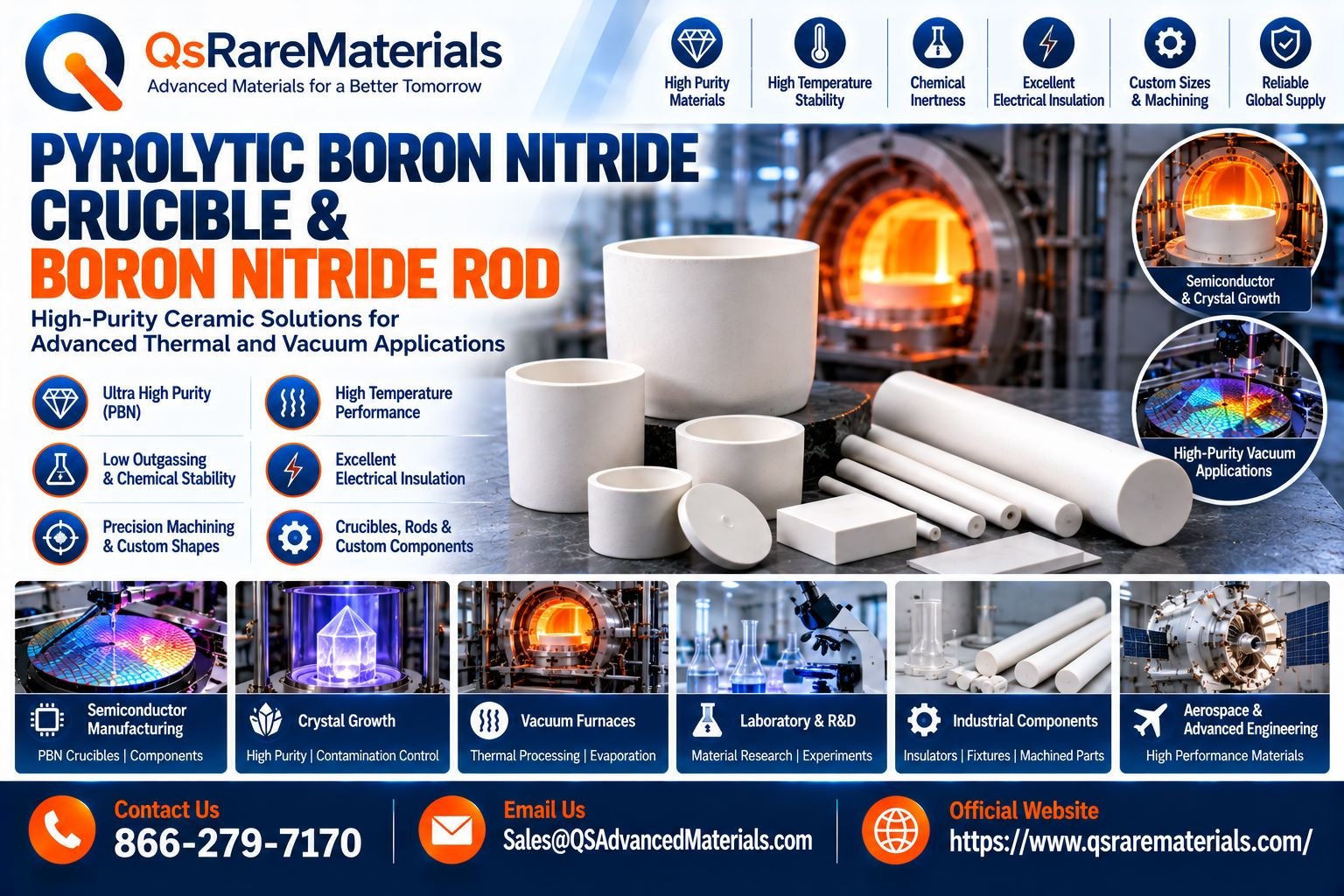
A Pyrolytic Boron Nitride Crucible provides a specialized container for selected high-purity thermal and vacuum-processing applications. Meanwhile, a Boron Nitride Rod offers a machinable ceramic material form suitable for manufacturing insulating supports, spacers, and precision furnace components.
These materials are drawing attention because high-performance processing systems require more than sophisticated heating equipment. The purity, geometry, and compatibility of every component inside the working environment can influence manufacturing outcomes.
Why Process Consistency Begins With Ceramic Components
In controlled thermal processing, small variations in material handling can affect experimental repeatability and product quality.
A crucible may come into direct contact with sensitive materials, while supporting components influence their positioning and electrical isolation.
Unsuitable materials can introduce contamination, undergo unwanted reactions, or deteriorate under operating conditions.
This makes advanced ceramic selection an essential engineering decision rather than a routine purchasing activity.
What Is a Pyrolytic Boron Nitride Crucible?
A Pyrolytic Boron Nitride Crucible is a specialized ceramic container manufactured using pyrolytic boron nitride, commonly known as PBN.
PBN is typically produced through chemical vapor deposition, which forms boron nitride on a suitable substrate under controlled conditions.
The resulting material can provide high purity, electrical insulation, and distinctive directional thermal properties.
Important Characteristics
- High Material Purity: Supports contamination-sensitive applications.
- Electrical Insulation: Useful in compatible equipment designs.
- Thermal Anisotropy: Heat conduction varies according to material orientation.
- Low Wettability: Beneficial with certain compatible molten substances.
- Specialized Geometry: Supports selected crucible and container configurations.
- Vacuum Compatibility: Suitable for specified vacuum-processing environments.
However, performance depends on temperature, atmosphere, processed materials, and component construction.
Understanding Boron Nitride Rod Technology
A Boron Nitride Rod is a cylindrical ceramic component commonly produced from suitable hexagonal boron nitride-based materials.
Unlike deposited PBN crucibles, many commercial rods are manufactured using consolidated ceramic materials that can be precision-machined.
Common Industrial Uses
Electrical Insulation: Separating compatible conductive components.
Furnace Fixtures: Supporting specialized equipment assemblies.
Precision Spacers: Maintaining required distances between components.
Research Equipment: Providing customizable ceramic parts.
Thermal Processing: Supporting selected components under appropriate operating conditions.
Different boron nitride grades have different properties. A machinable rod should not automatically be assumed to possess the same purity or microstructure as deposited PBN.
How Crucibles and Rods Support Thermal Equipment
Although these materials perform different functions, they can contribute to the same general manufacturing environment.
For example, a vacuum-processing installation may require a high-purity container for holding a process material alongside suitable ceramic parts for insulation or mechanical positioning.
The crucible manages direct material containment, while machined rods or rod-derived components can serve supporting functions.
Engineers should evaluate thermal expansion, contamination requirements, structural loads, and chemical exposure across the complete system.
Applications in Semiconductor and Vacuum Processing
Vacuum Evaporation
Suitable PBN crucibles are used in selected evaporation processes where purity and material compatibility are important.
Crystal Growth Research
Specialized crucible geometries may support controlled material containment during certain crystal-growth operations.
Semiconductor Equipment
Boron nitride ceramic parts can provide suitable insulating or structural functions in compatible processing equipment.
Laboratory Furnaces
Machined rods may be used for appropriate supports, separators, and insulating components.
Advanced Materials Research
Specialized containers and fixtures support investigations requiring controlled processing conditions.
Each application requires technical review of the actual material, atmosphere, and operating temperature.
PBN Crucible vs. Boron Nitride Rod
| Feature | PBN Crucible | BN Rod |
| Main purpose | Material containment | Insulation and component fabrication |
| Typical material form | Deposited ceramic container | Cylindrical ceramic stock |
| Manufacturing approach | Commonly chemical vapor deposition | Often consolidation and machining |
| Key consideration | Purity and chemical compatibility | Grade, dimensions, and strength |
| Common use | Evaporation and crystal growth | Spacers, fixtures, insulating parts |
These components complement different engineering requirements but are not interchangeable.
Why Thermal Anisotropy Matters
An important property of pyrolytic boron nitride is its directional thermal conductivity.
Heat can travel differently along and across its layered structure.
This behavior can influence how a crucible responds to heating, cooling, and temperature gradients.
Design engineers should consider the material’s orientation, wall geometry, and thermal exposure when selecting a Pyrolytic Boron Nitride Crucible.
High-temperature suitability must also be assessed against the operating atmosphere, since boron nitride can undergo oxidation in oxygen-containing environments.
Dimensional Precision and Ceramic Component Design
A Boron Nitride Rod can be processed into specialized shapes, depending on its grade and manufacturing characteristics.
Potential components include sleeves, spacers, supports, and insulating fixtures.
Important Design Requirements
- Accurate dimensional tolerances.
- Appropriate surface finish.
- Suitable component geometry.
- Material grade compatibility.
- Resistance to intended mechanical loads.
- Careful handling of ceramic edges.
Machining and assembly procedures should account for the material’s brittleness and application-specific limitations.
Contamination Control and Product Handling
High-purity ceramic components can lose practical value if they are contaminated during storage, handling, or assembly.
Appropriate protective packaging, clean handling procedures, and material traceability help preserve component quality.
Users should follow suitable cleaning guidance rather than applying aggressive chemicals without confirming compatibility.
For sensitive processes, contamination-control procedures should cover the complete workflow, including tooling and installation.
Evaluating Material Quality Before Procurement
Buyers should define technical requirements before selecting advanced ceramic products.
Recommended Quality Checks
Material Composition: Confirm the specified ceramic grade.
Purity Documentation: Request relevant material information.
Dimensional Inspection: Verify agreed measurements.
Surface Examination: Identify cracks, chips, and unacceptable defects.
Process Compatibility: Assess chemical and atmospheric requirements.
Sample Evaluation: Examine performance under representative conditions.
Clear specifications help avoid unsuitable substitutions between different boron nitride materials.
Frequently Asked Questions (FAQs)
1. What is a Pyrolytic Boron Nitride Crucible?
It is a high-purity ceramic container commonly manufactured using chemical vapor deposition.
2. What is a Boron Nitride Rod?
It is a cylindrical ceramic material used directly or machined into specialized components.
3. Where are PBN crucibles used?
They are used in selected vacuum evaporation, crystal growth, and high-purity processing applications.
4. Is PBN electrically insulating?
Yes. PBN is an electrically insulating ceramic under appropriate operating conditions.
5. Can boron nitride rods be machined?
Many suitable grades can be machined into precision ceramic components.
Media Contact
Department: High-Purity Ceramics and Advanced Materials
Email: Sales@QSAdvancedMaterials.com
Contact: 866-279-7170
Official Website: https://www.qsrarematerials.com/