
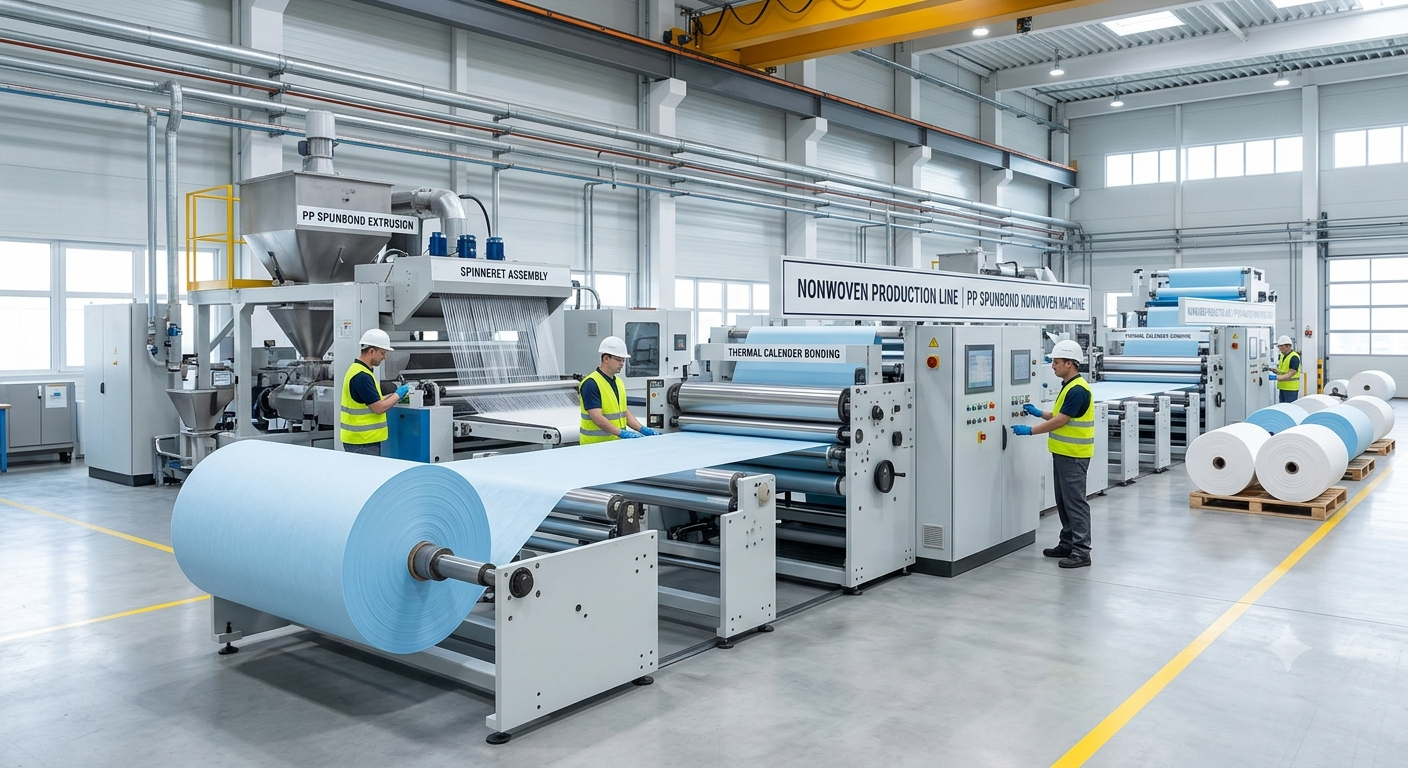
The global textile and hygiene industries are rapidly shifting toward efficient, cost-effective, and high-performance materials. At the center of this transformation lies the nonwoven production line and the advanced PP spunbond nonwoven machine, which together enable large-scale manufacturing of lightweight, durable, and versatile nonwoven fabrics.
From medical textiles and hygiene products to agriculture and packaging, nonwoven materials have become essential across multiple industries due to their strength, flexibility, and affordability.
What Is a Nonwoven Production Line?
A nonwoven production line is an integrated industrial system designed to manufacture fabric-like materials without traditional weaving or knitting. Instead of yarn interlacing, fibers are bonded using mechanical, thermal, or chemical processes.
Key Functions of a Nonwoven Production Line
- Polymer melting and extrusion
- Fiber formation through spinnerets
- Web formation and laying process
- Thermal bonding or calendaring
- Winding and finishing of fabric rolls
Why It Matters in Modern Manufacturing
- High-speed production capability
- Lower manufacturing cost compared to woven fabrics
- Consistent fabric quality
- Wide application range
- Energy-efficient production process
Understanding PP Spunbond Nonwoven Machine Technology
A PP spunbond nonwoven machine is a specialized system used to produce polypropylene-based nonwoven fabric. It melts PP granules and extrudes them into continuous filaments, which are then laid into a web and bonded using heat.
This technology is widely used because polypropylene offers excellent durability, chemical resistance, and lightweight properties.
Core Components of PP Spunbond Nonwoven Machine
- Extruder unit for melting PP granules
- Filter system for impurity removal
- Spinning beam and spinneret
- Web forming conveyor system
- Bonding and calendering unit
- Automatic winding system
How Nonwoven Production Line Works
The nonwoven production line follows a continuous and highly automated process.
Step-by-Step Process
- Feeding polypropylene raw material
- Melting and extrusion
- Filament spinning through spinnerets
- Cooling and stretching of fibers
- Web formation on conveyor belt
- Thermal bonding for fabric strength
- Rolling and packaging
Key Features of the Process
- Fully automated production cycle
- Minimal human intervention
- High output efficiency
- Uniform fabric thickness
- Scalable production capacity
Applications of PP Spunbond Nonwoven Machine Products
Products manufactured using a PP spunbond nonwoven machine are used across multiple industries.
Major Application Areas
- Medical face masks and gowns
- Hygiene products like diapers and sanitary pads
- Agricultural crop covers
- Shopping bags and packaging materials
- Furniture upholstery layers
- Automotive interior materials
- Industrial filtration systems
Comparison Between Nonwoven and Traditional Woven Fabrics
| Feature | Nonwoven Fabric | Woven Fabric |
| Manufacturing Process | Bonded fibers | Interlaced yarns |
| Production Speed | Very high | Moderate |
| Cost Efficiency | Lower | Higher |
| Durability | High (application dependent) | High |
| Water Resistance | Good | Limited |
| Customization | Easy | Moderate |
Advantages of PP Spunbond Nonwoven Machine
A modern PP spunbond nonwoven machine offers several industrial advantages.
Key Benefits
- High-speed continuous production
- Reduced labor cost
- Stable product quality
- Energy-efficient operation
- Low raw material wastage
- Easy automation integration
- Suitable for large-scale manufacturing
Why Nonwoven Production Line Is in High Demand
The demand for nonwoven production line systems has increased significantly due to global shifts in healthcare, hygiene, and sustainable packaging industries.
Key Growth Drivers
- Rising demand for disposable medical products
- Expansion of hygiene product manufacturing
- Growth in eco-friendly packaging solutions
- Increasing industrial filtration needs
- Cost-effective production advantages
Technical Features of Advanced PP Spunbond Nonwoven Machine
Machine Capabilities
- Multi-beam spinning technology
- High-speed production output
- Adjustable fabric GSM control
- Automatic tension regulation
- Smart temperature control systems
Safety and Efficiency Features
- Emergency shutdown systems
- Overheat protection
- Automated error detection
- Real-time monitoring panels
Choosing the Right Nonwoven Production Line
Selecting the right nonwoven production line is critical for long-term efficiency and product quality.
Key Selection Factors
- Production capacity requirements
- Machine automation level
- Energy consumption efficiency
- Maintenance and spare parts availability
- Output fabric quality consistency
- Supplier technical support
Common Mistakes to Avoid
- Ignoring long-term maintenance cost
- Choosing low-quality spinneret systems
- Overlooking automation features
- Underestimating production scalability
Future Trends in PP Spunbond Nonwoven Machine Industry
The nonwoven manufacturing industry is evolving rapidly with technological advancements.
Emerging Trends
- AI-based production monitoring systems
- Eco-friendly biodegradable PP alternatives
- Fully automated smart factories
- Energy-efficient extrusion systems
- High-performance filtration-grade fabrics
- Expansion in medical textile innovation
Frequently Asked Questions (FAQs)
1. What is a nonwoven production line used for?
It is used to manufacture fabric-like materials without weaving or knitting, mainly for hygiene, medical, and industrial applications.
2. What is a PP spunbond nonwoven machine?
It is a machine that produces nonwoven fabric using polypropylene (PP) through a spinning and bonding process.
3. What materials are used in nonwoven production?
Mainly polypropylene, polyester, and other thermoplastic polymers.
4. What industries use nonwoven fabric?
Medical, hygiene, agriculture, packaging, automotive, and filtration industries.
5. Is nonwoven fabric eco-friendly?
Some types are recyclable and eco-friendly, depending on raw material usage.
6. What is the difference between woven and nonwoven fabric?
Woven fabric is made by weaving yarns, while nonwoven fabric is made by bonding fibers directly.
7. How fast is a nonwoven production line?
Modern lines can produce fabric at very high continuous speeds depending on configuration.
8. What is GSM in nonwoven fabric?
GSM refers to grams per square meter, indicating fabric thickness and density.
9. Can PP spunbond machines produce medical-grade fabric?
Yes, they are widely used for medical masks, gowns, and hygiene products.
10. What are the main benefits of nonwoven production line systems?
They offer high efficiency, low cost, automation, and wide application versatility.