
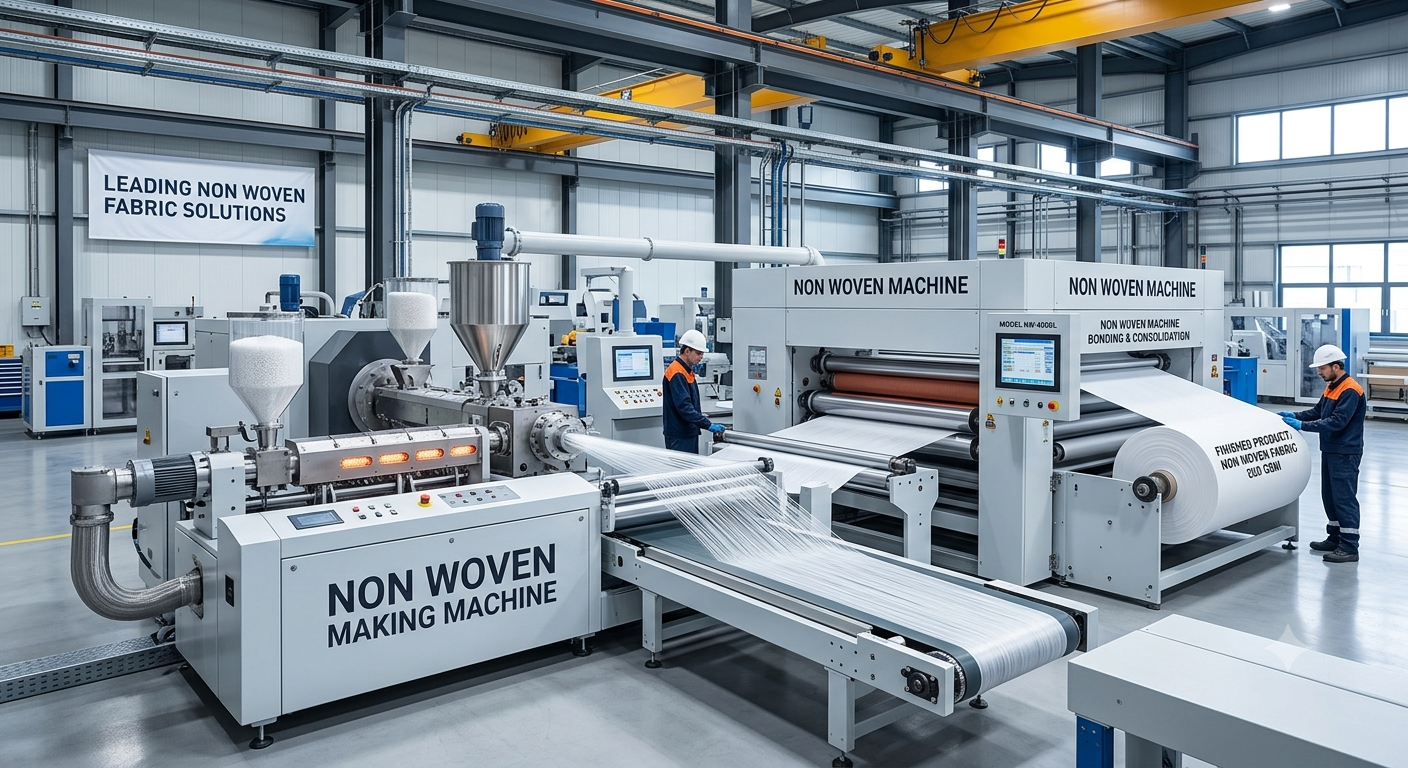
The demand for non woven making machine technology has increased rapidly across packaging, healthcare, agriculture, hygiene, and textile industries. A non woven machine is now considered a core part of modern manufacturing systems because it produces fabric-like materials without weaving or knitting, making production faster, cost-effective, and highly scalable.
With rising environmental concerns and the shift toward sustainable packaging, non woven fabric production has become a major industrial segment worldwide.
What is a Non Woven Machine?
A non woven machine is industrial equipment used to manufacture non woven fabric directly from synthetic or natural fibers. Unlike traditional textile machines, it does not require spinning or weaving processes.
Instead, fibers are bonded together using:
- Mechanical bonding
- Thermal bonding
- Chemical bonding
- Hydro entanglement
This makes production faster and more efficient compared to conventional fabric manufacturing.
What is a Non Woven Making Machine?
A non woven making machine refers to a complete production line that converts raw polymer materials (usually polypropylene) into finished non woven fabric rolls.
Core Output of the Machine
- Non woven fabric rolls
- Medical-grade fabric
- Shopping bag material
- Industrial packaging sheets
- Agricultural cover materials
How Non Woven Machines Work in Manufacturing
The production process in a non woven machine involves multiple technical stages designed for consistency and quality.
Step-by-Step Production Process
- Polymer melting and extrusion
- Fiber spinning (spunbond or meltblown process)
- Web formation
- Bonding using heat or pressure
- Cooling and stabilization
- Rolling and packaging
Types of Non Woven Making Machine Systems
Different industries require different machine configurations depending on production needs.
Common Machine Types
- Spunbond non woven machine
- Meltblown non woven machine
- SMS (Spunbond + Meltblown + Spunbond) machine
- Needle punch non woven machine
- Thermal bonded non woven machine
Applications of Non Woven Machine in Industries
The versatility of a non woven machine makes it highly valuable across multiple sectors.
Key Application Areas
- Medical masks and surgical gowns
- Shopping and carry bags
- Agricultural crop covers
- Hygiene products like diapers and wipes
- Furniture and upholstery padding
- Industrial filtration materials
- Packaging and protective wrapping
Advantages of Non Woven Making Machine
A modern non woven making machine offers several industrial and economic benefits.
Major Benefits
- High-speed production output
- Low manufacturing cost
- Eco-friendly fabric production options
- Customizable fabric thickness
- Reduced labor requirements
- Consistent product quality
- Minimal material wastage
Non Woven Machine vs Traditional Textile Machines
| Feature | Non Woven Machine | Traditional Textile Machine |
| Production Process | Direct fiber bonding | Weaving or knitting |
| Speed | Very high | Moderate |
| Cost Efficiency | High | Medium to low |
| Fabric Strength | Application-specific | Generally uniform |
| Waste Generation | Low | Higher |
| Setup Complexity | Moderate | High |
Key Components of a Non Woven Making Machine
Understanding machine structure helps manufacturers select the right system.
Important Parts
- Extruder unit
- Spinneret system
- Web forming section
- Bonding unit
- Cooling system
- Winding and rolling system
- Control panel (PLC system)
Factors to Consider Before Buying a Non Woven Machine
Selecting the right non woven machine is critical for long-term production efficiency.
Important Selection Criteria
- Production capacity (tons per day)
- Fabric width range
- Energy consumption efficiency
- Automation level
- Maintenance requirements
- Spare parts availability
- Machine durability
- Supplier reputation
Latest Technological Trends in Non Woven Making Machine Industry
The non woven manufacturing sector is rapidly evolving with advanced technology integration.
Modern Innovations
- Fully automated production lines
- AI-based quality monitoring
- Energy-efficient heating systems
- Eco-friendly biodegradable fiber processing
- Smart PLC control systems
- High-speed spunbond technology upgrades
Industrial Importance of Non Woven Machine in Global Market
A non woven machine plays a key role in supporting global supply chains, especially in healthcare and packaging industries.
Why Demand is Increasing
- Rising demand for medical protective gear
- Growth of eco-friendly packaging solutions
- Expansion of hygiene product markets
- Government restrictions on plastic usage
- Industrial shift toward sustainable materials
Maintenance Tips for Non Woven Making Machine
Proper maintenance improves machine life and efficiency.
Best Practices
- Regular lubrication of moving parts
- Cleaning extrusion units frequently
- Monitoring temperature controls
- Checking electrical systems
- Replacing worn-out components on time
- Scheduling preventive maintenance
Cost Factors of Non Woven Machine Setup
The investment in a non woven making machine depends on multiple factors.
Key Cost Influencers
- Machine capacity and size
- Level of automation
- Technology type (SMS, spunbond, etc.)
- Installation and setup costs
- Energy consumption efficiency
- After-sales service support
Frequently Asked Questions (FAQs)
1. What is a non woven machine used for?
It is used to manufacture non woven fabric used in medical, packaging, agriculture, and hygiene industries.
2. What is a non woven making machine?
It is a complete production system that converts polymer materials into non woven fabric rolls.
3. What materials are used in non woven production?
Mostly polypropylene (PP), polyester, and biodegradable fibers.
4. Is non woven fabric eco-friendly?
Yes, many types are recyclable and some are biodegradable depending on material.
5. What is the difference between woven and non woven fabric?
Woven fabric is made by weaving yarns, while non woven fabric is made by bonding fibers directly.
6. What industries use non woven machines?
Medical, agriculture, packaging, furniture, and hygiene industries.
7. How long does a non woven machine last?
With proper maintenance, it can last 10–15 years or more.
8. What is SMS non woven machine?
It is a combination of spunbond and meltblown technology used for high-quality filtration materials.
9. Is automation important in non woven machines?
Yes, automation improves efficiency, reduces labor costs, and ensures consistent quality.
10. What is the main advantage of a non woven making machine?
It offers fast production, low cost, and versatile fabric output for multiple industries.