
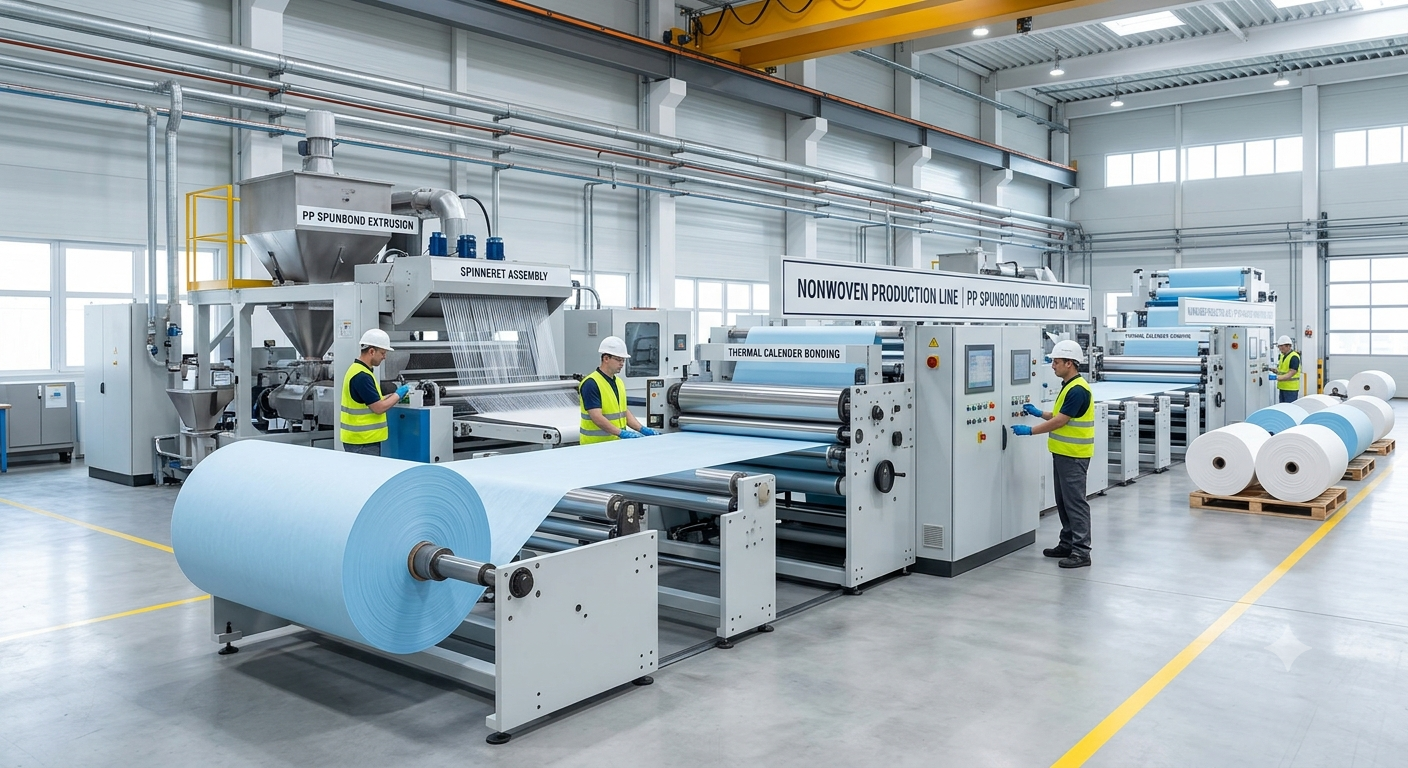
The demand for hygienic, durable, and cost-effective fabric alternatives has led to rapid growth in nonwoven production line technology and the adoption of the PP spunbond nonwoven machine across global manufacturing sectors. From medical textiles to agriculture, packaging, and hygiene products, nonwoven fabrics have become an essential material in modern industrial applications.
Unlike traditional woven fabrics, nonwoven materials are produced without weaving or knitting, making them faster to manufacture and highly customizable based on end-use requirements.
Understanding Nonwoven Production Line Technology
A nonwoven production line is an integrated manufacturing system designed to convert polypropylene (PP) or other polymer resins into nonwoven fabric through mechanical, thermal, or chemical bonding processes.
This production line is widely used for producing disposable and semi-durable fabric materials used in healthcare, agriculture, filtration, and packaging industries.
Key Stages in a Nonwoven Production Line
- Polymer feeding and melting
- Extrusion of fibers
- Fiber stretching and formation
- Web formation (laying fibers into sheet form)
- Bonding (thermal or mechanical)
- Cooling and finishing
- Winding and packaging
Core Features of Nonwoven Production Systems
- High-speed continuous production
- Automated control systems
- Uniform fiber distribution
- Energy-efficient operations
- Customizable fabric width and GSM
- Minimal human intervention
What is a PP Spunbond Nonwoven Machine?
A PP spunbond nonwoven machine is a specialized manufacturing system used to produce polypropylene-based nonwoven fabric using the spunbond process. In this method, melted polypropylene is extruded into fine filaments, stretched, and laid into a uniform web before bonding.
This technology is widely used due to its efficiency, scalability, and ability to produce strong yet lightweight fabrics.
Main Components of PP Spunbond Machine
- Extruder unit
- Melt pump system
- Spinneret (fiber forming unit)
- Drawing and stretching system
- Web forming conveyor
- Thermal bonding unit
- Winding system
How PP Spunbond Nonwoven Machine Works
The working process of a PP spunbond nonwoven machine is based on a continuous fiber production system.
Step-by-Step Process
- Polypropylene granules are fed into the extruder
- Material is melted at controlled temperature
- Molten polymer is passed through spinnerets
- Fibers are stretched using high-speed air flow
- Fibers are laid randomly on a conveyor belt
- Thermal bonding fuses fibers into fabric
- Fabric is cooled and rolled for final use
Applications of Nonwoven Production Line and PP Spunbond Nonwoven Machine
Nonwoven fabrics are used across multiple industries due to their versatility and cost efficiency.
Major Application Areas
- Medical textiles (masks, gowns, caps)
- Hygiene products (diapers, sanitary pads)
- Agriculture (crop covers, weed control fabrics)
- Packaging materials
- Furniture and upholstery
- Filtration systems (air and liquid filters)
- Automotive interiors
Comparison: Nonwoven Fabric vs Traditional Woven Fabric
| Feature | Nonwoven Fabric | Woven Fabric |
| Manufacturing Method | Fiber bonding | Yarn weaving |
| Production Speed | Very high | Moderate |
| Cost Efficiency | Low cost production | Higher cost |
| Strength | Adjustable | High tensile strength |
| Applications | Disposable & industrial use | Apparel & textiles |
| Customization | High flexibility | Limited flexibility |
Advantages of PP Spunbond Nonwoven Machine
The increasing adoption of PP spunbond nonwoven machine systems is driven by several industrial advantages.
Key Benefits
- High production efficiency
- Low labor dependency
- Consistent fabric quality
- Eco-friendly material options available
- Wide range of GSM output
- Reduced production waste
- Suitable for large-scale manufacturing
Advantages of Nonwoven Production Line Technology
A modern nonwoven production line provides manufacturers with flexibility and scalability.
Core Advantages
- Continuous production capability
- Reduced manufacturing cost per unit
- Easy automation and monitoring
- High output capacity
- Suitable for multiple product categories
- Stable quality control systems
Types of Nonwoven Production Technologies
Different methods are used depending on product requirements.
Common Nonwoven Technologies
- Spunbond technology
- Meltblown technology
- Spunlace technology
- Needle punch technology
- Thermal bonding technology
Each method serves different industrial needs, especially in filtration, hygiene, and medical sectors.
Key Factors to Consider Before Installing a PP Spunbond Nonwoven Machine
Investing in a PP spunbond nonwoven machine requires careful planning.
Important Considerations
- Production capacity requirements
- Machine width and configuration
- Energy consumption efficiency
- Automation level
- Raw material compatibility
- Maintenance and spare parts availability
- Operator training requirements
Latest Industry Trends in Nonwoven Manufacturing
The nonwoven industry is rapidly evolving with technological advancements.
Current Trends
- Smart automated production lines
- Eco-friendly biodegradable PP alternatives
- AI-based quality monitoring systems
- Energy-efficient extrusion systems
- Increased demand in healthcare sector
- Expansion in packaging and agriculture applications
Frequently Asked Questions (FAQs)
1. What is a nonwoven production line?
A nonwoven production line is a manufacturing system that produces fabric without weaving or knitting using fiber bonding techniques.
2. What is a PP spunbond nonwoven machine?
It is a machine that produces polypropylene-based nonwoven fabric using the spunbond process.
3. What raw material is used in spunbond production?
Polypropylene (PP) granules are the most commonly used raw material.
4. What industries use nonwoven fabrics?
Medical, hygiene, agriculture, packaging, filtration, and automotive industries.
5. Is nonwoven fabric eco-friendly?
Some nonwoven materials are recyclable and eco-friendly depending on composition.
6. What is GSM in nonwoven fabric?
GSM refers to grams per square meter, indicating fabric weight and thickness.
7. What is the production speed of a PP spunbond machine?
It varies based on model but can reach high-speed continuous production levels.
8. What is the difference between spunbond and meltblown?
Spunbond produces strong fabrics, while meltblown produces fine filtration materials.
9. How long does a nonwoven production line last?
With proper maintenance, it can operate efficiently for many years.
10. Is automation important in nonwoven machines?
Yes, automation improves efficiency, quality consistency, and reduces labor costs.