
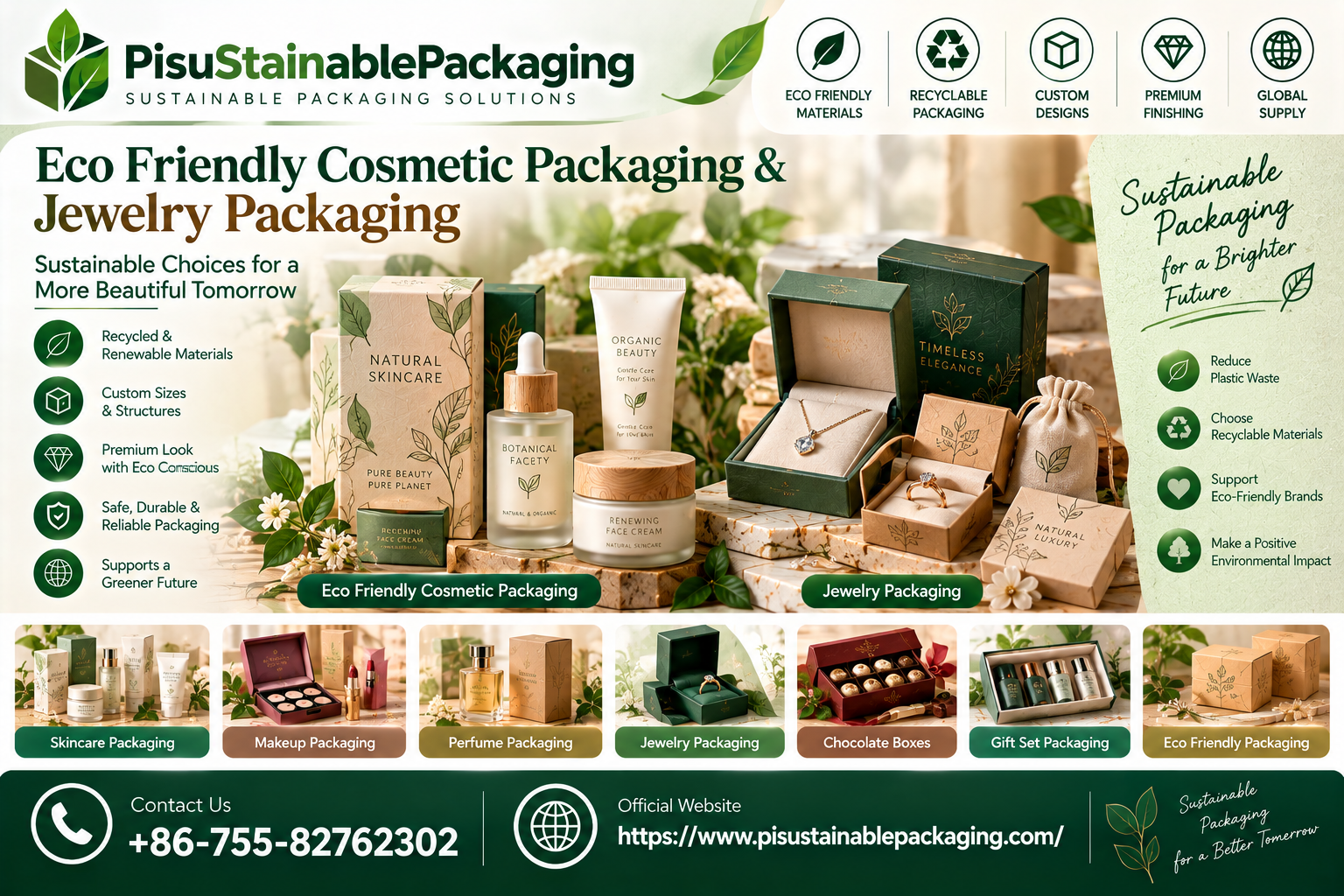
Rather than focusing exclusively on attractive presentation, businesses are examining how packaging can support reuse, efficient material recovery, and more responsible product distribution.
The beauty and jewelry industries are exploring a different approach to packaging development: creating packaging that remains useful beyond the initial purchase.
Eco friendly cosmetic packaging is becoming an important consideration for skincare and beauty brands seeking practical ways to reduce unnecessary packaging waste while preserving product quality.
Similarly, jewelry packaging offers opportunities to create durable storage solutions that customers may continue using after receiving their purchases.
These developments highlight an important change in packaging strategy. Businesses are beginning to consider what happens to packaging after the product reaches its customer.
For manufacturers, retailers, and packaging designers, this creates opportunities to connect product presentation with longer-term functionality.
Why Packaging Design Should Consider Its Complete Life Cycle
Traditional packaging decisions often focus on manufacturing costs, appearance, and transportation requirements.
However, environmental performance also depends on material sourcing, production processes, customer behaviour, and disposal methods.
A package that appears environmentally responsible may still create unnecessary waste if its materials are difficult to separate or recover.
Likewise, reusable packaging offers limited benefits when customers have no practical reason to retain it.
This perspective encourages businesses to evaluate packaging beyond the point of sale.
What Is Eco Friendly Cosmetic Packaging?
Eco friendly cosmetic packaging refers to packaging designed to reduce environmental impacts while maintaining suitable product protection, safety, and functionality.
Depending on the application, possible strategies include refillable containers, lightweight structures, responsibly sourced materials, and packaging compatible with established recycling systems.
Beauty products present particular challenges because formulations can interact with packaging materials.
Creams, serums, lotions, and other cosmetic products may require different protective properties.
Consequently, environmental improvements should never compromise formulation stability or product hygiene.
Brands should verify material compatibility and evaluate proposed packaging changes before commercial introduction.
How Refillable Beauty Packaging Can Support Circular Design
Refillable packaging is one approach used to reduce repeated consumption of certain packaging components.
A durable outer container may be designed to accommodate suitable replacement cartridges or refill units.
However, an effective refill system requires more than a reusable-looking container.
Brands must consider product compatibility, hygienic handling, customer convenience, and the materials used in refill components.
Some formulations may not be appropriate for consumer refilling without specific safeguards.
The environmental benefits also depend on how frequently customers actually reuse the original container.
Refillability should therefore be evaluated through practical product design and realistic consumer behaviour.
Jewelry Packaging That Customers Want to Keep
Unlike many disposable retail cartons, jewelry packaging can serve an additional purpose after purchase.
A carefully designed box may become a convenient storage solution for rings, earrings, necklaces, or other accessories.
Durability, protective interiors, and practical compartments can encourage customers to continue using the packaging.
For example, a compact ring box with a secure closure may provide convenient storage, while a necklace box can help organise delicate items.
However, lasting usefulness depends on structural strength and suitable materials.
This approach allows jewelry brands to connect premium presentation with practical everyday functionality.
Understanding Different Circular Packaging Strategies
Not every packaging category benefits from the same environmental approach.
| Strategy | Cosmetic Packaging Application | Jewelry Packaging Application |
| Material Reduction | Lightweight cartons and suitable containers | Compact protective boxes |
| Reuse | Refillable systems where appropriate | Long-term jewelry storage |
| Recyclability | Compatible, appropriately separated materials | Recyclable board structures |
| Modular Design | Replaceable suitable components | Removable or adaptable inserts |
| Durability | Reusable outer containers | Strong storage boxes |
| Material Transparency | Verified material specifications | Clear board and insert information |
The most appropriate strategy depends on product requirements and actual customer use.
Why Modular Packaging Deserves Attention
Modular packaging uses components that can be adapted, replaced, or separated according to the intended design.
For certain cosmetic collections, brands may explore standardised outer boxes with product-specific inserts.
This can simplify packaging development across different product sizes.
Jewelry retailers may also consider reusable box structures with interchangeable inserts for rings, earrings, and other products.
However, modular packaging requires accurate dimensions and appropriate component compatibility.
Poorly designed removable elements may reduce protection or create handling difficulties.
A successful modular structure should improve practical flexibility without introducing unnecessary materials.
Measuring Environmental Performance More Carefully
Businesses should avoid assuming that paper-based, reusable, or lightweight packaging is automatically environmentally superior.
Environmental performance depends on multiple factors, including manufacturing inputs, transportation, material recovery, and actual reuse.
For example, a heavier reusable box may require repeated use before its environmental impact compares favourably with a simpler alternative.
Similarly, decorative coatings or mixed-material construction can complicate recycling.
Packaging businesses may benefit from evaluating relevant indicators such as material weight, recycled content, packaging damage, and recovery opportunities.
Claims about recyclability or environmental benefits should be supported by appropriate evidence.
How Brand Identity and Responsible Design Can Work Together
Sustainable packaging does not require every brand to adopt the same appearance.
Minimalist beauty companies may prefer simple cartons with clear typography.
Premium skincare brands may use durable containers with restrained decorative finishes.
Jewelry businesses may emphasise refined structures, protective interiors, and coordinated colours.
What matters is whether the design accurately reflects the product while fulfilling its practical purpose.
Brands should avoid relying on environmental language alone to establish credibility.
Transparent material information and realistic claims can support more trustworthy communication.
Choosing Packaging Suppliers With Long-Term Goals
Packaging procurement should consider both manufacturing quality and the intended environmental strategy.
Important evaluation criteria include:
- Material Information: Confirm relevant composition and sourcing details.
- Product Compatibility: Verify suitability for the packaged item.
- Design Flexibility: Assess reusable or modular options where practical.
- Quality Consistency: Review approved samples and production specifications.
- Environmental Evidence: Request support for relevant sustainability claims.
- Distribution Performance: Ensure adequate protection during handling.
Working with suppliers who understand these requirements can help businesses develop packaging that balances appearance, usability, and environmental considerations.
Frequently Asked Questions (FAQs)
1. What is eco friendly cosmetic packaging?
It refers to cosmetic packaging designed with environmental considerations such as material efficiency, suitable reuse, refillability, or recyclability while maintaining product safety and functionality.
2. How can jewelry packaging become more sustainable?
Jewelry brands can explore durable reusable boxes, suitable recyclable materials, efficient dimensions, and protective inserts designed for practical continued use.
3. Is refillable cosmetic packaging suitable for every beauty product?
No. Suitability depends on formulation compatibility, hygiene requirements, packaging design, and applicable product regulations.
4. What is circular packaging design?
Circular packaging design considers ways to reduce unnecessary material consumption and support suitable reuse, material recovery, or recycling.
5. How should businesses select environmentally responsible packaging?
Businesses should evaluate product protection, material specifications, realistic reuse potential, verified environmental claims, manufacturing quality, and disposal options.
Media Contact
Department: Sustainable Cosmetic and Jewelry Packaging Enquiries
Contact: +852-3069 7269
Email: marketing@pisustainablepackaging.com
Official Website: https://www.pisustainablepackaging.com/
Read More:-