
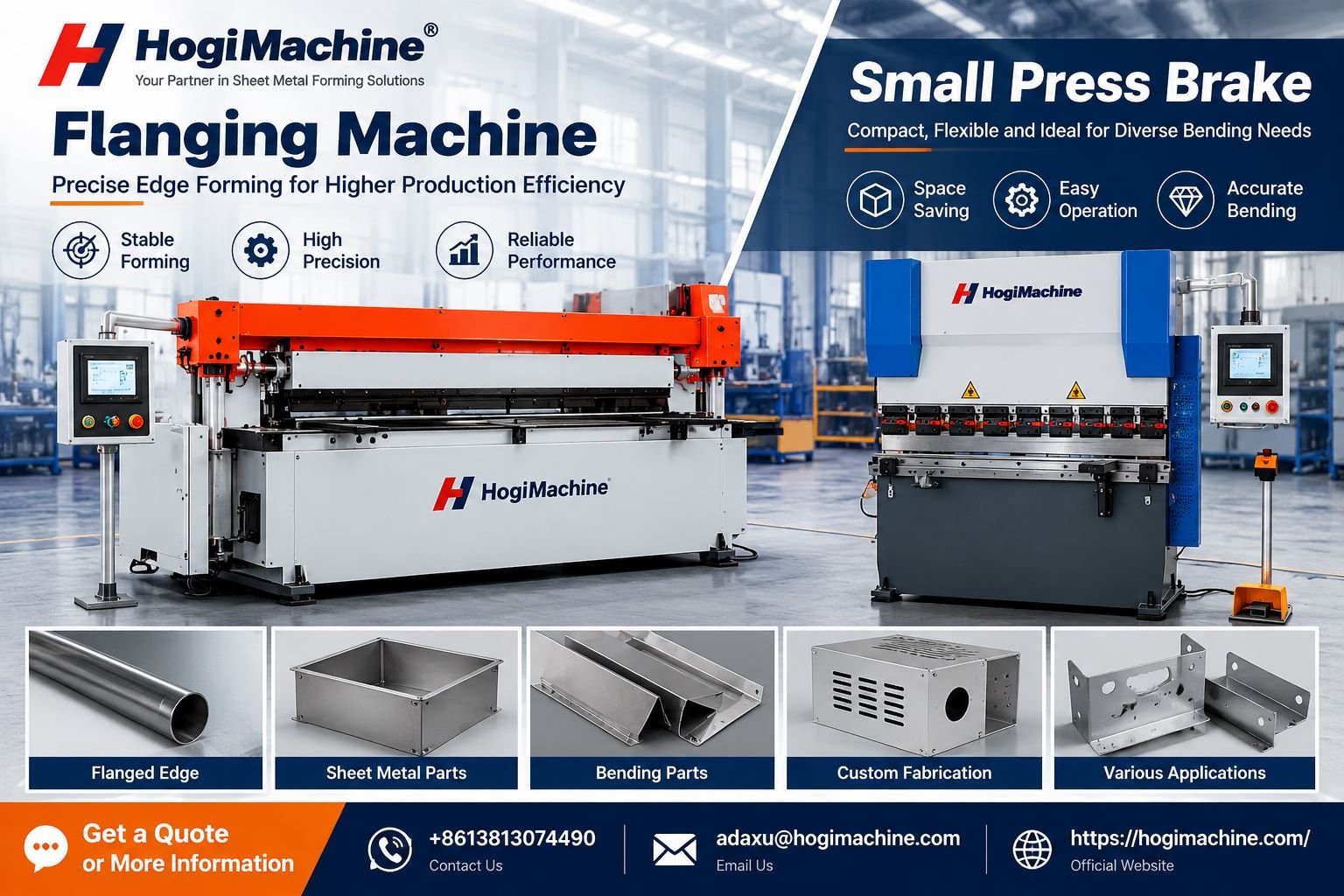
Water treatment equipment manufacturers are exploring practical metal fabrication methods to improve component reliability, corrosion resistance, and installation efficiency. From industrial filtration assemblies to wastewater handling systems, accurately manufactured metal components play an important role in equipment performance.
A Flanging machine supports specialised metal edge-forming operations, helping manufacturers prepare suitable components for joining, reinforcement, and assembly.
Meanwhile, a small press brake provides controlled sheet metal bending capabilities for manufacturing support brackets, protective covers, equipment panels, and mounting structures.
These machines perform different operations but can complement one another in water treatment equipment manufacturing.
For engineering businesses, equipment suppliers, and metal fabrication workshops, selecting appropriate forming technology can support accurate production and dependable assembly.
Why Metal Fabrication Matters in Water Treatment Equipment
Water treatment facilities use various mechanical systems to filter, transport, and process water.
These systems may include filtration equipment, storage assemblies, pumping units, and associated support structures.
Metal components used in such applications must meet specific mechanical and environmental requirements.
Poorly fabricated brackets, covers, or joining features can create installation difficulties and maintenance problems.
Dimensional accuracy is especially important when components must connect with existing equipment.
Appropriate forming methods help manufacturers maintain consistent dimensions across production.
Understanding the Role of a Flanging Machine
A Flanging machine is industrial metal-forming equipment designed to create specified profiles along compatible workpiece edges.
Depending on the machine design, it may process circular, cylindrical, or other suitable metal components.
In water treatment equipment manufacturing, flanging operations can support selected vessel components, non-pressure housings, and specialised joining arrangements.
Formed edges may help prepare components for subsequent assembly.
However, flanging equipment capabilities vary considerably.
Manufacturers should confirm suitable material grades, workpiece dimensions, thickness limits, and forming profiles before choosing a machine.
Pressure-containing components require additional engineering and compliance considerations beyond accurate edge forming.
How a Small Press Brake Supports Equipment Manufacturing
A small press brake uses compatible punches and dies to bend sheet metal into specified angles and profiles.
It can support the production of compact equipment panels, electrical cabinet components, protective covers, and structural brackets.
For example, a water filtration system may require precisely bent mounting plates for instrumentation or control equipment.
Compact press brakes may be suitable for these applications when components fall within the machine’s rated capacity.
However, bending performance depends on material properties, thickness, bending length, and available forming force.
Correct tooling selection remains essential for consistent results.
Stainless Steel Fabrication and Corrosion Resistance
Water treatment environments can expose metal components to moisture, cleaning chemicals, and potentially corrosive substances.
Stainless steel is commonly considered for suitable applications because selected grades provide useful corrosion resistance.
However, no stainless steel grade is universally resistant to every chemical environment.
Material selection should account for water chemistry, temperature, cleaning procedures, and equipment requirements.
During forming, manufacturers should avoid unnecessary contamination, cracking, and surface damage.
Proper handling and suitable finishing procedures help maintain the intended material condition.
The correct forming process must therefore be selected alongside the appropriate material.
Comparing Forming Equipment for Water Treatment Applications
| Manufacturing Factor | Flanging Machine | Small Press Brake |
| Primary Operation | Specialised edge forming | Controlled sheet metal bending |
| Typical Components | Compatible formed edges and vessel-related parts | Panels, brackets, covers |
| Main Quality Requirement | Flange geometry and alignment | Bend angle and positioning |
| Tooling Consideration | Suitable edge-forming arrangement | Compatible punch and die |
| Material Requirement | Formability and thickness compatibility | Bend radius and springback |
| Assembly Contribution | Prepared joining features | Accurate structural components |
Each machine should be evaluated against the actual component design rather than treated as a universal forming solution.
Designing Metal Components for Maintenance Access
Water treatment equipment often requires access for inspection, cleaning, and component replacement.
Poorly positioned panels or support structures can make these activities difficult.
Appropriately bent covers and mounting brackets may help manufacturers provide accessible equipment arrangements.
However, maintenance accessibility must be considered during engineering development.
Designers should evaluate fastening positions, service clearances, and safe removal procedures.
Manufacturing accuracy supports these objectives by helping individual components fit correctly.
Why Flange Geometry Matters for Assembly
Certain industrial assemblies rely on flange profiles to support joining or alignment.
If a formed edge is distorted, adjacent components may not fit as intended.
Incorrect flange dimensions can also affect fastening arrangements.
Manufacturers should therefore verify relevant geometry against approved technical drawings.
However, a correctly formed flange does not automatically provide a leak-resistant joint.
Sealing performance depends on the complete joint design, including appropriate gaskets, fastening methods, and operating conditions.
For pressure-related applications, qualified engineering and applicable testing requirements are essential.
Reducing Distortion During Sheet Metal Forming
Metal components can experience springback, surface marking, or unwanted deformation during forming.
The likelihood and severity depend on material properties, tooling geometry, and processing conditions.
For stainless steel components, manufacturers should consider bend radius and forming force carefully.
Unsuitable tooling may damage material surfaces or affect dimensional accuracy.
Representative trials can help determine whether an intended component can be produced consistently.
Inspection should focus on critical features rather than appearance alone.
Controlled manufacturing helps reduce unnecessary corrections during equipment assembly.
Supporting Custom Filtration System Fabrication
Custom water treatment projects may require specialised metal components that differ from standard catalogue products.
Examples include instrument mounting brackets, filter skid covers, drainage trays, and protective panels.
Small-scale bending equipment can support the manufacture of suitable customised parts.
Specialised edge-forming machinery may be useful where compatible flange geometries are required.
The manufacturing process should follow approved component drawings and application-specific requirements.
Clear communication between engineers and fabricators can help avoid incorrect assumptions about component dimensions or performance.
Quality Inspection for Formed Metal Components
Dimensional inspection helps manufacturers confirm that fabricated parts meet agreed specifications.
Important checks may include:
- Bend angles and overall component dimensions.
- Flange geometry and alignment.
- Mounting hole positions and assembly compatibility.
- Surface condition and visible forming defects.
- Material identification and applicable documentation.
Where equipment requires pressure resistance, leak tightness, or specific environmental performance, additional testing of the relevant assembly may be necessary.
Inspection procedures should reflect the intended application and applicable standards.
Selecting Suitable Metal Forming Machinery
Businesses evaluating forming equipment should consider material compatibility, machine capacity, tooling availability, and dimensional accuracy.
Operator safety is equally important.
Appropriate guarding, operating instructions, maintenance arrangements, and training should be verified before equipment use.
Manufacturers should also consider whether the machine can produce representative workpieces consistently.
A technical evaluation based on actual production requirements provides a stronger purchasing foundation than comparing equipment prices alone.
Frequently Asked Questions (FAQs)
1. What is a Flanging machine?
A flanging machine is metal-forming equipment used to create specified edge profiles on compatible workpieces for joining, reinforcement, or specialised fabrication.
2. What is a small press brake used for?
A small press brake bends suitable sheet metal into defined profiles for brackets, panels, protective covers, and other fabricated components.
3. Can flanging machines be used in water treatment equipment manufacturing?
Yes. Suitable machines can form compatible edges for selected equipment components and joining applications.
4. Which metals are suitable for water treatment fabrication?
Stainless steel, coated steel, and aluminium may be considered depending on corrosion exposure, mechanical requirements, and equipment design.
5. How can manufacturers improve metal component accuracy?
They should use approved drawings, suitable tooling, controlled forming procedures, representative trials, and consistent dimensional inspection.
Media Contact
Department: Industrial Metal Forming and Fabrication Machinery Enquiries
Phone: +86 138 1307 4490
Email: daxu@hogimachine.com
Official Website: https://hogimachine.com/