
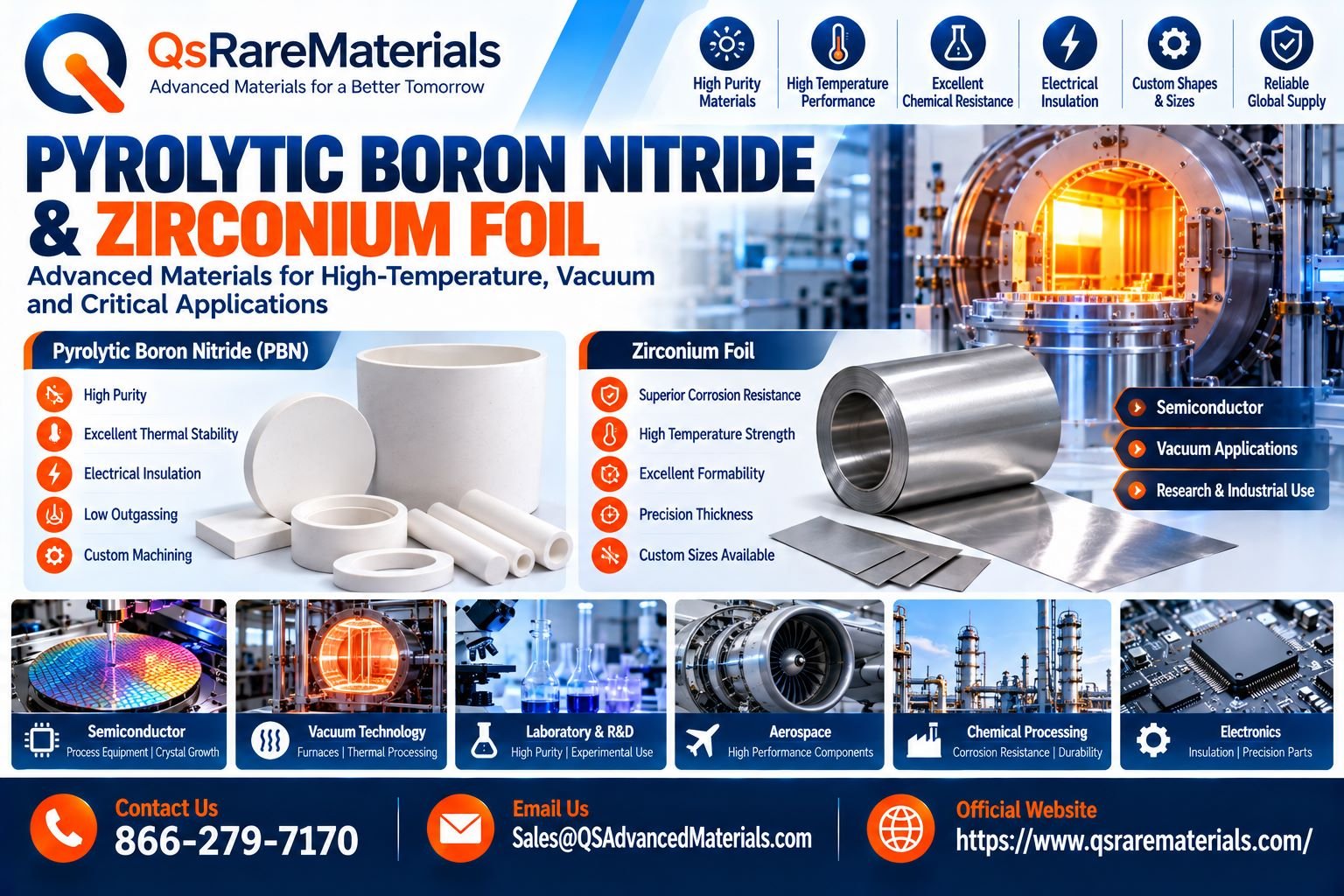
From semiconductor fabrication and vacuum equipment to laboratory research and high-performance components, material selection plays an important role in achieving consistent results.
Pyrolytic Boron Nitride is a high-purity ceramic material valued for its distinctive thermal, electrical, and structural characteristics in selected demanding applications.
Meanwhile, Zirconium Foil is a thin metallic material offering useful corrosion resistance and specialised chemical properties under suitable operating conditions.
Although these materials differ significantly in composition and behaviour, both can contribute to advanced engineering applications where conventional materials may not meet specific technical requirements.
For research organisations, equipment manufacturers, and industrial procurement teams, understanding their individual properties is essential for selecting appropriate materials.
Why Specialised Materials Matter in Precision Engineering
Precision manufacturing often involves carefully controlled temperatures, atmospheres, and material interactions.
A component that performs reliably under ordinary conditions may encounter difficulties in vacuum chambers, specialised chemical environments, or high-temperature processing equipment.
Material contamination, thermal expansion, and chemical reactions can influence production outcomes.
Engineers therefore evaluate materials according to actual operating conditions rather than general descriptions of durability.
This approach makes advanced ceramic and metallic materials important considerations in specialised equipment development.
What Is Pyrolytic Boron Nitride?
Pyrolytic Boron Nitride, commonly abbreviated as PBN, is a high-purity boron nitride ceramic generally produced through a chemical vapour deposition process.
Unlike some conventional pressed boron nitride ceramics, PBN can be manufactured without the binders commonly associated with certain machinable ceramic grades.
Its layered crystal structure produces direction-dependent thermal and mechanical properties.
Depending on its grade and construction, the material can offer useful electrical insulation, chemical compatibility, and thermal characteristics.
PBN components may be considered for specialised vacuum equipment, evaporation systems, and semiconductor-related processes.
However, maximum operating temperature and chemical resistance depend on atmosphere, exposure conditions, and the material being processed.
Understanding Zirconium Foil and Its Properties
Zirconium Foil is a thin sheet of metallic zirconium manufactured to controlled thickness and dimensional specifications.
Zirconium is recognised for its corrosion resistance in various environments, supported by the formation of a protective oxide layer.
Thin foil products can be considered for specialised research, industrial processing, and engineered component applications.
Their suitability depends on purity, thickness, surface condition, and manufacturing quality.
Zirconium also has a strong affinity for certain reactive gases under appropriate conditions, making selected zirconium materials relevant to specialised getter applications.
However, metallic zirconium should not be assumed resistant to every chemical environment or temperature.
The Role of PBN in Vacuum Processing
Vacuum processing is important in several advanced manufacturing operations, including certain coating and material deposition techniques.
Equipment components used in these environments may require low contamination levels, electrical insulation, and suitable thermal behaviour.
PBN can be considered for selected evaporation crucibles, insulating components, and specialised processing structures.
Its properties may help manufacturers manage certain material interactions during carefully controlled processes.
Nevertheless, engineers must evaluate the complete operating environment.
For example, a material that performs well in vacuum may behave differently in oxygen-containing atmospheres.
Selecting vacuum-compatible materials requires careful attention to actual process conditions and verified material specifications.
Why Zirconium Foil Is Relevant to High-Performance Applications
Thin metallic foils can support applications where compact geometry, controlled thickness, and particular chemical properties are important.
Zirconium foil may be incorporated into suitable research components, specialised assemblies, and technical processes.
Its metallic nature distinguishes it from electrically insulating ceramics.
The material’s surface condition can also influence performance, particularly where chemical interaction is important.
Manufacturers should consider how cutting, handling, cleaning, and storage affect finished foil products.
These considerations are especially important for applications involving controlled atmospheres or demanding material specifications.
Comparing Pyrolytic Boron Nitride and Zirconium Foil
| Property | Pyrolytic Boron Nitride | Zirconium Foil |
| Material Category | Advanced ceramic | Metallic material |
| Main Composition | Boron and nitrogen | Zirconium metal |
| Electrical Behaviour | Generally insulating | Electrically conductive |
| Typical Form | Crucibles, sheets and specialised components | Thin foil or sheet |
| Important Characteristics | High purity, insulation, directional thermal properties | Corrosion resistance, formability and chemical reactivity |
| Application Considerations | Atmosphere, thermal behaviour and compatibility | Surface condition, purity and chemical environment |
These materials fulfil different engineering functions and should not be considered direct substitutes.
Thermal Stability and Operating Environment
Temperature is an important factor when evaluating advanced materials.
PBN exhibits anisotropic thermal properties, meaning its behaviour can vary depending on the direction of measurement.
This characteristic should be considered when designing components subjected to thermal gradients.
Zirconium foil behaves differently because it is metallic and can interact with gases at elevated temperatures.
Oxidation and other chemical reactions may limit its suitability under particular conditions.
Neither material should be selected based exclusively on an advertised temperature rating.
Engineers should consider heating cycles, exposure duration, atmosphere, and interaction with adjacent components.
Material Purity and Contamination Control
Manufacturing processes involving sensitive materials often require careful control of impurities.
For PBN, relevant considerations include deposition quality, material composition, and surface cleanliness.
For zirconium foil, buyers may examine elemental purity, thickness consistency, and surface contamination.
Handling procedures are also important.
Unnecessary contact, unsuitable cleaning agents, or inappropriate packaging can affect material surfaces.
Suppliers should provide applicable specifications and inspection documentation where required.
Representative testing can help establish whether a product meets its intended processing requirements.
Precision Manufacturing and Custom Component Development
Advanced engineering applications frequently require customised dimensions and specialised geometries.
PBN products may be supplied in suitable formed structures or manufactured into specialised components according to production capabilities.
Zirconium foil may require accurate cutting, forming, or preparation for particular assemblies.
However, the two materials require different manufacturing approaches.
PBN can be brittle, while zirconium foil requires appropriate metallic processing methods and handling controls.
Clear engineering drawings should identify material grade, dimensions, tolerances, and required surface condition.
Prototype evaluation helps minimise manufacturing errors before larger commercial orders.
Selecting a Reliable Advanced Materials Supplier
Industrial buyers should evaluate suppliers according to technical requirements rather than product names alone.
Important considerations include:
- Material Purity: Confirm composition and relevant impurity limits.
- Manufacturing Method: Understand the production process and available material grades.
- Dimensional Accuracy: Review thickness, geometry, and manufacturing tolerances.
- Application Compatibility: Assess thermal, chemical, and electrical requirements.
- Quality Documentation: Request appropriate specifications and inspection records.
- Customisation Support: Evaluate the availability of application-specific dimensions and components.
Reliable supplier communication helps engineering teams make informed purchasing decisions.
Frequently Asked Questions (FAQs)
1. What is Pyrolytic Boron Nitride used for?
PBN is used in selected high-purity processing environments, including specialised vacuum equipment, evaporation systems, and electrically insulating components.
2. What is Zirconium Foil?
Zirconium foil is a thin metallic sheet made from zirconium and manufactured according to specified thickness, purity, and dimensional requirements.
3. Is PBN different from conventional boron nitride ceramics?
Yes. PBN is commonly produced through chemical vapour deposition and differs from many pressed boron nitride materials in structure and manufacturing characteristics.
4. Can zirconium foil be used in high-temperature environments?
It may be suitable for selected applications, but performance depends on temperature, atmosphere, oxidation conditions, and material specifications.
5. How should buyers select these specialised materials?
Buyers should evaluate purity, thermal behaviour, chemical compatibility, dimensional requirements, manufacturing quality, and available technical documentation.
Media Contact
Department: Advanced Materials and Specialty Metal Enquiries
Contact: 866-279-7170
Email: Sales@QSAdvancedMaterials.com
Official Website: https://www.qsrarematerials.com/