
Advanced materials manufacturers are paying closer attention to contamination control as industrial laboratories and specialised production facilities work with increasingly sensitive materials.
In semiconductor research, crystal processing, metallurgical development, and laboratory experiments, even small amounts of unwanted contamination can influence product quality and experimental reliability.
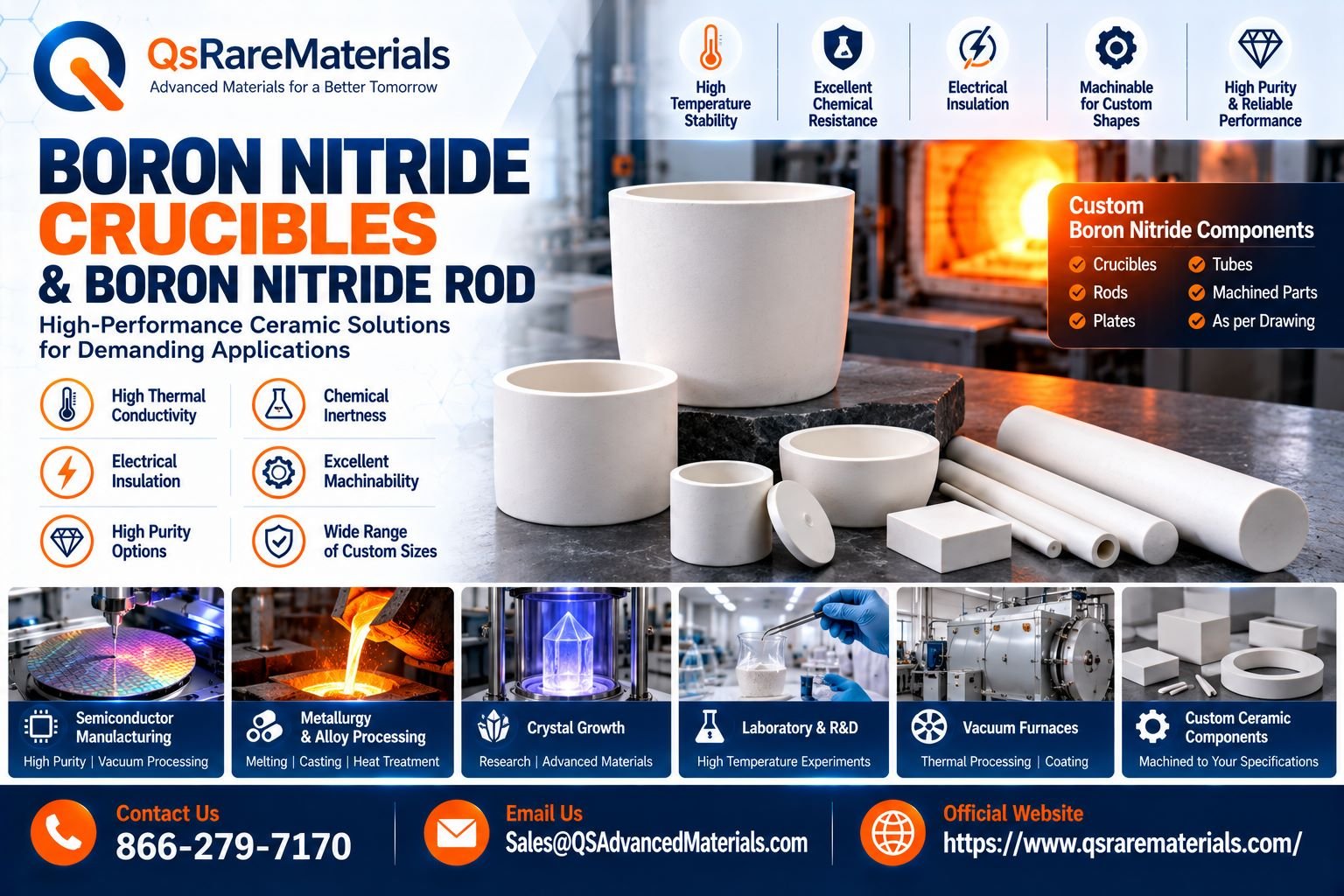
Boron Nitride Crucibles offer a specialised ceramic option for containing compatible materials during selected high-temperature processing operations.
Meanwhile, a Boron Nitride Rod can be machined into components used for electrical insulation, thermal processing assemblies, and other specialised engineering applications.
Together, these materials can support carefully designed processing systems where chemical compatibility, thermal performance, and controlled material handling are important.
For laboratory engineers, advanced material manufacturers, and industrial procurement teams, selecting appropriate ceramic components is an essential part of maintaining process consistency.
Why Contamination Control Matters in Advanced Manufacturing
Many specialised manufacturing operations involve materials that must maintain carefully controlled chemical compositions.
Unwanted particles, residues, or reactions between processing equipment and workpieces can compromise these requirements.
Potential contamination sources include processing vessels, handling tools, furnace components, and cleaning procedures.
Selecting suitable contact materials helps reduce unnecessary risks.
However, ceramic components must be evaluated under actual operating conditions. No processing material should be assumed completely inert in every environment.
What Are Boron Nitride Crucibles?
Boron Nitride Crucibles are ceramic containers manufactured from suitable boron nitride materials for specialised thermal processing applications.
Hexagonal boron nitride is particularly recognised for its thermal characteristics, electrical insulation properties, and compatibility with selected materials.
Crucibles may be produced in different shapes and sizes according to equipment and process requirements.
Depending on material grade and operating conditions, they may be considered for research involving molten materials, vacuum environments, or controlled-atmosphere processing.
Their suitability depends on temperature, atmosphere, chemical exposure, and the specific substance being processed.
Understanding the Role of a Boron Nitride Rod
A Boron Nitride Rod is a solid ceramic component that can be used directly or machined into specialised parts.
Depending on the grade, rods may be suitable for producing spacers, supports, insulating elements, and other custom components.
Their machinability can provide flexibility for developing complex ceramic geometries.
However, boron nitride ceramics are generally brittle compared with many metals.
Designers must consider mechanical loading, dimensional requirements, and handling conditions.
Correct material selection helps ensure the finished component performs its intended function without unnecessary damage.
How Ceramic Components Support Material Purity
Processing vessels and equipment components can affect the purity of sensitive materials.
A crucible that reacts with its contents may introduce unwanted substances or alter the processed material.
Likewise, unsuitable support components can create problems in specialised furnace assemblies.
Boron nitride may provide useful compatibility in selected applications, but chemical behaviour varies considerably.
Some molten materials, reactive chemicals, or oxidising conditions may be unsuitable for particular boron nitride grades.
Representative trials are therefore important before approving components for critical production.
Comparing Crucibles and Rods in Thermal Processing
| Evaluation Factor | Boron Nitride Crucibles | Boron Nitride Rod |
| Primary Form | Hollow processing container | Solid ceramic stock |
| Common Purpose | Containing compatible materials | Supports, spacers, insulation |
| Design Requirement | Wall thickness and cavity geometry | Diameter and machining dimensions |
| Main Consideration | Contact-material compatibility | Mechanical and thermal suitability |
| Customisation | Shape and capacity | Machined features and dimensions |
| Inspection Focus | Surface integrity and cracks | Geometry and structural condition |
Both product types require application-specific material evaluation.
Why Material Grade Makes a Difference
Not all boron nitride products have identical properties.
Manufacturing methods, purity, density, and composition can influence ceramic behaviour.
Some commercially available grades may contain additives or binders that affect performance.
These differences matter when materials are used in sensitive processes.
For example, a grade suitable for an electrical insulation component may not be appropriate for direct contact with a particular molten substance.
Buyers should request relevant material specifications and clarify intended operating conditions.
Thermal Performance Under Controlled Conditions
Boron nitride ceramics can offer useful thermal properties for specialised industrial applications.
However, thermal conductivity, temperature capability, and thermal shock behaviour depend on grade, geometry, and processing environment.
Hexagonal boron nitride also exhibits directional material properties.
This may influence component design where heat transfer is important.
Oxidising environments can limit service temperatures, making furnace atmosphere a critical consideration.
Manufacturers should avoid relying on a single advertised temperature rating without understanding the associated testing conditions.
Cleaning and Handling Considerations
High-purity processing requires attention to component handling before and after use.
Dust, oils, cleaning residues, and mechanical damage can affect sensitive applications.
Ceramic containers should be inspected for visible contamination or cracks before loading.
Machined rods and supporting components also require careful storage and handling.
Cleaning methods must be compatible with the selected ceramic grade.
Aggressive chemicals or unsuitable mechanical cleaning may create additional problems.
A documented handling procedure can support more consistent laboratory and manufacturing operations.
Custom Ceramic Components for Research Equipment
Specialised equipment frequently requires parts that differ from standard catalogue dimensions.
A research furnace may need a crucible with a particular internal capacity or wall configuration.
An insulation assembly may require machined ceramic rods with precise locating features.
Customisation can address these requirements, subject to manufacturing capabilities.
However, intricate geometries may introduce machining difficulties or structural weaknesses.
Early communication between equipment designers and ceramic suppliers can help establish realistic tolerances and suitable component designs.
Quality Inspection Before Industrial Use
Inspection procedures should reflect the intended application.
Relevant checks may include dimensional accuracy, surface condition, material identification, and visible cracking.
For critical high-purity applications, additional material certification or analytical testing may be appropriate.
Buyers should clearly define acceptance criteria before procurement.
Representative component testing can help evaluate chemical compatibility and thermal performance.
Proper documentation supports repeatable material selection and more reliable technical communication.
Frequently Asked Questions (FAQs)
1. What are Boron Nitride Crucibles used for?
Boron nitride crucibles are used in selected high-temperature processing, laboratory research, and specialised material-handling applications where their properties are suitable.
2. What is a Boron Nitride Rod?
A boron nitride rod is a solid ceramic component that may be machined into specialised insulating, supporting, or thermal processing parts.
3. Can boron nitride crucibles be used in vacuum furnaces?
Certain grades may be suitable for selected vacuum applications, depending on temperature, material compatibility, and process conditions.
4. Are boron nitride ceramics resistant to every chemical?
No. Chemical compatibility depends on material grade, processing atmosphere, temperature, and the substances involved.
5. How should buyers choose suitable boron nitride components?
Buyers should evaluate material purity, operating conditions, component dimensions, chemical compatibility, supplier documentation, and representative testing requirements.
Media Contact
Department: Advanced Ceramic Materials and Technical Product Enquiries
Phone: 866-279-7170
Email: Sales@QSAdvancedMaterials.com
Official Website: https://www.qsrarematerials.com/