
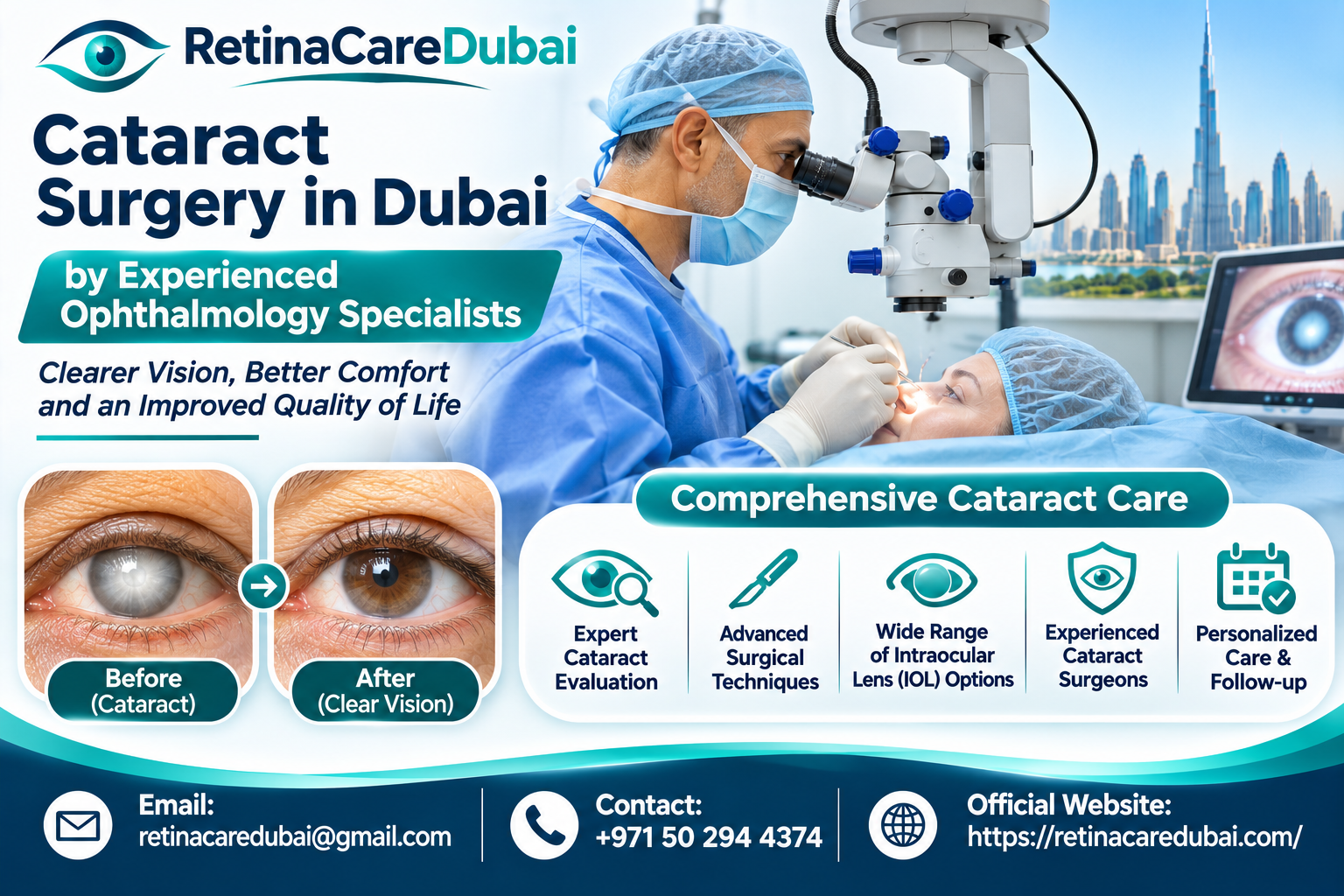
Clear vision plays an essential role in everyday independence, from reading and driving to working, travelling, and enjoying recreational activities. When cataracts affect eyesight, patients may experience blurred vision, increased sensitivity to glare, and difficulties performing familiar tasks.
Modern Cataract Surgery in Dubai offers a treatment option for removing a cloudy natural lens and replacing it with an artificial intraocular lens.
However, a successful treatment plan involves more than removing the cataract. The choice of replacement lens, individual visual requirements, and overall eye health can influence the patient’s experience after surgery.
People searching for the best cataract surgeons in dubai should therefore consider the surgeon’s clinical expertise, approach to personalised treatment, and ability to explain available lens options.
The central discussion focuses on how informed lens selection and realistic visual expectations contribute to responsible cataract care.
Why Cataract Surgery Requires Personalised Planning
A cataract develops when the eye’s natural lens becomes cloudy, interfering with the passage of light to the retina.
Patients may experience difficulty reading, recognising faces, driving in low light, or seeing clearly through glare.
Although cataracts commonly develop with ageing, other factors, including previous eye injury and certain medical conditions, may contribute.
Surgery is generally considered when cataracts interfere with daily activities or when another clinical indication exists.
This principle makes individual assessment essential.
What Is Cataract Surgery in Dubai?
Cataract Surgery in Dubai is an ophthalmic procedure that removes the cloudy natural lens and replaces it with an artificial intraocular lens, commonly called an IOL.
Phacoemulsification is a widely used surgical technique involving ultrasound energy to break up and remove the cataractous lens.
The artificial lens is then implanted to provide the eye with appropriate focusing power.
The procedure is usually performed using local anaesthesia, often with eye drops.
However, the recommended surgical approach depends on the patient’s eye condition and medical requirements.
An ophthalmologist should explain the expected benefits, potential risks, and alternative options before surgery.
Why Intraocular Lens Selection Matters
One important decision in cataract surgery involves choosing the replacement lens.
Different intraocular lenses are designed to meet different visual requirements.
Some primarily provide clear vision at a selected distance, while others are designed to reduce dependence on glasses across multiple distances.
However, no single lens is appropriate for every patient.
The choice depends on eye measurements, lifestyle preferences, existing eye conditions, and visual expectations.
Patients should understand that premium lens technology does not automatically produce better results for every individual.
Suitability matters more than product labels.
Understanding Different Intraocular Lens Options
| Lens Type | Main Purpose | Important Consideration |
| Monofocal Lens | Focuses primarily at one distance | Glasses may be needed for other distances |
| Toric Lens | Corrects selected amounts of corneal astigmatism | Requires accurate measurements and alignment |
| Multifocal Lens | Provides multiple focal ranges | May cause halos or glare in some patients |
| Extended Depth-of-Focus Lens | Extends the range of functional vision | Some activities may still require glasses |
The final choice should follow a detailed discussion with the treating ophthalmologist.
How Lifestyle Influences Lens Selection
Visual requirements vary substantially between individuals.
Someone who spends considerable effort reading may have different priorities from a patient who regularly drives or works at a computer.
A person who enjoys outdoor activities may prioritise distance vision, while another may value reduced dependence on reading glasses.
These preferences can influence the selection of an intraocular lens.
However, lifestyle goals must be balanced against clinical suitability.
Realistic expectations help patients make more informed decisions.
Why Preoperative Eye Measurements Are Essential
Accurate eye measurements are fundamental to cataract surgery planning.
The ophthalmologist may assess corneal curvature, eye length, astigmatism, and other relevant characteristics.
These measurements help determine appropriate intraocular lens power.
Additional examinations may identify conditions affecting the retina, cornea, or optic nerve.
For example, macular disease or advanced glaucoma may influence the suitability of certain lens designs.
Dry eye disease can also affect the reliability of some preoperative measurements.
A comprehensive examination helps ensure that surgical planning addresses the complete eye condition.
How to Evaluate the Best Cataract Surgeons in Dubai
Patients researching the best cataract surgeons in dubai should focus on independently verifiable qualifications and relevant clinical experience.
Professional licensing, training, surgical expertise, and clear communication are important considerations.
A surgeon should explain why a particular procedure and lens are recommended.
Patients may also ask how existing eye conditions will influence treatment planning and postoperative expectations.
An effective consultation should provide opportunities to discuss concerns without pressure.
No surgeon can guarantee perfect vision or freedom from glasses.
Transparent explanations and appropriate medical judgement are more meaningful than promotional rankings.
Understanding Visual Recovery After Cataract Surgery
Vision often improves following cataract surgery, although the recovery experience varies.
Some patients notice clearer vision relatively quickly, while others experience temporary blurring or fluctuations during healing.
The ophthalmologist may prescribe anti-inflammatory or other postoperative medications and provide instructions about eye protection.
Patients should attend recommended examinations and follow medication instructions carefully.
Severe pain, significant redness, or sudden deterioration in vision requires urgent ophthalmic assessment.
Final visual results depend on healing, lens selection, and any additional eye conditions.
Surgery cannot guarantee a particular level of vision for every patient.
Can Cataract Surgery Eliminate the Need for Glasses?
Cataract surgery can reduce dependence on glasses for certain patients, particularly when an appropriate lens is selected.
However, spectacle independence is not guaranteed.
A monofocal lens typically focuses at a chosen distance, meaning glasses may remain necessary for other activities.
Other lens designs may extend the range of useful vision but can involve optical trade-offs.
The ophthalmologist should explain what each lens can realistically achieve.
Patients should make decisions based on their individual visual priorities and clinical findings.
Why Follow-Up Care Remains Important
Cataract surgery is only one part of the treatment process.
Postoperative examinations allow the ophthalmologist to assess healing, eye pressure, inflammation, and visual recovery.
Patients should report unexpected symptoms and follow instructions regarding medication and eye care.
Some individuals may require updated glasses after their vision stabilises.
Others may have additional retinal or corneal conditions that influence the final result.
Continuity of care helps identify concerns and supports appropriate management.
Frequently Asked Questions (FAQs)
1. What is Cataract Surgery in Dubai?
It is an ophthalmic procedure that removes a cloudy natural lens and replaces it with an artificial intraocular lens to improve vision when clinically appropriate.
2. How can I choose the best cataract surgeons in Dubai?
Evaluate professional licensing, surgical qualifications, relevant experience, patient communication, diagnostic facilities, and the quality of individualised treatment planning.
3. Which intraocular lens is best for cataract surgery?
There is no universally best lens. The appropriate choice depends on eye health, astigmatism, visual requirements, and tolerance for possible optical side effects.
4. Will I need glasses after cataract surgery?
Possibly. Dependence on glasses varies according to lens selection, eye condition, and individual visual needs.
5. Is cataract surgery safe?
Cataract surgery is a commonly performed procedure with a generally favourable safety profile, but complications can occur. Patients should discuss individual risks with their ophthalmologist.
Media Contact
Department: Ophthalmology and Vision Care Enquiries
Enquiry Categories: Cataract Surgery, Intraocular Lens Selection, Ophthalmology Consultation, Vision Assessment, and Specialist Eye Care.
Contact: +971 50 294 4374
Email: retinacaredubai@gmail.com
Official Website: https://retinacaredubai.com/