
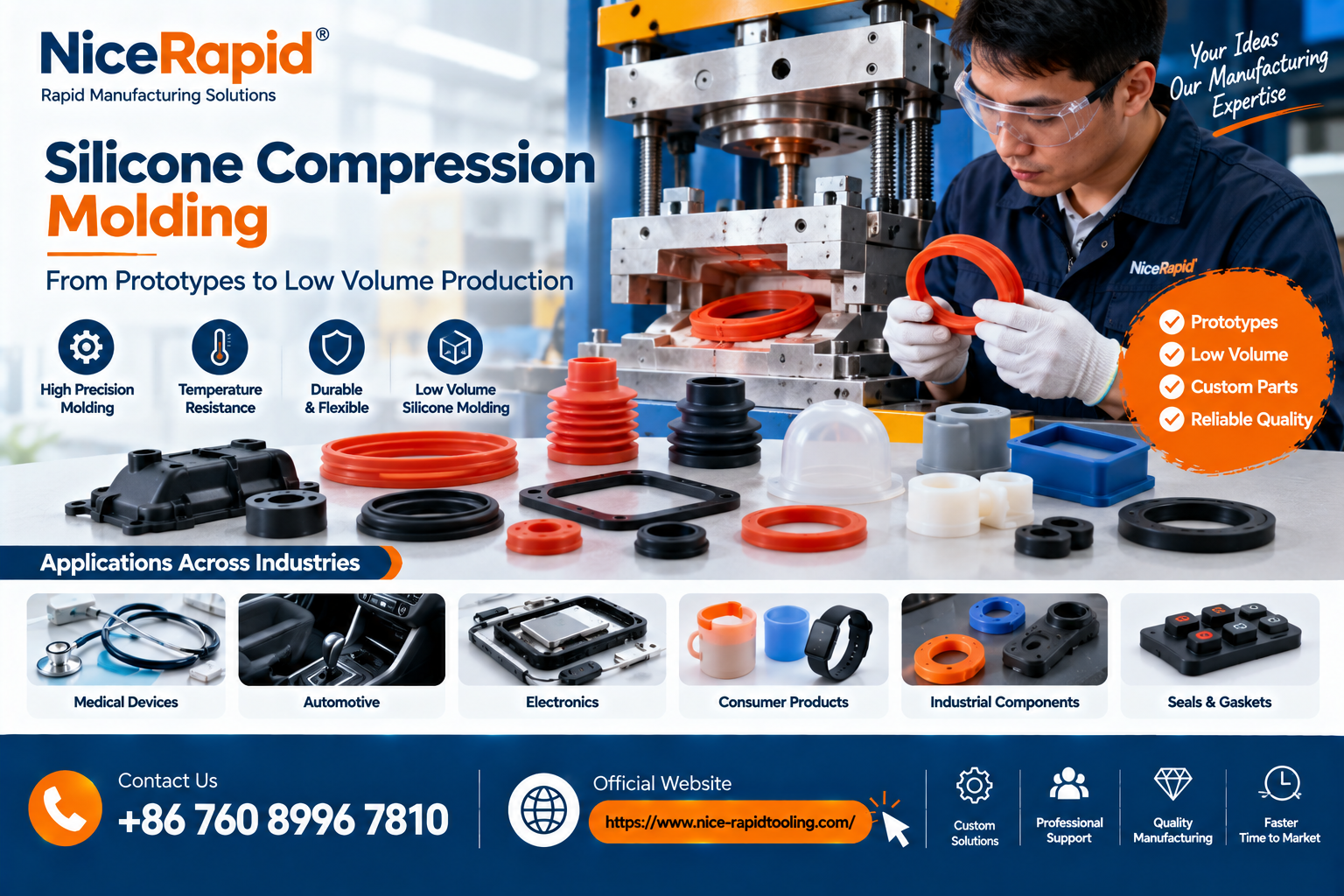
Manufacturers developing specialised products often face an important challenge: producing reliable components without committing to large manufacturing volumes.
From electronic equipment and industrial machinery to consumer products and specialised engineering applications, businesses increasingly need flexible production solutions that support design improvements and controlled manufacturing costs.
Silicone Compression Molding provides a practical manufacturing option for producing custom silicone rubber components using moulds, heat, and pressure.
Meanwhile, low volume silicone molding allows businesses to manufacture smaller quantities of specialised parts for product validation, limited production requirements, and engineering applications.
Together, these approaches help manufacturers balance design flexibility, component performance, and production efficiency.
Why Low Volume Manufacturing Matters
Not every product requires mass production.
Some companies develop specialised equipment that needs only a limited quantity of custom components. Others require functional samples before confirming a final product design.
Traditional high-volume manufacturing may involve tooling investments that are difficult to justify for smaller production requirements.
Low-volume production provides an alternative by allowing manufacturers to focus on essential quantities.
This approach can support product development while reducing unnecessary inventory.
What Is Silicone Compression Molding?
Silicone Compression Molding is a manufacturing process used to produce shaped silicone rubber components.
The process generally involves placing a measured quantity of uncured silicone rubber into a mould cavity.
The mould closes, and controlled heat and pressure help the material conform to the required shape and cure.
After curing, the component is removed and may undergo trimming, inspection, or additional finishing.
The method is used for components such as seals, gaskets, protective covers, flexible pads, and custom rubber parts.
Its suitability depends on the material formulation, component geometry, production volume, and required specifications.
How Low Volume Silicone Molding Supports Product Development
Low volume silicone molding is particularly useful when manufacturers need manageable production quantities for design evaluation or specialised applications.
Engineering teams can use small batches to assess component fit, flexibility, and functional performance.
For example, a manufacturer developing an electronic enclosure may require a silicone sealing component before approving the complete assembly.
Producing a limited batch allows the component to be evaluated in its intended environment.
However, successful prototype performance does not automatically establish suitability for larger-scale production.
Material behaviour, tooling consistency, and manufacturing requirements must also be considered.
Why Compression Molding Can Suit Smaller Production Runs
Compression moulding may offer practical advantages for certain low-volume projects because its tooling arrangements can be less complex than those required for some injection moulding applications.
However, this is not universal.
Tooling costs depend on part design, precision requirements, mould construction, and material characteristics.
For appropriate applications, compression moulding can support controlled production without unnecessary equipment complexity.
The process is especially relevant when the component geometry and expected quantities align with the method’s capabilities.
Selecting the right manufacturing process should begin with an engineering evaluation rather than assumptions about cost alone.
Design Considerations for Custom Silicone Parts
A well-designed silicone component must account for both its intended function and the manufacturing process.
Important design considerations include:
- Wall Thickness: Suitable dimensions for consistent material flow and curing.
- Parting Lines: Appropriate locations where mould sections meet.
- Material Hardness: Selection according to required flexibility and support.
- Dimensional Tolerances: Realistic specifications based on material behaviour.
- Component Geometry: Shapes compatible with moulding and demoulding.
- Functional Requirements: Resistance to relevant operating conditions.
Early design review can help identify potential production difficulties.
Compression Molding Versus Alternative Silicone Processes
Different silicone manufacturing processes are suitable for different requirements.
| Manufacturing Method | Main Characteristic | Typical Consideration |
| Compression Molding | Material is compressed within a heated mould | Suitable for selected custom and limited-volume parts |
| Liquid Silicone Injection Molding | Liquid silicone is injected into a mould | Often considered for automated production |
| Transfer Molding | Material moves into cavities under pressure | Useful for certain complex moulding applications |
| Silicone Casting | Material is cast into suitable tooling | May support selected prototype requirements |
The best process depends on design complexity, material requirements, expected volume, and quality expectations.
Choosing the Right Silicone Material
Silicone rubber is available in different formulations with varying mechanical and environmental characteristics.
Some applications require flexibility, while others prioritise resistance to elevated temperatures, compression, or environmental exposure.
Material hardness is commonly evaluated using Shore hardness measurements.
However, hardness alone does not describe a material’s complete performance.
Engineers may also assess tensile properties, elongation, compression set, and relevant chemical compatibility.
For regulated applications, such as medical or food-contact products, additional material and regulatory requirements may apply.
Material selection should always be based on documented application needs.
Why Tooling Accuracy Influences Product Quality
Mould design plays a significant role in the consistency of silicone components.
Poorly designed tooling may contribute to dimensional variation, unwanted flash, or difficulties removing completed parts.
Accurate mould construction can help manufacturers achieve the intended component geometry.
However, silicone shrinkage and other material characteristics must also be considered.
Tooling inspection and suitable process controls contribute to repeatable results.
For low-volume projects, investing in appropriate tooling quality can prevent avoidable problems during testing and assembly.
Managing Quality in Small Batch Silicone Production
Limited production quantities do not remove the need for quality assurance.
Manufacturers should establish inspection requirements based on the component’s intended function.
Dimensional measurements, visual inspections, and relevant performance testing may be necessary.
For sealing applications, testing may focus on fit and specified sealing performance.
Other components may require evaluation of flexibility, mechanical behaviour, or environmental suitability.
Quality documentation helps engineering teams compare results and identify potential improvements.
A controlled process supports consistent outcomes even when production quantities remain relatively small.
Supporting Product Improvements Through Design Feedback
One practical advantage of limited-volume manufacturing is the opportunity to evaluate components before committing to additional production.
Engineers may discover that a gasket requires dimensional adjustment or that a protective pad needs different material characteristics.
These findings can inform modifications to the design or tooling.
However, changes must be reviewed carefully because they may affect cost, performance, and manufacturing requirements.
An organised feedback process helps manufacturers distinguish between design problems and production-related variations.
This can support better decisions as the product moves toward its intended manufacturing arrangement.
Applications of Custom Silicone Compression Molded Parts
Silicone moulded components are used across numerous industries.
Common applications include:
- Electronics: Protective covers, insulation components, and sealing elements.
- Industrial Equipment: Flexible pads, gaskets, and vibration-control components.
- Consumer Products: Custom buttons, grips, and protective accessories.
- Automotive Systems: Selected seals and flexible rubber components.
- Specialised Engineering: Custom parts manufactured according to defined specifications.
Each application requires appropriate material selection, technical validation, and manufacturing controls.
Frequently Asked Questions (FAQs)
1. What is Silicone Compression Molding?
It is a manufacturing process that shapes and cures silicone rubber inside a mould using controlled heat and pressure.
2. What is low volume silicone molding?
It refers to manufacturing smaller quantities of silicone components for prototypes, specialised equipment, product validation, or limited production requirements.
3. Is compression molding suitable for custom silicone parts?
Yes. It can be suitable for many custom components, depending on geometry, material specifications, tolerances, and production quantities.
4. What affects the cost of silicone compression molding?
Important factors include tooling complexity, part dimensions, material choice, manufacturing volume, and inspection requirements.
5. Can low-volume silicone parts be used for functional testing?
Yes. Properly manufactured components can support functional evaluation, although suitability must be confirmed through appropriate application-specific testing.
Media Contact
Department: Precision Manufacturing and Custom Molding Enquiries
Enquiry Categories: Silicone Compression Molding, Low Volume Silicone Molding, Custom Silicone Components, Rapid Tooling, Prototype Development, and Industrial Manufacturing.
Contact: +86 760 8996 7810
Email: enquiry@nice-rapidtooling.com
Official Website: https://www.nice-rapidtooling.com/