
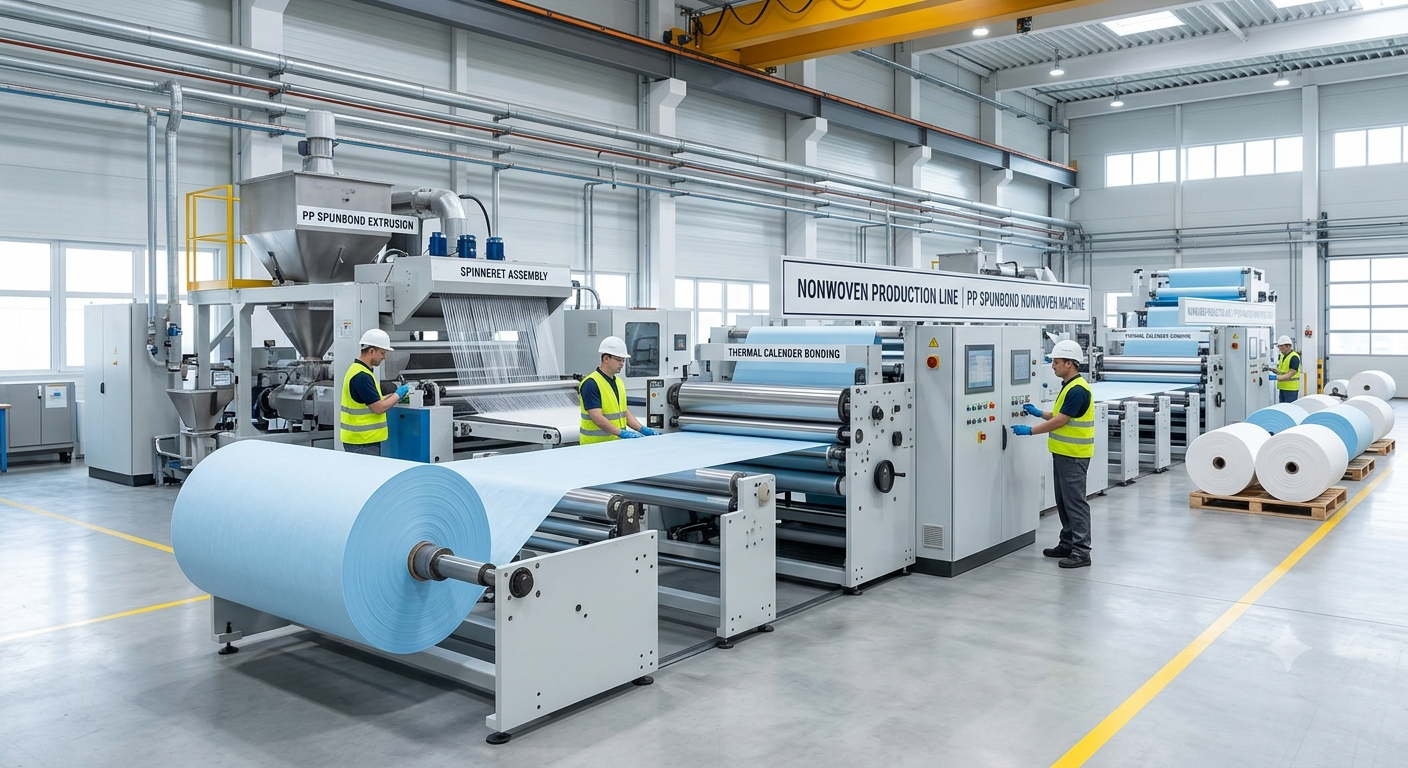
The global demand for lightweight, durable, and cost-effective fabrics has led to rapid growth in nonwoven production line technology and the adoption of the PP spunbond nonwoven machine. These systems have become essential in industries such as medical textiles, hygiene products, agriculture, packaging, and filtration.
Unlike traditional weaving or knitting, nonwoven manufacturing directly converts polypropylene (PP) polymer into fabric without yarn formation. This makes the process faster, more efficient, and highly scalable for industrial production.
What is a Nonwoven Production Line?
A nonwoven production line is an integrated manufacturing system that produces fabric by bonding fibers together using mechanical, thermal, or chemical processes. It eliminates the need for spinning and weaving, reducing production time and cost.
Key Functions of a Nonwoven Production Line
- Polymer melting and extrusion
- Fiber spinning and web formation
- Web bonding through heat or pressure
- Fabric winding and finishing
- Quality inspection and control
Core Advantages
- High-speed production capability
- Consistent fabric quality
- Lower labor and operational cost
- Flexible material customization
- Eco-efficient manufacturing process
Understanding PP Spunbond Nonwoven Machine
A PP spunbond nonwoven machine is a specialized system used to produce spunbond fabrics using polypropylene resin. The machine melts PP granules, extrudes them into continuous filaments, and bonds them into a uniform web structure.
Main Components
- Extruder system for polymer melting
- Spinneret for filament formation
- Web forming conveyor
- Bonding unit (thermal calendar system)
- Winding and slitting section
Key Output Features
- Lightweight fabric structure
- High tensile strength
- Breathability and softness
- Uniform fiber distribution
- Excellent durability
How Nonwoven Production Line Works
The working process of a nonwoven production line involves multiple integrated stages that ensure smooth conversion from raw material to finished fabric.
Step-by-Step Process
- Polypropylene granules are fed into the extruder
- Material is melted at controlled temperature
- Melt is extruded through spinnerets into filaments
- Filaments are cooled and stretched
- Web is formed on a conveyor system
- Thermal bonding creates fabric strength
- Fabric is wound into rolls for further use
Applications of PP Spunbond Nonwoven Machine Products
The output of a PP spunbond nonwoven machine is widely used across multiple industries due to its versatility and cost-effectiveness.
Industrial Applications
- Medical gowns, masks, and surgical drapes
- Hygiene products like diapers and sanitary napkins
- Agricultural covers and crop protection sheets
- Shopping bags and packaging materials
- Filtration systems for air and liquids
- Furniture and automotive interiors
Comparison Between Nonwoven and Woven Fabrics
| Feature | Nonwoven Fabric | Woven Fabric |
| Manufacturing Process | Direct fiber bonding | Yarn weaving |
| Production Speed | Very high | Moderate |
| Cost Efficiency | Low production cost | Higher cost |
| Strength | Adjustable | High but rigid |
| Application Range | Broad industrial use | Apparel and textiles |
| Customization | High flexibility | Limited |
Advantages of PP Spunbond Nonwoven Machine
A modern PP spunbond nonwoven machine offers significant benefits for manufacturers aiming to scale production efficiently.
Key Benefits
- Continuous high-speed output
- Low energy consumption per unit
- Stable and uniform fabric quality
- Reduced raw material waste
- Automated operation with minimal labor
- Easy integration with downstream processes
Types of Nonwoven Production Line Systems
Different configurations are available depending on production needs.
Common Types
- Single beam spunbond line
- Double beam spunbond line
- SMS (Spunbond-Meltblown-Spunbond) line
- SS (Spunbond-Spunbond) line
- Customized multi-layer production systems
Key Technical Parameters to Consider
When selecting a nonwoven production line, manufacturers focus on several critical parameters.
Important Factors
- Production width capacity
- Fabric GSM range
- Line speed (meters per minute)
- Energy efficiency
- Automation level
- Raw material compatibility
- Cooling and bonding efficiency
Quality Control in Nonwoven Manufacturing
Maintaining consistent output is essential in nonwoven production line operations.
Quality Testing Measures
- Tensile strength testing
- Thickness and GSM measurement
- Uniformity inspection
- Air permeability tests
- Thermal resistance checks
- Visual defect detection systems
Market Demand for PP Spunbond Nonwoven Machine
The global demand for PP spunbond nonwoven machine technology continues to grow due to rising hygiene awareness and industrial expansion.
Growth Drivers
- Increased demand for medical protective products
- Expansion of hygiene product manufacturing
- Growth in eco-friendly packaging solutions
- Industrial filtration applications
- Agricultural modernization trends
Operational Tips for Better Efficiency
To ensure optimal performance of a nonwoven production line, manufacturers follow specific operational practices.
Best Practices
- Maintain consistent raw material quality
- Regular calibration of spinnerets
- Monitor temperature and pressure systems
- Conduct routine maintenance checks
- Ensure proper cooling system efficiency
Common Production Challenges
Despite advanced automation, certain challenges may occur.
Issues Faced
- Fiber breakage during extrusion
- Uneven fabric formation
- Temperature fluctuation in melting system
- Blockage in spinneret holes
- Variation in fabric GSM
Future Trends in Nonwoven Technology
The nonwoven production line industry is evolving rapidly with innovation and sustainability focus.
Emerging Trends
- AI-based production monitoring systems
- Energy-efficient machine designs
- Recycled PP material usage
- Smart automation integration
- Eco-friendly biodegradable fiber development
Frequently Asked Questions (FAQs)
1. What is a nonwoven production line?
It is a manufacturing system that produces fabric directly from polymer without weaving or knitting.
2. What is a PP spunbond nonwoven machine used for?
It produces polypropylene-based nonwoven fabric used in medical, hygiene, and industrial applications.
3. What raw material is used in spunbond machines?
Polypropylene (PP) granules are the primary raw material.
4. Is nonwoven fabric strong?
Yes, it can be engineered to have high tensile strength depending on requirements.
5. What industries use nonwoven fabric?
Medical, agriculture, packaging, filtration, and hygiene industries.
6. What is GSM in nonwoven fabric?
GSM refers to grams per square meter, indicating fabric weight.
7. Can nonwoven production lines be automated?
Yes, modern systems are highly automated with minimal manual intervention.
8. What is the lifespan of a PP spunbond nonwoven machine?
With proper maintenance, it can last many years with consistent performance.
9. Is nonwoven fabric eco-friendly?
It can be eco-friendly depending on material usage and recycling methods.
10. Why is demand for nonwoven production line increasing?
Due to rising demand in healthcare, hygiene, packaging, and industrial sectors.