
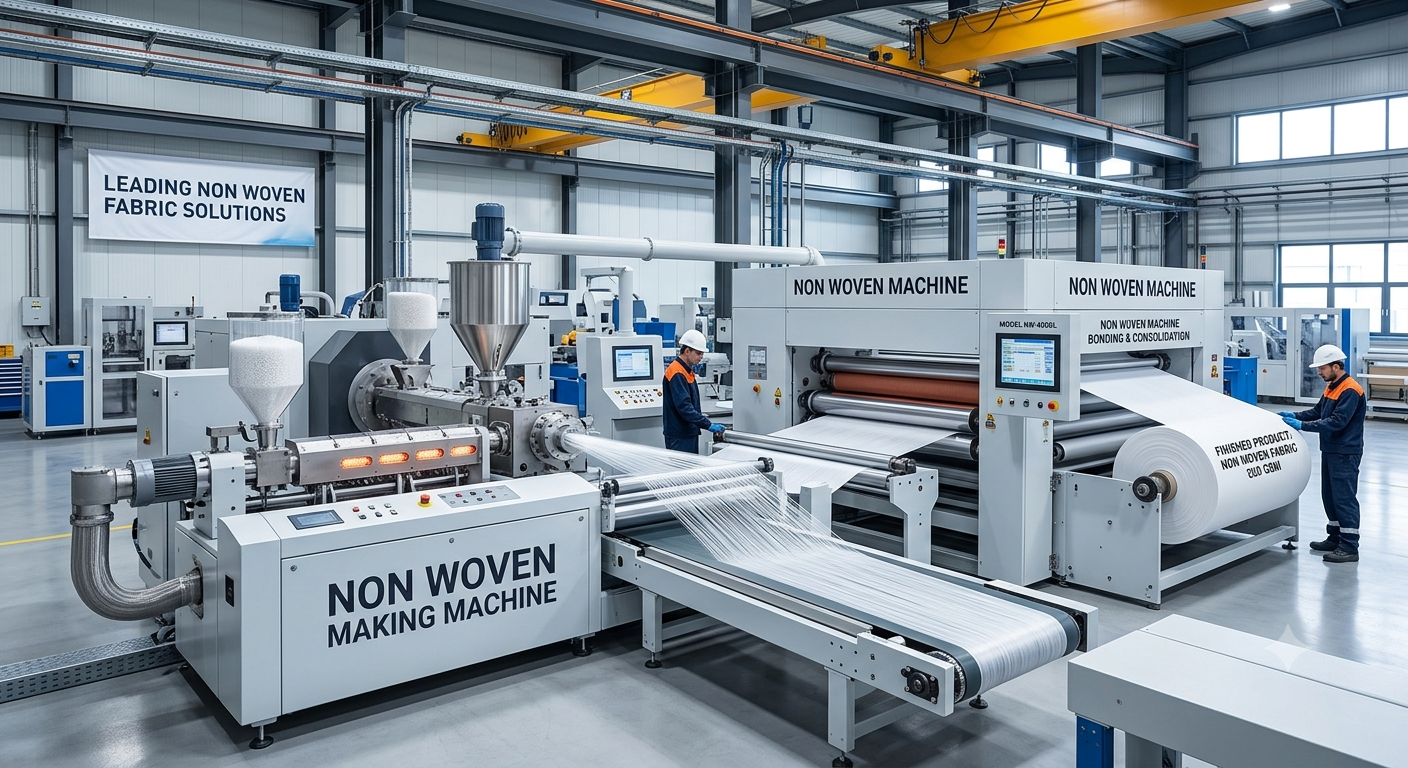
The global packaging, hygiene, medical, and textile industries are rapidly shifting toward sustainable and cost-efficient materials. At the center of this transformation is the non woven making machine and advanced non woven machine systems, which are enabling manufacturers to produce high-quality fabric without traditional weaving or knitting processes.
Unlike conventional textiles, non woven materials are produced directly from fibers bonded together using mechanical, thermal, or chemical processes. This innovation has significantly reduced production costs while improving scalability and environmental performance.
What Is a Non Woven Machine?
A non woven machine is an industrial system designed to convert raw polymer materials—commonly polypropylene (PP)—into non woven fabric rolls. These machines eliminate the need for spinning yarn or weaving fabric, making production faster and more efficient.
Core Functionality
- Melts polymer granules
- Extrudes fibers through spinnerets
- Forms web structures
- Bonds fibers using heat or pressure
- Produces finished fabric rolls
Understanding Non Woven Making Machine Technology
A non woven making machine refers to the complete production line used to manufacture non woven fabric. It includes multiple integrated systems working in sequence to ensure consistent fabric quality and output.
Main Components
- Extruder unit
- Melt pump system
- Spinning beam
- Web formation conveyor
- Calender bonding system
- Winding unit
Types of Non Woven Machines Used in Industry
Different industries require different types of non woven machine systems depending on fabric quality, strength, and application.
Common Machine Types
- Spunbond Non Woven Machine
- Meltblown Non Woven Machine
- SMS (Spunbond-Meltblown-Spunbond) Machine
- Needle Punch Non Woven Machine
- Thermal Bonded Non Woven Machine
Key Applications of Non Woven Making Machine
Non woven fabric has become essential across multiple industries due to its durability, hygiene properties, and cost efficiency.
Major Applications
- Medical masks and surgical gowns
- Hygiene products like diapers and wipes
- Shopping bags and packaging materials
- Agriculture covers and crop protection sheets
- Automotive interiors
- Furniture padding and insulation materials
How a Non Woven Machine Works: Step-by-Step Process
Understanding the working process helps manufacturers optimize production quality.
Production Workflow
- Raw polymer feeding (PP granules)
- Melting and extrusion
- Fiber formation through spinnerets
- Web laying on conveyor belt
- Bonding using heat or pressure
- Cooling and solidification
- Rolling and packaging
Comparison Between Non Woven Making Machine and Traditional Textile Machines
| Feature | Non Woven Machine | Traditional Textile Machine |
| Production Method | Direct fiber bonding | Yarn weaving/knitting |
| Speed | Very high | Moderate |
| Cost Efficiency | High | Higher production cost |
| Labor Requirement | Lower | Higher |
| Fabric Type | Disposable & technical fabrics | Apparel fabrics |
| Setup Time | Faster | Longer |
Advantages of Using Non Woven Making Machine
Manufacturers prefer non woven making machine systems because of their efficiency and scalability.
Key Benefits
- High production output
- Lower manufacturing cost
- Eco-friendly material options
- Reduced labor dependency
- Consistent fabric quality
- Wide application versatility
Industrial Importance of Non Woven Machine Systems
The rise of hygiene awareness and medical demand has increased the importance of non woven machine technology globally.
Why Industries Invest in It
- Growing demand for medical-grade fabrics
- Expansion of disposable product markets
- Government regulations for hygiene safety
- Shift toward sustainable packaging
- Export opportunities in textile sector
Technical Features of Modern Non Woven Making Machine
Modern machines are designed with automation and precision control systems.
Advanced Features
- PLC control system
- Automatic tension control
- Energy-efficient heating systems
- Real-time production monitoring
- High-speed spinning units
- Uniform fabric thickness control
Maintenance Tips for Non Woven Machine
Proper maintenance ensures long-term performance and reduced downtime.
Best Practices
- Regular cleaning of spinnerets
- Lubrication of mechanical parts
- Monitoring temperature controls
- Checking conveyor alignment
- Replacing worn-out filters
- Scheduled preventive maintenance
Factors to Consider Before Buying Non Woven Making Machine
Investing in a non woven making machine requires careful evaluation.
Important Considerations
- Production capacity requirements
- Fabric GSM range flexibility
- Automation level
- Power consumption efficiency
- Spare parts availability
- After-sales service support
- Machine durability and build quality
Future Trends in Non Woven Machine Industry
The industry is evolving rapidly with technological advancements.
Emerging Innovations
- AI-based production control systems
- Fully automated smart factories
- Eco-friendly biodegradable fabric production
- High-speed energy-efficient machines
- Hybrid multi-layer fabric technology
Frequently Asked Questions (FAQs)
1. What is a non woven making machine?
It is an industrial machine used to produce non woven fabric directly from polymer materials without weaving.
2. What is a non woven machine used for?
It is used to manufacture fabrics for medical, hygiene, packaging, and agricultural applications.
3. Which raw material is used in non woven machines?
Polypropylene (PP) is the most commonly used raw material.
4. What are the main types of non woven machines?
Spunbond, meltblown, SMS, needle punch, and thermal bonded machines.
5. Is non woven fabric eco-friendly?
Yes, many types are recyclable and can be made eco-friendly.
6. What is the production speed of a non woven making machine?
It varies depending on model but can produce several tons per day in industrial setups.
7. What industries use non woven machines?
Medical, textile, packaging, agriculture, automotive, and hygiene industries.
8. How long does a non woven machine last?
With proper maintenance, it can last 10–15 years or more.
9. Is training required to operate these machines?
Yes, trained operators are recommended for efficient production.
10. What is the difference between spunbond and meltblown machines?
Spunbond produces strong fabric layers, while meltblown produces fine filtration layers.