
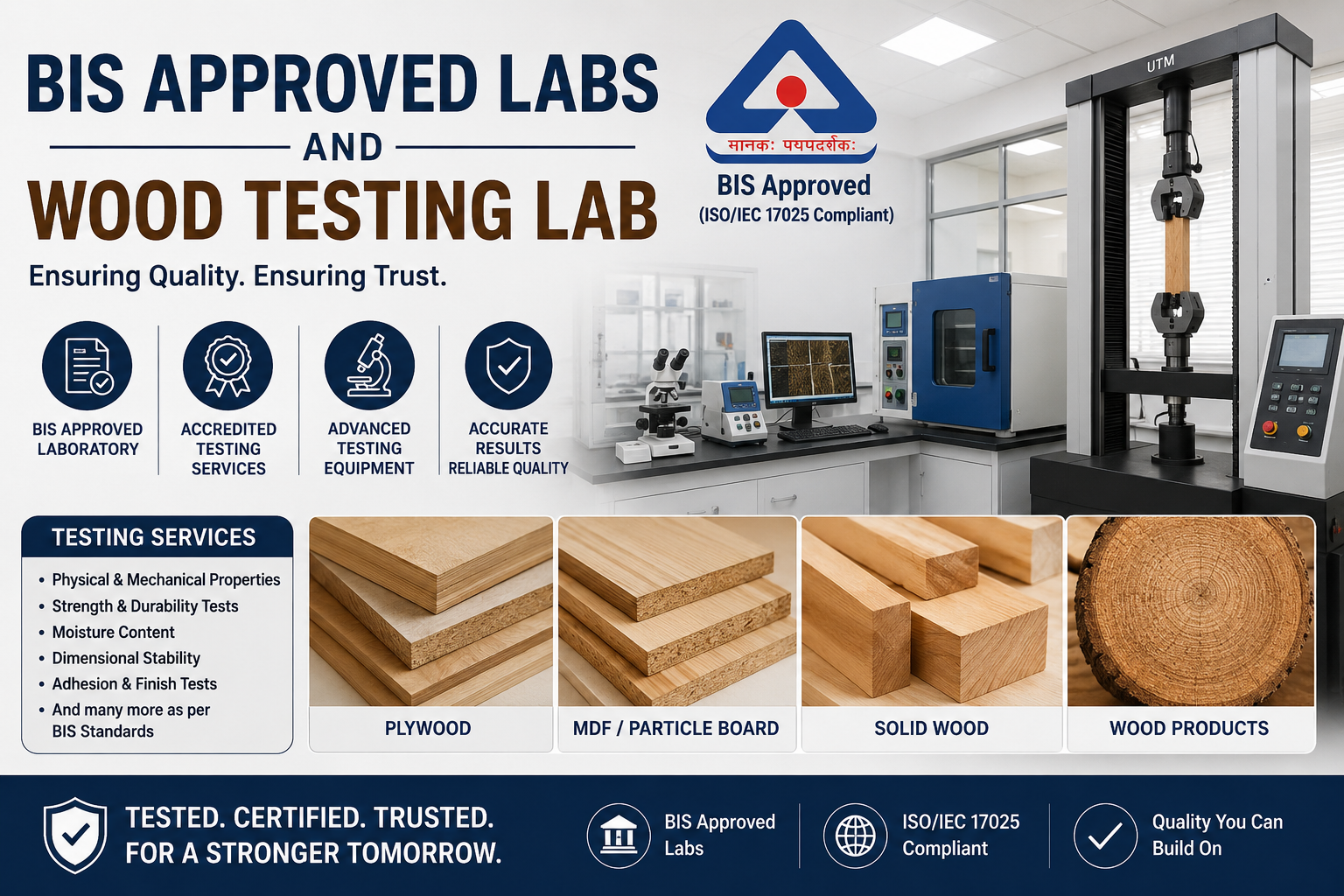
As India’s manufacturing, construction, and infrastructure sectors continue to expand, quality assurance has become a critical priority. Businesses are increasingly relying on BIS approved Labs and specialized Wood Testing lab facilities to ensure that wood products meet national standards for safety, durability, and performance.
Whether the product is plywood, timber, particle board, furniture, or engineered wood, scientific testing helps manufacturers maintain consistency while complying with regulatory requirements. With consumers becoming more quality-conscious and government regulations becoming stricter, certified testing has become an essential part of the production process rather than an optional step.
Understanding BIS Approved Labs
BIS approved Labs are testing facilities recognized by the Bureau of Indian Standards (BIS) to evaluate products according to established Indian Standards (IS). These laboratories perform comprehensive testing that helps manufacturers verify product quality before certification and market distribution.
The primary objective of these laboratories is to ensure that products comply with national safety, quality, and performance benchmarks.
Core Functions
- Product quality evaluation
- Compliance testing as per BIS standards
- Material verification
- Performance assessment
- Safety analysis
- Certification support
- Technical reporting
What Is a Wood Testing Lab?
A Wood Testing lab is a specialized laboratory that evaluates the physical, mechanical, chemical, and biological properties of wood and wood-based products. Testing helps determine whether the material is suitable for residential, commercial, industrial, or export applications.
Modern testing laboratories use advanced scientific equipment to analyze wood performance under different environmental and mechanical conditions.
Common Materials Tested
- Natural timber
- Hardwood
- Softwood
- Plywood
- MDF boards
- Particle boards
- Block boards
- Veneers
- Laminated wood
- Engineered wood products
Why Scientific Wood Testing Is Essential
Wood is a natural material, and its characteristics can vary depending on species, moisture content, climate, and manufacturing processes. Proper testing ensures consistent quality and long-term performance.
Major Benefits
- Improved product durability
- Better structural reliability
- Compliance with Indian standards
- Enhanced customer confidence
- Reduced manufacturing defects
- Safer construction materials
- Better export acceptance
Important Tests Performed in a Wood Testing Lab
A professional Wood Testing lab conducts multiple evaluations depending on the product and its intended application.
Physical Tests
- Moisture content
- Density measurement
- Dimensional stability
- Water absorption
- Thickness swelling
Mechanical Tests
- Compression strength
- Tensile strength
- Bending strength
- Impact resistance
- Nail and screw holding capacity
Chemical Tests
- Adhesive bond quality
- Chemical preservative analysis
- Formaldehyde emission testing
- Surface coating evaluation
Biological Tests
- Termite resistance
- Fungal resistance
- Decay resistance
- Weathering performance
Industries That Depend on BIS Approved Labs
Today, BIS approved Labs support numerous industries where product quality directly impacts safety and performance.
Major Industry Applications
- Furniture manufacturing
- Construction and infrastructure
- Interior decoration
- Real estate development
- Packaging industry
- Educational furniture
- Modular kitchens
- Railway projects
- Government procurement
- Export manufacturing
Advantages of Choosing BIS Approved Labs
Testing through certified laboratories provides confidence to manufacturers, suppliers, contractors, and end users.
Key Advantages
- Accurate laboratory reports
- Reliable testing procedures
- Nationally recognized certification support
- Improved product credibility
- Better regulatory compliance
- Reduced business risk
- Enhanced market reputation
- Greater customer satisfaction
BIS Approved Labs vs Ordinary Testing Facilities
| Feature | BIS Approved Labs | Ordinary Testing Labs |
| Government Recognition | Yes | Not always |
| BIS Standard Compliance | Fully compliant | May vary |
| Testing Accuracy | High | Depends on facility |
| Certification Support | Available | Limited |
| Report Acceptance | Nationally recognized | May not be accepted everywhere |
| Advanced Equipment | Modern instruments | Varies by laboratory |
| Industry Trust | Very high | Moderate |
The Complete Wood Testing Process
Every testing project follows a systematic scientific approach to ensure accurate and repeatable results.
Testing Workflow
- Sample collection
- Sample identification
- Laboratory preparation
- Conditioning under controlled temperature and humidity
- Physical property testing
- Mechanical strength evaluation
- Chemical analysis
- Biological resistance testing
- Data verification
- Final laboratory report generation
Modern Technologies Used in Wood Testing Labs
Today’s laboratories use sophisticated equipment for precise analysis.
Advanced Instruments
- Universal Testing Machine (UTM)
- Digital moisture analyzer
- Density testing equipment
- Environmental conditioning chambers
- Spectrophotometers
- Compression testing systems
- Microscopic analysis equipment
- Digital data acquisition systems
How BIS Standards Improve Product Quality
Indian Standards developed by BIS establish clear guidelines for product manufacturing and testing. These standards help manufacturers maintain consistent quality across production batches.
Some commonly referenced standards include specifications for plywood, block boards, timber grading, particle boards, and engineered wood products.
Following these standards reduces product failures while improving customer confidence.
How Businesses Benefit from Certified Testing
Investing in certified laboratory testing delivers long-term commercial advantages.
Business Benefits
- Faster market acceptance
- Better tender eligibility
- Stronger brand image
- Reduced warranty claims
- Improved export opportunities
- Lower product rejection rates
- Enhanced manufacturing efficiency
Emerging Trends in Wood Testing and Quality Assurance
Technology continues to improve laboratory efficiency and testing accuracy.
Latest Industry Developments
- AI-assisted quality analysis
- Digital laboratory reporting
- Automated testing equipment
- Sustainable material evaluation
- Environment-friendly certification programs
- Smart laboratory management systems
- Real-time quality monitoring
Best Practices Before Sending Samples for Testing
Proper sample preparation helps laboratories produce accurate results.
Useful Recommendations
- Collect representative samples
- Protect samples from moisture during transportation
- Label every sample clearly
- Share complete product specifications
- Mention intended application
- Choose accredited laboratories
- Verify testing requirements beforehand
Frequently Asked Questions (FAQs)
1. What are BIS approved Labs?
These are laboratories recognized by the Bureau of Indian Standards to perform testing according to Indian quality standards.
2. Why is a Wood Testing lab important?
It verifies the strength, durability, safety, and overall quality of wood products.
3. Which products require wood testing?
Timber, plywood, MDF, particle boards, veneers, block boards, furniture components, and engineered wood products.
4. Are BIS approved laboratory reports legally accepted?
Yes. Reports from recognized laboratories are widely accepted for regulatory and certification purposes.
5. What properties are tested in wood?
Moisture content, density, strength, durability, chemical composition, and biological resistance.
6. Can laboratory testing improve product quality?
Yes. Scientific testing identifies defects early and helps manufacturers improve production quality.
7. How long does wood testing usually take?
The testing duration depends on the required evaluations and product type.
8. Is testing necessary for export products?
Many international buyers require certified laboratory reports before accepting shipments.
9. How do I select a reliable Wood Testing lab?
Choose laboratories with experienced professionals, advanced equipment, recognized accreditation, and transparent reporting systems.
10. Why do manufacturers prefer BIS approved Labs?
They provide credible testing, nationally accepted reports, regulatory compliance, and improved customer confidence.