
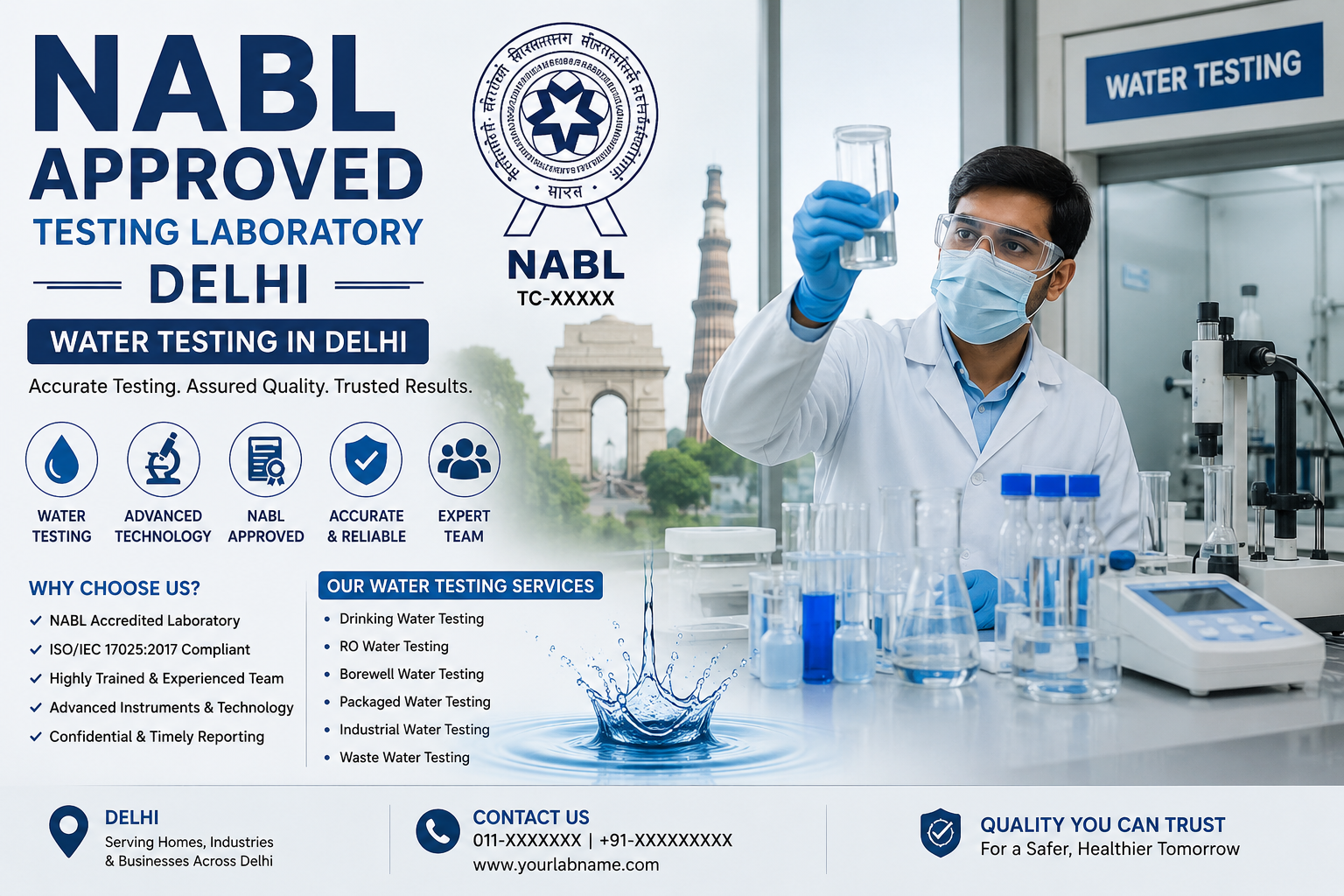
As industries, institutions, and households become increasingly focused on quality assurance and public health, the demand for a NABL approved testing laboratory Delhi has grown rapidly. Accurate laboratory testing plays a vital role in ensuring that products, materials, and water supplies meet established safety standards. At the same time, water testing in Delhi has become more important than ever due to rapid urbanization, industrial development, and growing concerns about water quality.
Professional laboratories equipped with advanced testing technology help identify contaminants, verify compliance with national standards, and provide reliable reports that support informed decision-making for businesses and individuals alike.
What Is a NABL Approved Testing Laboratory?
A NABL approved testing laboratory Delhi refers to a laboratory accredited by the National Accreditation Board for Testing and Calibration Laboratories (NABL). Accreditation demonstrates that the laboratory follows internationally recognized quality management systems and technical standards while delivering accurate and reliable testing results.
These laboratories perform scientific analysis across multiple industries, including environmental testing, food safety, pharmaceuticals, construction materials, chemicals, and water quality.
Core Functions of NABL Approved Laboratories
- Quality assurance testing
- Product compliance verification
- Environmental analysis
- Industrial material testing
- Food and beverage testing
- Pharmaceutical quality evaluation
- Water quality assessment
- Calibration services
Understanding the Importance of Water Testing in Delhi
With increasing pressure on water resources, water testing in Delhi has become a crucial step for maintaining public health and environmental safety. Drinking water may contain physical, chemical, or biological contaminants that are not visible to the naked eye.
Regular laboratory testing helps detect impurities before they become serious health concerns and ensures that water complies with recommended safety standards.
Why Water Testing Matters
- Protects public health
- Identifies harmful contaminants
- Supports industrial compliance
- Ensures safe drinking water
- Helps maintain environmental quality
- Improves water treatment efficiency
Common Water Quality Parameters Tested
Professional laboratories evaluate multiple characteristics to determine water quality.
Physical Parameters
- Colour
- Odour
- Turbidity
- Temperature
- Total Dissolved Solids (TDS)
Chemical Parameters
- pH value
- Hardness
- Chloride
- Fluoride
- Sulphate
- Nitrate
- Iron
- Lead
- Arsenic
- Mercury
Microbiological Parameters
- Total Coliform
- E. coli
- Pathogenic bacteria
- Microbial contamination
Industries That Depend on NABL Approved Testing Laboratory Delhi
Accredited laboratories support numerous industries where quality and regulatory compliance are essential.
Major Sectors
- Manufacturing
- Pharmaceuticals
- Food processing
- Chemical industries
- Construction
- Healthcare
- Hospitality
- Educational institutions
- Government organizations
- Water treatment companies
Who Should Consider Water Testing in Delhi?
Regular water testing in Delhi is recommended for both residential and commercial users.
Suitable For
- Homeowners
- Apartment societies
- Schools and colleges
- Hospitals
- Restaurants
- Hotels
- Factories
- Corporate offices
- Water purification plants
- Real estate developers
Benefits of Choosing a NABL Approved Testing Laboratory Delhi
Selecting an accredited laboratory provides confidence in the accuracy and reliability of test reports.
Key Benefits
- Internationally recognized testing procedures
- Accurate and consistent results
- Qualified laboratory professionals
- Modern analytical equipment
- Regulatory compliance support
- Transparent reporting
- Faster turnaround time
- Greater credibility for certification purposes
How Water Testing Is Performed
Laboratories follow standardized procedures to maintain accuracy throughout the testing process.
Typical Testing Process
- Sample collection
- Proper sample preservation
- Laboratory registration
- Scientific analysis
- Quality verification
- Preparation of detailed test reports
- Interpretation of results
- Recommendations, if required
Modern Technologies Used in Laboratory Testing
Advanced laboratories employ sophisticated analytical instruments to improve testing precision.
Common Equipment
- Atomic Absorption Spectrometer (AAS)
- ICP-MS
- UV Spectrophotometer
- Gas Chromatography (GC)
- High Performance Liquid Chromatography (HPLC)
- Microbiological incubators
- pH meters
- Conductivity meters
- Automated water analyzers
NABL Approved Testing Laboratory Delhi vs Non-Accredited Laboratory
| Feature | NABL Approved Testing Laboratory Delhi | Non-Accredited Laboratory |
| Accreditation | NABL Certified | May not have accreditation |
| Testing Standards | Internationally recognized | Varies by laboratory |
| Report Accuracy | Highly reliable | May differ |
| Regulatory Acceptance | Widely accepted | Limited acceptance |
| Technical Competence | Verified through audits | Not always independently assessed |
| Quality Assurance | Comprehensive | May vary |
How to Choose the Right Laboratory
Choosing the appropriate testing laboratory ensures dependable results and professional service.
Important Factors
- NABL accreditation
- Industry experience
- Modern laboratory equipment
- Qualified technical staff
- Transparent pricing
- Fast report delivery
- Good customer support
- Positive client reviews
Emerging Trends in Laboratory Testing
The laboratory industry continues to adopt new technologies and digital solutions.
Recent Developments
- Digital laboratory reporting
- AI-assisted data analysis
- Cloud-based report access
- Automated sample tracking
- Portable water testing solutions
- Sustainable laboratory practices
- Smart laboratory management systems
Frequently Asked Questions (FAQs)
1. What is a NABL approved testing laboratory Delhi?
It is a laboratory accredited by NABL to perform testing according to internationally accepted quality standards.
2. Why is water testing in Delhi important?
Water testing helps identify contaminants and ensures that drinking water is safe for consumption and industrial use.
3. How often should drinking water be tested?
Most experts recommend testing at least once a year or whenever water quality changes noticeably.
4. What contaminants are commonly found in water?
Common contaminants include bacteria, heavy metals, nitrates, fluoride, pesticides, and chemical pollutants.
5. Can laboratory reports be used for regulatory compliance?
Yes. Reports from accredited laboratories are widely accepted by regulatory authorities and industries.
6. How long does water testing usually take?
Depending on the type of analysis, reports are generally available within a few days.
7. Are NABL laboratory reports reliable?
Yes. NABL-accredited laboratories follow strict quality management procedures to ensure reliable results.
8. Can industries use these laboratories for environmental testing?
Yes. Accredited laboratories perform various environmental and industrial compliance tests.
9. What is the difference between chemical and microbiological water testing?
Chemical testing analyzes substances like minerals and heavy metals, while microbiological testing identifies harmful bacteria and microorganisms.
10. How do I select the best laboratory for water testing in Delhi?
Choose a laboratory with NABL accreditation, experienced professionals, modern equipment, transparent reporting, and a strong reputation for quality.