
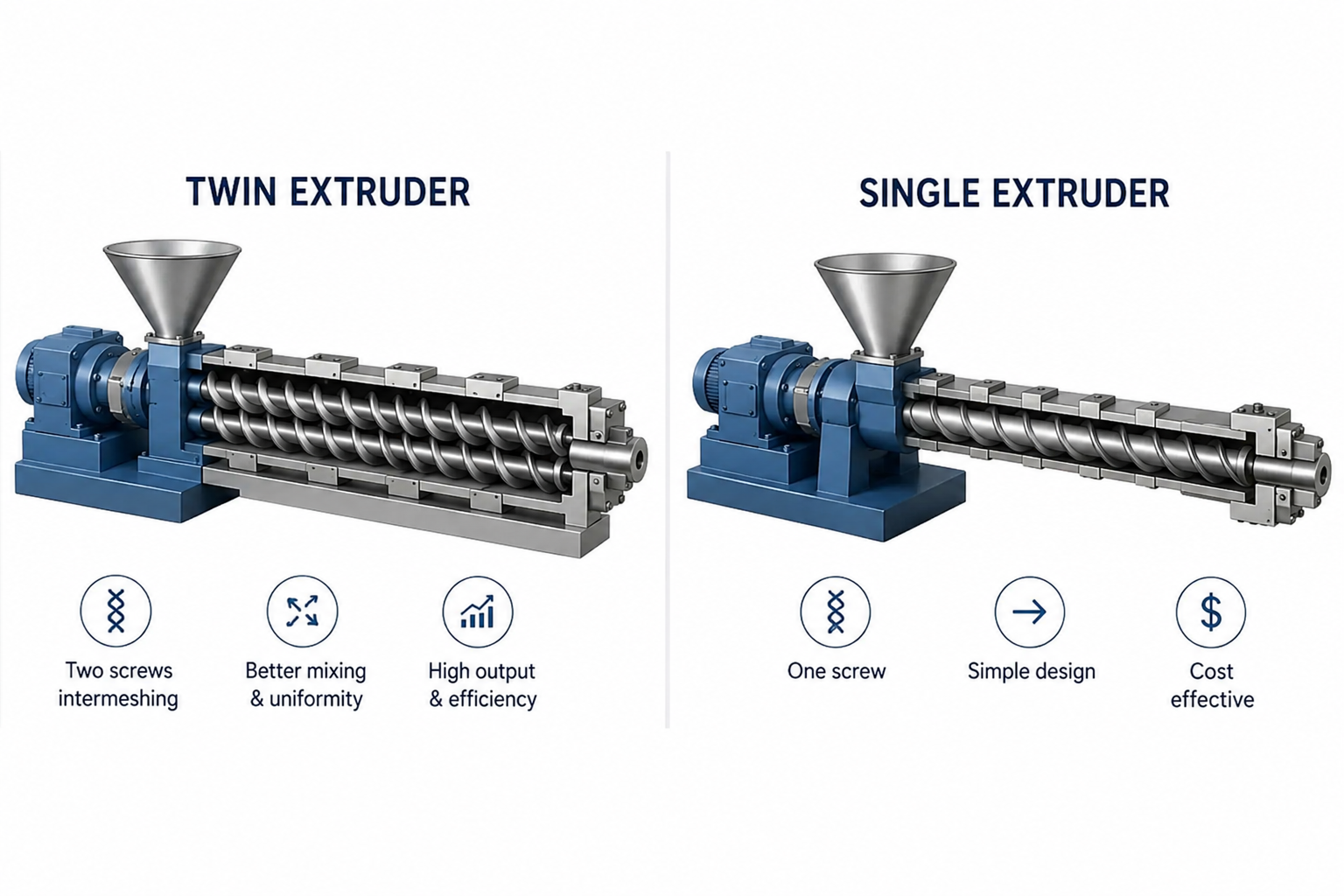
The plastic processing and manufacturing industry has continuously evolved with advancements in extrusion technology. Among the most important developments are twin extruder and single extruder systems, which have played a significant role in producing plastic films, pipes, profiles, sheets, packaging materials, and engineered compounds.
Both extrusion technologies have unique capabilities, applications, and advantages. A single extruder remains a reliable solution for basic plastic processing requirements, while a twin extruder offers advanced mixing, compounding, and material processing capabilities. Understanding their history, current applications, and future development helps manufacturers choose the right extrusion system for their production needs.
History and Development of Single Extruder Technology
Early Beginning of Single Extrusion Machines
The concept of extrusion began in the 19th century when manufacturers searched for efficient methods to shape materials continuously. Early extrusion systems were simple machines designed to push soft materials through a die to create uniform shapes.
The development of thermoplastic materials during the early 20th century accelerated the growth of single extruder technology. These machines became widely used because of their simple design, easy operation, and cost-effective production capabilities.
Traditional single extruders mainly consisted of:
- A rotating screw
- Heated barrel system
- Feed section
- Compression zone
- Die system
- Cooling and shaping equipment
These components allowed manufacturers to melt plastic materials and produce continuous products.
Growth of Single Extruder Applications
As industries expanded, single extruders became essential for manufacturing various plastic products, including:
- Plastic pipes
- Wires and cables
- Packaging films
- Plastic sheets
- Tubes
- Profiles
- Basic plastic components
The simplicity and reliability of the single extruder made it a preferred choice for manufacturers requiring consistent production with standard materials.
History and Development of Twin Extruder Technology
Introduction of Twin Screw Extrusion
The development of the twin extruder came from the need for better material mixing and improved processing performance. Single extruders could process many materials effectively, but they had limitations when handling complex formulations, additives, fillers, and advanced polymers.
Twin screw extrusion technology was introduced to improve:
- Material blending
- Heat distribution
- Additive dispersion
- Polymer modification
- Processing efficiency
The presence of two screws rotating inside the barrel created stronger mixing forces compared with traditional single screw systems.
Expansion of Twin Extruder Technology
During the second half of the 20th century, twin extruders became increasingly popular in industries requiring advanced plastic compounds.
They were widely adopted for:
- Engineering plastics
- Masterbatch production
- Polymer blends
- Reinforced plastics
- Biodegradable materials
- Medical-grade polymers
Modern twin extruders provide manufacturers with greater control over material properties, making them valuable for high-performance applications.
Present-Day Role of Single Extruder Technology
How Single Extruders Work Today
A modern single extruder uses one rotating screw to transport, melt, and push plastic material through a shaping die. The process involves several stages:
- Feeding raw plastic pellets into the hopper
- Melting material through controlled heating
- Compressing and mixing the polymer
- Pushing molten plastic through the die
- Cooling and forming the final product
Modern single extruders include advanced features such as:
- Digital temperature control
- Energy-efficient motors
- Automated monitoring systems
- Improved screw designs
- Smart production controls
Advantages of Single Extruder Systems
Single extruders remain popular because they provide:
- Lower equipment investment
- Simple maintenance
- Easy operation
- Lower energy consumption
- Reliable production performance
They are ideal for applications where the material formulation does not require intensive mixing or modification.
Present-Day Role of Twin Extruder Technology
Advanced Processing Capabilities
A twin extruder provides superior processing abilities because two screws create higher shear forces and better material interaction.
Modern twin extruders are commonly used for:
- Polymer compounding
- Additive mixing
- Color masterbatch production
- Recycling applications
- Nanocomposite manufacturing
- High-performance plastic development
Benefits of Twin Extruders
Key advantages include:
- Excellent material mixing
- Better filler distribution
- Higher processing flexibility
- Improved product quality
- Ability to process complex materials
Twin extruders are especially important in industries where precise material characteristics are required.
Comparison Between Twin Extruder and Single Extruder
| Feature | Twin Extruder | Single Extruder |
| Screw Design | Two screws | One screw |
| Mixing Ability | Excellent mixing performance | Limited mixing capability |
| Processing Complexity | Suitable for advanced materials | Suitable for standard materials |
| Cost | Higher investment | More affordable |
| Maintenance | More complex maintenance | Easier maintenance |
| Energy Usage | Higher due to advanced processing | Lower energy requirement |
| Applications | Compounding, recycling, engineering plastics | Pipes, films, sheets, profiles |
| Material Flexibility | Handles multiple additives and fillers | Best for simple polymers |
Future Development of Single Extruder Technology
Smart Manufacturing Integration
The future of single extruders will focus on automation and intelligent production systems. Manufacturers are adopting Industry 4.0 technologies to improve efficiency and reduce waste.
Future improvements may include:
- AI-based process monitoring
- Automated quality control
- Real-time production analysis
- Remote machine management
Sustainable Plastic Processing
Environmental concerns are influencing extrusion technology. Future single extruders are expected to support:
- Recycled polymer processing
- Lower energy consumption
- Sustainable material production
- Reduced manufacturing waste
Improved screw designs will help process recycled materials more effectively while maintaining product quality.
Future Development of Twin Extruder Technology
Advanced Material Innovation
The demand for lightweight, durable, and sustainable materials will continue driving twin extruder development.
Future twin extruder systems will support:
- Bio-based polymers
- Carbon fiber reinforced plastics
- Smart materials
- Medical-grade compounds
- Advanced recycling processes
Artificial Intelligence and Automation
Future twin extruders will become more intelligent through:
- AI-driven parameter adjustment
- Predictive maintenance
- Automated material control
- Digital twin technology
These improvements will help manufacturers achieve higher productivity and consistent product performance.
Emerging Trends in Extrusion Technology
1. Sustainable Extrusion Solutions
Environmental responsibility is becoming a major focus in plastic manufacturing. Extrusion equipment manufacturers are developing machines that consume less energy and process recycled materials efficiently.
2. High-Speed Production
Modern industries require faster production without compromising quality. Both twin extruders and single extruders are being improved for higher output rates.
3. Smart Factory Integration
Automation and connected manufacturing systems will allow extrusion machines to communicate with production networks, improving efficiency and reducing downtime.
4. Customized Material Processing
Future extrusion systems will provide greater flexibility for producing customized polymer blends with specific performance characteristics.
Choosing Between Twin Extruder and Single Extruder
Manufacturers should consider several factors before selecting extrusion equipment.
Choose a Single Extruder When:
- Processing standard plastic materials
- Manufacturing simple profiles or films
- Lower investment is required
- Easy operation is preferred
Choose a Twin Extruder When:
- Advanced mixing is needed
- Additives and fillers are required
- Producing engineered compounds
- Material modification is necessary
Frequently Asked Questions (FAQ)
1. What is a single extruder?
A single extruder is a plastic processing machine that uses one rotating screw to melt and shape polymer materials into continuous products.
2. What is a twin extruder?
A twin extruder is an extrusion machine with two screws that provides improved mixing, blending, and processing capabilities for advanced materials.
3. What is the main difference between twin extruder and single extruder?
The main difference is the screw design. A single extruder uses one screw, while a twin extruder uses two screws for better mixing and material control.
4. Which extruder provides better mixing performance?
A twin extruder provides better mixing performance because the two screws create stronger material interaction and dispersion.
5. Is a single extruder cheaper than a twin extruder?
Yes, a single extruder generally requires lower investment and has simpler maintenance compared with a twin extruder.
6. Can twin extruders process recycled plastics?
Yes, twin extruders are widely used for recycling applications because they provide better mixing and contamination control.
7. Which industries use single extruders?
Single extruders are commonly used in packaging, pipe manufacturing, cable production, and plastic profile industries.
8. Which industries use twin extruders?
Twin extruders are used in automotive, electronics, medical, packaging, and advanced polymer industries.
9. Are future extruders becoming automated?
Yes, future extrusion systems will increasingly use AI, automation, sensors, and smart manufacturing technologies.
10. Which extruder is better for plastic compounding?
Twin extruders are generally preferred for plastic compounding because they provide superior mixing and additive dispersion.