
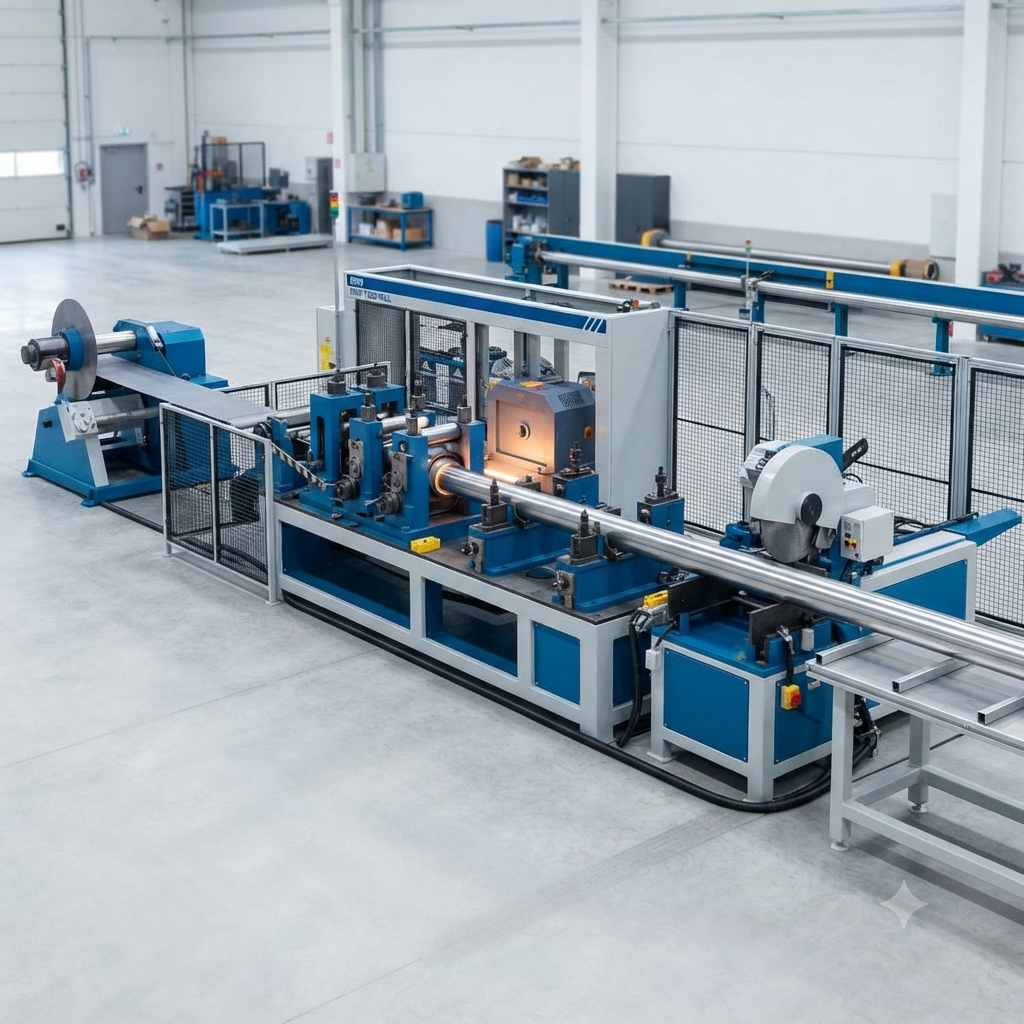
From skyscrapers and bridges to automobiles, pipelines, warehouses, and industrial machinery, steel tubes quietly support some of the world’s most important industries. Behind the scenes, advanced manufacturing technology is making it possible to produce these tubes faster, more accurately, and at a lower cost.
At the center of this transformation is the modern ERW Tube Mill Line.
ERW, short for Electric Resistance Welding, is a widely used manufacturing process in which flat steel strip is continuously formed into a tubular shape and longitudinally welded. A complete Tube Mill Line brings together coil handling, forming, high-frequency welding, sizing, cutting, inspection, and finishing into one coordinated production system.
For steel manufacturers, the right mill is more than a collection of machines. It is a complete production ecosystem that determines productivity, quality, flexibility, energy consumption, and long-term profitability.
From Steel Coil to Finished Tube: A Remarkable Manufacturing Journey
The manufacturing process begins with something that looks relatively simple—a large coil of flat steel strip.
But transforming that coil into a precise, high-quality tube requires a carefully synchronized sequence of operations.
The coil enters the mill through the entry section, where equipment such as an uncoiler and coil handling system prepares the material for continuous processing. Depending on the line configuration, end shears, strip joining systems, and accumulators help maintain a steady flow of steel.
The flat strip then enters a series of forming stands.
Instead of bending the steel into a tube in one sudden movement, the ERW Tube Mill Line gradually changes its shape through multiple forming stages. This controlled deformation helps maintain dimensional accuracy and reduces unnecessary stress on the material.
As the edges of the strip approach one another, the welding stage begins.
High-frequency electrical energy rapidly heats the edges of the steel. The heated edges are then pressed together under controlled pressure, producing a longitudinal weld.
After welding, the tube may pass through scarfing equipment to remove excess weld material. Cooling systems then stabilize the product before it enters the sizing and straightening section.
Finally, a flying cutoff system cuts the continuously manufactured tube into the required lengths.
What appears to be a simple steel tube is actually the result of a highly coordinated manufacturing process involving mechanical engineering, electrical systems, automation, metallurgy, and quality control.
Why ERW Tube Mill Technology Is So Important
The demand for steel tubes continues to grow across construction, infrastructure, transportation, energy, manufacturing, and industrial applications.
Manufacturers therefore need production systems capable of delivering three things simultaneously:
Speed. Precision. Reliability.
A modern Tube Mill Line is designed to achieve this balance.
Continuous production minimizes unnecessary interruptions. Automated controls help maintain stable operating conditions. Precision forming stands provide consistent tube geometry, while advanced welding systems help produce reliable longitudinal seams.
The result is a production process that can deliver large quantities of tubes while maintaining repeatable quality.
For many manufacturers, this combination makes ERW technology an attractive option for suitable product ranges.
What Happens Inside an ERW Tube Mill Line?
A complete production line can be divided into several major stages.
Stage One: Coil Entry
Everything starts with the steel coil.
The entry section may include:
- Coil loading equipment
- Coil car
- Uncoiler
- Peeler
- End shear
- Strip joining machine
- Accumulator
The primary objective is to provide a stable and continuous supply of steel strip to the forming section.
Stage Two: Strip Preparation
Before forming begins, the strip edges may require preparation.
Edge trimming or milling equipment can help achieve the required edge condition and geometry for the welding process.
This stage is extremely important because poor edge preparation can negatively affect weld quality.
Stage Three: Precision Forming
The flat steel strip enters multiple roll-forming stands.
Each stand performs a controlled amount of deformation until the strip gradually becomes an open-seam tube.
The forming process must be carefully engineered to control:
- Material stress
- Edge alignment
- Tube geometry
- Dimensional stability
- Surface quality
Stage Four: High-Frequency Welding
This is where the open tube becomes a welded tube.
The edges are heated using high-frequency electrical energy and brought together under pressure.
Unlike processes that use separate filler material, ERW welding creates the bond by heating and forging the prepared strip edges.
Welding parameters must be precisely controlled because factors such as speed, power, pressure, and material condition can influence the final weld.
Stage Five: Cooling and Sizing
After welding, the tube is cooled and then passed through sizing stands.
The purpose is to achieve the required:
- Diameter
- Shape
- Straightness
- Ovality
- Dimensional tolerances
For square and rectangular profiles, sizing becomes particularly important because the final geometry must remain consistent across the entire production length.
Stage Six: Cutting and Finishing
A flying cutoff system synchronizes with the moving tube and cuts it into predetermined lengths.
The finished tubes may then undergo inspection, testing, bundling, and packaging before being shipped to customers.
One Tube Mill Line, Many Industrial Possibilities
The versatility of an ERW Tube Mill Line is one of its biggest advantages.
Depending on the equipment configuration and tooling, manufacturers can produce a wide range of products.
These may include:
- Round steel tubes
- Square hollow sections
- Rectangular hollow sections
- Structural tubes
- Mechanical tubes
- Automotive components
- Furniture profiles
- Industrial tubing
- Utility pipes
- Selected line-pipe products
However, not every mill can manufacture every product.
The production range depends on factors such as:
- Mill design
- Forming technology
- Welding capacity
- Roll tooling
- Material grade
- Tube diameter
- Wall thickness
- Applicable standards
This is why product planning should always come before equipment selection.
The Industries Driving Demand for ERW Tubes
ERW tubes have become an important part of modern industrial supply chains.
Construction
Steel tubes are widely used in structural frameworks, scaffolding, bridges, guardrails, and infrastructure projects.
Their combination of strength, formability, and manufacturing efficiency makes them suitable for numerous construction applications.
Automotive
Automotive manufacturers rely on precision steel tubing for various structural and mechanical components.
In this industry, dimensional accuracy and repeatable production are especially important.
Energy and Pipelines
Certain ERW pipes are used in energy and pipeline applications when they meet the relevant material, manufacturing, testing, and specification requirements.
For demanding applications, manufacturers must carefully control weld quality and inspection procedures.
Water and Utilities
Depending on project specifications, ERW pipes may be used in water transportation and utility infrastructure.
General Engineering
Industrial equipment manufacturers also use welded steel tubes in machinery, agricultural equipment, material handling systems, and fabrication projects.
The Secret Behind High-Quality ERW Tubes
Buying an advanced Tube Mill Line does not automatically guarantee high-quality products.
The real secret lies in process control.
High-quality manufacturing begins with the raw material.
Steel coils must meet the required specifications for chemistry, mechanical properties, dimensions, and surface condition.
During production, manufacturers need to control critical variables such as:
- Welding power
- Welding frequency
- Production speed
- Strip alignment
- Edge condition
- Squeeze pressure
- Cooling
- Forming accuracy
Modern mills increasingly combine automated controls with online inspection systems.
This allows manufacturers to detect process deviations quickly rather than discovering defects after an entire production batch has been completed.
Inspection: Where Technology Meets Trust
In industries where tube failure can have serious consequences, inspection is not optional.
Depending on the product and applicable specification, manufacturers may use:
- Ultrasonic testing
- Eddy-current inspection
- Hydrostatic testing
- Tensile testing
- Flattening tests
- Bend testing
- Impact testing
- Dimensional inspection
The exact inspection requirements depend on the product’s intended use and governing standard.
For manufacturers supplying critical infrastructure, robust quality management and traceability systems can provide an additional layer of confidence.
ERW Tube Mill Line vs. Other Pipe Manufacturing Technologies
One question frequently asked by investors is whether ERW is better than seamless or other welded pipe technologies.
The answer is not universal.
Each manufacturing method has its own strengths and appropriate applications.
ERW technology is often attractive when manufacturers need:
- High production rates
- Consistent dimensions
- Efficient material utilization
- Automated continuous production
- Flexible product manufacturing
- Competitive manufacturing costs
However, certain applications involving extremely large diameters, heavy wall thicknesses, or specialized service conditions may require alternative manufacturing technologies.
The best choice depends on the final product requirements.
What Can Go Wrong Without Proper Mill Design?
A poorly designed or improperly operated ERW Tube Mill Line can create expensive production problems.
Common challenges may include:
- Weld defects
- Edge misalignment
- Poor forming
- Excessive ovality
- Dimensional inconsistency
- High scrap rates
- Frequent tooling changes
- Unexpected downtime
- Excessive maintenance
- Unstable production speeds
These issues can quickly reduce profitability.
That is why manufacturers should evaluate the entire system rather than focusing on one impressive specification, such as maximum line speed.
A high-speed machine that produces excessive scrap is not necessarily a high-performance machine.
How Smart Manufacturers Choose a Tube Mill Line
Selecting a Tube Mill Line should begin with a clear understanding of the business.
Manufacturers should first define their target market and product portfolio.
Important questions include:
- What tube sizes will be produced?
- What wall thicknesses are required?
- Which steel grades will be processed?
- What production volume is expected?
- What quality standards must be followed?
- How frequently will product sizes change?
- What level of automation is required?
After defining these requirements, buyers can evaluate potential equipment suppliers.
Key factors include:
Production Capability: Can the mill manufacture the required products efficiently?
Tooling Flexibility: Can the system accommodate multiple sizes with reasonable changeover times?
Automation: Does the system provide modern PLC, HMI, servo, monitoring, and data management capabilities?
Quality Control: Can the mill support the required inspection and testing processes?
Maintenance: Are critical components accessible and easy to service?
Technical Support: Can the supplier provide installation, commissioning, training, and long-term support?
The Real Cost of an ERW Tube Mill Line
The initial purchase price may attract attention, but experienced manufacturers know that the real cost goes much deeper.
A proper investment analysis should consider total cost of ownership.
This includes:
- Equipment investment
- Installation
- Utilities
- Energy consumption
- Labor
- Tooling
- Spare parts
- Maintenance
- Scrap
- Downtime
- Changeover losses
A well-engineered ERW Tube Mill Line may deliver a stronger return on investment by improving uptime, reducing waste, and increasing production consistency.
In other words, the cheapest machine is not always the most economical machine.
Automation Is Changing the Tube Manufacturing Game
The modern Tube Mill Line is becoming increasingly intelligent.
Today’s systems can integrate advanced control technologies that allow manufacturers to monitor production in real time.
Emerging capabilities include:
- PLC automation
- HMI-based operation
- Servo-driven systems
- Real-time data monitoring
- Online dimensional measurement
- Digital quality records
- Remote diagnostics
- Predictive maintenance
- Energy monitoring
The future is moving toward smart factories where production data is continuously collected and analyzed.
This can help manufacturers identify problems before they become major failures.
A vibration sensor may detect a developing bearing issue. A quality monitoring system may identify a dimensional deviation. A digital production record may help trace a product back to its raw material batch.
This is the next evolution of tube manufacturing.
Why the Manufacturer Behind the Machine Matters
Even the most advanced equipment requires experienced engineering and technical support.
A reliable ERW Tube Mill Line supplier should understand not only machine construction but also the complete tube manufacturing process.
Before making an investment, buyers should investigate:
- Supplier experience
- Previous installations
- Engineering capabilities
- Product references
- Quality management
- Research and development
- Automation expertise
- Spare parts support
- Commissioning services
- Operator training
Visiting an operating reference line can be particularly valuable.
It provides an opportunity to see how the equipment performs in a real production environment rather than relying solely on brochures and presentations.
Read more – https://newsgrow.blogspot.com/2026/07/erw-tube-mill-line-powerful-technology.html