
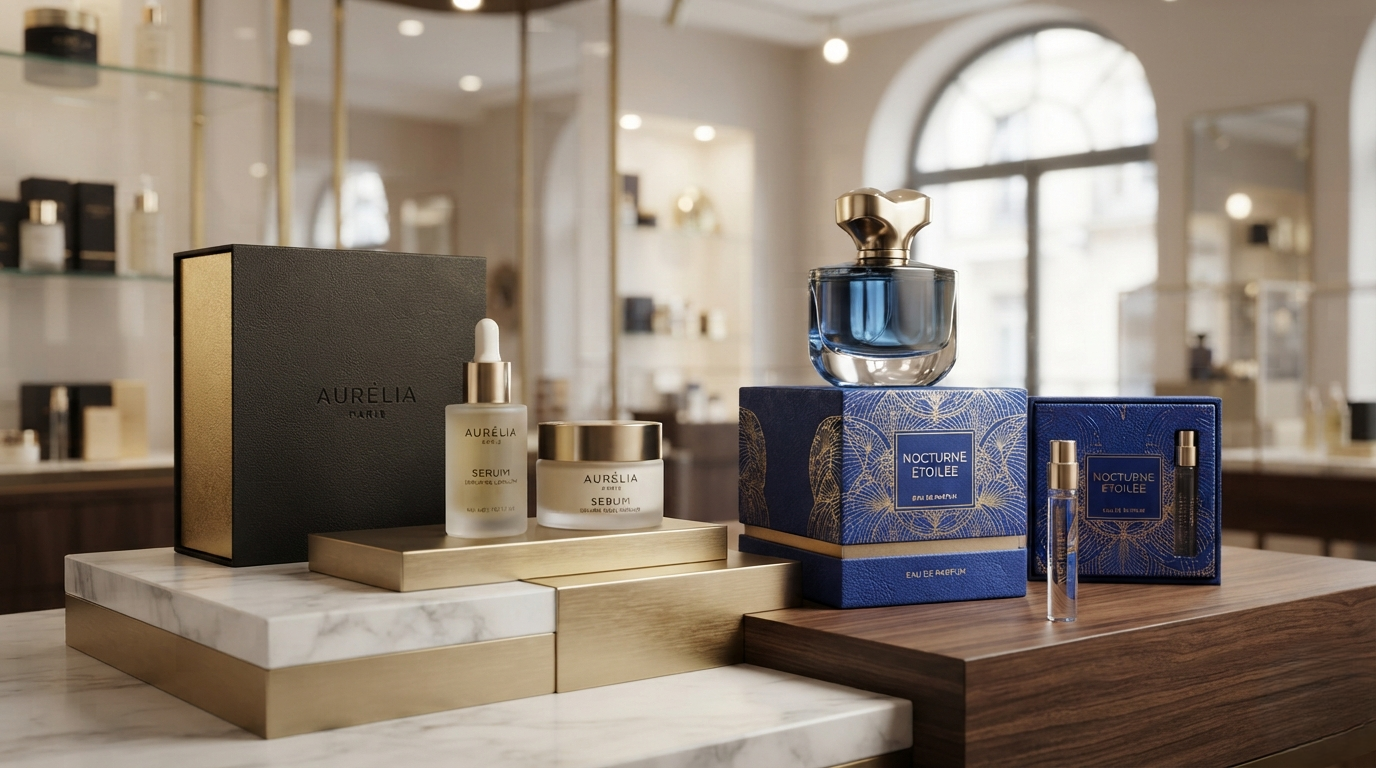
The beauty industry has changed dramatically over generations, but one principle has remained consistent: presentation influences perception. Consumers encounter a package before they experience the formula, texture, color, or fragrance inside it. For premium brands, this first interaction can determine whether a product appears ordinary, sophisticated, innovative, exclusive, or sustainable.
This is why luxury cosmetic packaging and perfume packaging have developed into specialized disciplines combining industrial design, materials science, branding, engineering, psychology, and environmental strategy.
The industry is now entering another major transition. Traditional luxury emphasized decoration and visual richness, while emerging luxury increasingly emphasizes craftsmanship, functionality, longevity, refillability, personalization, and responsible materials.
The Earliest Forms of Beauty Packaging
Beauty packaging has existed for thousands of years. Ancient communities stored fragrances, oils, pigments, balms, and other cosmetic preparations in vessels made from locally available materials.
Containers made from clay, stone, glass, ceramic, and metal were used for different purposes. Their size, shape, decoration, and material often reflected the value of the contents or the social position of the owner.
This early history established two fundamental functions of beauty packaging:
- Protecting the product
- Communicating value
These functions remain central to modern packaging, although today’s products require significantly more sophisticated solutions.
The Birth of Commercial Beauty Packaging
As international trade expanded, fragrances and cosmetics became increasingly commercial products.
Manufacturers began to recognize that packaging could distinguish one product from another. Improvements in glassmaking and printing allowed companies to develop consistent visual identities.
During the industrial era, packaging became more standardized while simultaneously becoming more recognizable.
Brands began controlling elements such as:
- Logo placement
- Typography
- Color systems
- Bottle architecture
- Carton design
- Closure design
- Decorative finishes
This created the modern relationship between packaging and branding.
Why Perfume Packaging Developed Differently
Fragrance has a unique packaging challenge: the product itself cannot be seen.
Consumers cannot visually inspect a scent before using it. Consequently, the bottle must communicate something about the fragrance.
A perfume bottle may communicate freshness through transparency, sophistication through minimalism, heritage through ornamentation, or creativity through unconventional geometry.
This makes perfume packaging a particularly powerful form of visual storytelling.
The bottle is not merely a container. It becomes a physical representation of the fragrance’s personality.
The Rise of Luxury Cosmetic Packaging
The cosmetics industry introduced its own packaging innovations.
Creams, serums, foundations, powders, lip products, and skincare formulas require different dispensing and protection mechanisms.
For example, certain formulations can benefit from airless systems designed to limit exposure to air. Droppers may support controlled dispensing, while pumps can improve convenience and hygiene.
Consequently, modern luxury cosmetic packaging must solve both aesthetic and technical problems.
A package can look beautiful, but if it leaks, damages the formulation, dispenses poorly, or becomes difficult to use, the premium experience is weakened.
Packaging Is a Multidisciplinary Design Process
High-quality packaging requires more than attractive graphics.
A successful packaging project may involve:
- Industrial designers
- Packaging engineers
- Material specialists
- Cosmetic formulators
- Manufacturing teams
- Sustainability professionals
- Brand strategists
- Quality-control specialists
- Marketing teams
Each group evaluates different requirements.
Designers focus on appearance and ergonomics. Engineers consider structural performance. Formulators evaluate material compatibility. Sustainability teams examine environmental impact. Brand teams ensure that the package communicates the intended market position.
The final package is therefore the result of multiple technical and creative decisions.
The Importance of Material Selection
Material selection can influence almost every aspect of a package.
Glass
Glass remains a major material for fragrance and premium cosmetic containers. It can provide transparency, chemical resistance, barrier performance, and a substantial tactile experience.
It can also be shaped into distinctive forms and decorated with coatings, frosting, color, printing, or other techniques.
Metal
Aluminum and other metals can provide durability and premium visual effects while offering opportunities for lightweight structures.
Metal is frequently used for caps, collars, closures, decorative components, and selected containers.
Plastic
Plastic offers flexibility in design, low weight, manufacturing efficiency, and compatibility with many cosmetic applications.
The challenge is improving its environmental profile through recycled content, material reduction, mono-material construction, and improved recovery systems.
Paperboard
Paperboard plays an important role in cartons and secondary packaging. Modern finishing techniques allow paper-based packaging to achieve sophisticated visual and tactile results.
The Psychology of Premium Packaging
Consumers do not evaluate packaging only rationally.
Visual and tactile signals can influence expectations about product quality. Color, texture, weight, shape, typography, and finishing can create subconscious associations.
For example, precise manufacturing and high-quality surfaces can communicate attention to detail.
However, consumer psychology is changing.
Sustainability is increasingly becoming part of perceived value. A package that is refillable or reusable may now communicate sophistication because it demonstrates thoughtful design.
This means luxury packaging is moving from material abundance toward meaningful craftsmanship.
The Major Sustainability Shift
Sustainability has become one of the defining issues in packaging development.
The industry is examining how to reduce unnecessary materials, improve recyclability, increase recycled content, and extend packaging life.
Current market analysis identifies refillable packaging, sustainable materials, lightweighting, smart dispensing, and customization as important areas influencing cosmetic packaging development. (globenewswire.com)
This shift is significant because luxury packaging traditionally relied heavily on presentation.
The new challenge is to create premium presentation using fewer unnecessary resources.
Refillability Changes the Product Life Cycle
Refillable packaging represents a different way of thinking about product design.
Traditional packaging generally follows a linear model:
Manufacture → Purchase → Use → Dispose
A refillable system attempts to create a longer cycle:
Manufacture → Purchase → Use → Refill → Reuse → Refill Again
The longer the primary container remains in use, the more important its durability and design become.
This is especially relevant to premium packaging because consumers may already be emotionally attached to high-quality containers.
The Growing Refill Movement
Large beauty companies are increasingly promoting refillable products.
In June 2026, L’Oréal announced its largest global #JoinTheRefillMovement campaign, involving 18 brands and 28 products across skincare, fragrance, makeup, and haircare. (loreal.com)
The development demonstrates how refillability is becoming a mainstream industry strategy rather than an isolated packaging experiment.
In fragrance, refillable perfume packaging can be particularly attractive because the original bottle can remain a long-term part of the consumer’s environment.
The Future of Materials
Future packaging development is likely to involve a broader material portfolio.
Designers may increasingly evaluate:
- Recycled glass
- Recycled polymers
- Bio-based materials
- Fiber-based structures
- Lightweight metals
- Mono-material packaging
- Reduced-material designs
However, material selection should not be based solely on whether a material is labeled “green.”
The correct choice depends on product compatibility, manufacturing requirements, transportation, consumer use, local recycling infrastructure, and end-of-life pathways.
A life-cycle approach is therefore becoming increasingly important.
Lightweighting Without Losing Luxury
One of the industry’s most difficult challenges is reducing material weight while maintaining premium perception.
Consumers often associate substantial weight with quality, particularly in fragrance bottles.
Engineers must therefore find ways to remove unnecessary material without making the package feel cheap or fragile.
Advanced structural design, optimized wall thickness, improved closures, and material engineering can help achieve this balance.
The objective is not simply to make packaging lighter. It is to make it efficiently designed.
Smart Packaging Creates New Consumer Connections
Packaging is increasingly becoming digitally connected.
QR codes and NFC technologies can provide access to information that would be impossible to fit onto a physical label.
Smart packaging can potentially support:
- Authentication
- Product registration
- Ingredient information
- Refill instructions
- Recycling information
- Usage guidance
- Brand storytelling
- Digital customer engagement
For premium products, this creates an additional layer of value.
The physical package remains important, but it becomes the starting point for a broader digital experience.
Personalization Becomes More Accessible
Mass production historically required standardized packaging.
Digital manufacturing is changing this limitation.
Brands can now experiment with smaller runs and more customized designs, supporting:
- Personalized labels
- Special messages
- Seasonal collections
- Limited editions
- Event-specific packaging
- Regional artwork
- Customized gifts
This is particularly relevant to perfume packaging, where gifting and personal identity are major components of consumer behavior.
E-Commerce Changes Packaging Requirements
The rise of online shopping adds another layer of complexity.
A package designed for a retail shelf may face completely different conditions when shipped directly to a consumer.
It must withstand:
- Warehouse handling
- Transportation vibration
- Drops and impacts
- Temperature changes
- Compression
- Repeated handling
At the same time, consumers increasingly expect an attractive unboxing experience.
This means future packaging needs to balance structural protection with presentation while avoiding excessive protective materials.
Luxury Cosmetic Packaging and Perfume Packaging Compared
| Factor | Luxury Cosmetic Packaging | Perfume Packaging |
| Main role | Protection, dispensing and presentation | Protection, dispensing and storytelling |
| Design emphasis | Functionality plus premium appearance | Bottle identity and emotional appeal |
| Common material | Glass, plastic, aluminum, paperboard | Glass, metal, paperboard |
| Technical focus | Pumps, droppers, airless systems | Sprayers, closures and refill mechanisms |
| Sustainability priority | Refillability and material efficiency | Refillable bottles and lightweight design |
| Future opportunity | Smart and modular containers | Reusable and digitally connected bottles |
The Future of Luxury Cosmetic Packaging
The next generation of luxury cosmetic packaging will likely be modular.
Instead of designing every component as disposable, manufacturers may create systems where outer shells, dispensing mechanisms, and product reservoirs can have different life cycles.
This could make packaging easier to repair, refill, upgrade, or reuse.
Premium design could therefore become increasingly associated with longevity.
A package that remains attractive after several refill cycles may deliver greater value than a package designed to be discarded after one use.
The Future of Perfume Packaging
The fragrance sector has an opportunity to transform the perfume bottle into a long-term brand asset.
Future bottles may be specifically designed for repeated refilling, with durable glass structures, replaceable internal components, and improved dispensing mechanisms.
Digital identification could connect individual bottles to authenticity information, product history, refill services, or loyalty programs.
At the same time, designers will continue using bottle shape, glass treatment, caps, and decorative details to preserve the emotional character of fragrance.
Major Trends for the Next Decade
Several trends are likely to influence premium packaging development:
- Refillability: Extending the life of primary containers.
- Circular design: Considering the complete packaging life cycle.
- Lightweighting: Reducing material without sacrificing performance.
- Personalization: Creating more individualized experiences.
- Digital packaging: Connecting products with online information.
- Material innovation: Exploring recycled and renewable options.
- Minimalist luxury: Replacing unnecessary decoration with refined craftsmanship.
- Modular design: Allowing components to be reused or replaced independently.
Frequently Asked Questions
What makes cosmetic packaging luxurious?
Luxury comes from a combination of material quality, craftsmanship, design precision, functionality, brand identity, and consumer experience.
What makes perfume packaging different?
Perfume packaging has a particularly strong storytelling role because the bottle helps consumers understand the identity and positioning of an invisible product.
Why is glass popular in perfume packaging?
Glass offers a premium appearance, design flexibility, strong barrier properties, and durability suitable for fragrance applications.
What is refillable luxury packaging?
It is premium packaging designed so that the durable outer container can remain in use while the product inside is replaced.
Why is sustainability important for luxury packaging?
Consumers increasingly expect premium brands to address material use, waste, recyclability, reuse, and environmental responsibility.
Is recycled material suitable for luxury packaging?
Recycled materials can be suitable when they meet the necessary technical, aesthetic, safety, and product-compatibility requirements.
What is smart packaging?
Smart packaging uses technologies such as QR codes, NFC, and digital identifiers to connect physical packaging with digital information or services.
How does personalization affect packaging?
Personalization can make products more distinctive by allowing customized labels, artwork, messages, finishes, or limited-edition designs.
Will refillable perfume bottles become more common?
Refillable fragrance systems are gaining attention as brands seek to extend container life and respond to sustainability expectations.
What will luxury packaging look like in the future?
It will likely combine sophisticated design with refillability, durability, responsible materials, personalization, digital connectivity, and efficient manufacturing.
Read more – https://tandtlawassociates.com/cosmetic-packaging-boxes-and-cosmetic-packaging-past-present-and-future/
https://newsgrow.blogspot.com/2026/08/cosmetic-packaging-boxes-deep-guide-to.html
https://bhoomijanatural.info/beauty-packaging-enters-a-new-chapter-as-luxury-meets-sustainability/