
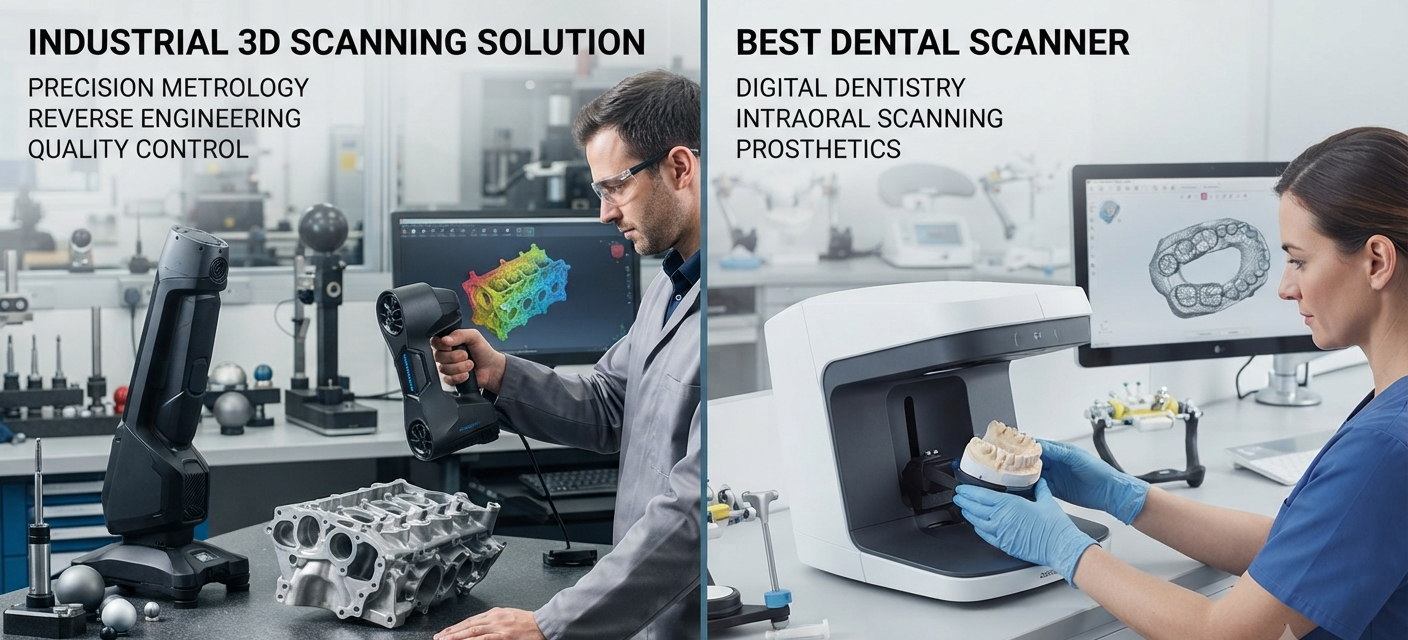
The digital transformation of physical measurement has created new opportunities across manufacturing and healthcare. Three-dimensional scanning is at the center of this transformation, allowing physical surfaces to be captured and converted into digital models for analysis, design, inspection, and production.
The industrial 3D scanner has become an important technology for manufacturers seeking greater measurement efficiency and detailed inspection. In dentistry, the Best Dental Scanner is helping professionals capture digital impressions and connect clinical procedures with CAD/CAM workflows.
While these technologies serve different purposes, their development follows a common path: replacing fragmented physical measurement with comprehensive digital information.
The Journey From Manual Measurement to Digital Scanning
For decades, engineers relied on physical measurement tools to understand component dimensions. Calipers, micrometers, gauges, probes, and coordinate measuring systems were essential in engineering and manufacturing.
However, traditional methods could become difficult when working with complicated geometry. Measuring a curved or irregular component required numerous individual measurements and considerable operator involvement.
The introduction of optical scanning changed this process. Laser technology, structured light, imaging sensors, and computer processing made it possible to capture surface geometry digitally.
The shift created an entirely new approach to measurement—one based on collecting complete three-dimensional datasets rather than isolated dimensions.
The Industrial 3D Scanner in Modern Manufacturing
Today, an industrial 3D scanner can support numerous stages of product development and manufacturing. Engineers can scan prototypes, inspect production parts, verify tooling, or digitize existing components.
A scanner can provide detailed surface information that can be compared with a reference CAD model. This helps reveal deviations that may otherwise remain difficult to identify.
Major applications include:
- Dimensional inspection
- Quality assurance
- Reverse engineering
- Prototype validation
- Tool and mold inspection
- Product development
- Surface measurement
- Additive manufacturing
The ability to capture complex geometry makes 3D scanning especially valuable for components that are difficult to measure using conventional methods.
Reverse Engineering Becomes More Accessible
Many industrial organizations maintain equipment that was designed before modern CAD systems became standard. Replacement components may exist physically but lack usable digital documentation.
An industrial 3D scanner can help bridge this gap.
Engineers can capture the existing part and process the scan into digital geometry. The resulting information can then support redesign, modification, analysis, or manufacturing.
A typical reverse-engineering workflow includes:
- Physical inspection and preparation.
- Complete surface scanning.
- Point-cloud or mesh generation.
- Data cleanup and processing.
- Digital alignment and analysis.
- CAD reconstruction.
- Manufacturing preparation.
This approach can preserve the geometry of legacy components while making future modifications easier.
The Digital Transformation of Dentistry
Dentistry has also experienced significant changes through digital imaging. Conventional impression methods require physical materials and manual handling. Intraoral scanning provides a digital method for capturing teeth and oral structures.
The resulting digital model can be viewed immediately and transferred into compatible software systems.
Digital scanning can support:
- Restorative dentistry
- Orthodontic workflows
- Dental laboratory communication
- CAD/CAM design
- Digital records
- Treatment visualization
- Computer-aided manufacturing
As dental practices increasingly adopt connected digital processes, the Best Dental Scanner has become an important part of equipment selection.
What Should Define the Best Dental Scanner?
There is no universal answer to which device is the Best Dental Scanner. The most suitable option depends on the practice’s procedures, patient volume, laboratory relationships, software environment, and budget.
Accuracy and Data Quality
The scanner should provide appropriate detail for the intended application. Accurate digital information is fundamental to many restorative and orthodontic workflows.
Speed and Productivity
Efficient scanning can reduce appointment times and improve daily workflow.
Comfort and Ergonomics
The physical design should allow the operator to scan efficiently without unnecessary difficulty.
Software Integration
A scanner should work effectively with the digital systems already used by the practice or laboratory.
Usability
A straightforward interface can reduce training time and make adoption easier for the dental team.
Industrial and Dental Scanners Serve Different Needs
| Factor | Industrial 3D Scanner | Best Dental Scanner |
| Main users | Engineers and manufacturers | Dentists and technicians |
| Scanning target | Industrial parts | Teeth and oral structures |
| Main purpose | Inspection and engineering | Digital dental workflows |
| Operating environment | Factory or laboratory | Clinic or laboratory |
| Key priorities | Accuracy and repeatability | Accuracy, speed and ergonomics |
| Typical output | CAD and inspection data | Dental CAD/CAM data |
The technologies may share optical concepts, but their hardware and software are designed around their respective environments.
Why Software Is Changing the Value of Scanning
Scanning technology has become increasingly software-driven. Capturing a surface is only the first step. The resulting data must be processed, interpreted, compared, stored, and transferred.
Industrial software can help engineers align scan data with CAD models and identify deviations. Dental software can assist with digital model preparation and workflow integration.
This means organizations should evaluate scanning solutions as complete systems rather than focusing solely on scanner hardware.
The Next Generation of Industrial 3D Scanners
Manufacturing is moving toward automation and interconnected production. The future industrial 3D scanner is expected to become more deeply integrated into smart manufacturing environments.
Future systems could feature:
- AI-powered inspection
- Automated defect identification
- Robotic scanning
- Real-time quality monitoring
- Digital twin connectivity
- Automated reporting
- Cloud-based engineering collaboration
These capabilities could enable manufacturers to detect quality problems earlier and reduce the dependence on manual inspection.
The Future of Dental Scanning Technology
The future Best Dental Scanner will likely be defined by intelligent software and broader digital integration.
AI may help recognize teeth, identify incomplete scan areas, evaluate scan quality, and automate repetitive measurements. Better connectivity could also allow dental professionals and laboratories to collaborate more efficiently.
Future developments may include:
- Intelligent tooth segmentation
- Automatic scan-quality assessment
- Faster full-arch acquisition
- Automated measurements
- Improved margin identification
- Facial scan integration
- Digital treatment planning
- Cloud-based laboratory workflows
The scanner could increasingly serve as a digital entry point connecting multiple stages of patient care.
Making the Right Technology Investment
A scanner should solve a real workflow requirement. Buyers should therefore evaluate technology according to practical use rather than specifications alone.
Before purchasing, consider:
- Required accuracy
- Scanning speed
- Target size and complexity
- Software compatibility
- File formats
- Training
- Technical support
- Maintenance
- Integration requirements
- Total ownership cost
- Future expansion
A carefully selected system can provide value for years, particularly when it can adapt to changing digital workflows.
Frequently Asked Questions
What is an industrial 3D scanner?
It is a non-contact measurement device that captures the geometry of physical objects and converts the information into digital three-dimensional data.
What industries use industrial 3D scanners?
Automotive, aerospace, engineering, tooling, medical manufacturing, product development, and additive manufacturing are common application areas.
Why is 3D scanning useful for reverse engineering?
It allows engineers to capture existing physical geometry and use the resulting data to reconstruct or modify digital designs.
What is a dental scanner?
A dental scanner captures teeth and oral structures and creates digital models for clinical and laboratory applications.
What is the Best Dental Scanner?
The best choice depends on accuracy, speed, ergonomics, software integration, workflow requirements, and budget.
Are digital dental impressions useful?
They can simplify digital workflows, provide immediate visualization, and facilitate electronic communication with laboratories.
Does scanner software matter?
Yes. Software controls important functions such as data processing, alignment, analysis, export, and workflow integration.
Can AI improve industrial inspection?
AI can assist with automated defect recognition, pattern analysis, and interpretation of large scan datasets.
Can AI improve dental scanning?
AI may assist with tooth recognition, segmentation, scan-quality assessment, and automated measurements.
Will 3D scanning become more automated?
Automation is expected to increase through AI, robotics, connected software, and real-time inspection systems.
What should manufacturers evaluate before buying?
Accuracy, repeatability, scanning range, software, automation capabilities, training, support, maintenance, and ownership costs should all be considered.
What should dentists evaluate?
Dentists should examine accuracy, speed, ergonomics, patient comfort, software compatibility, laboratory connectivity, and technical support.
https://freeseobacklinks.info/3d-scanning-technology-reshapes-manufacturing-and-digital-dentistry/
https://blogstream.net/precision-goes-digital-as-3d-scanning-advances-across-industry-and-dentistry/
https://newsgrow.blogspot.com/2026/08/from-machine-parts-to-perfect-smiles-3d.html