
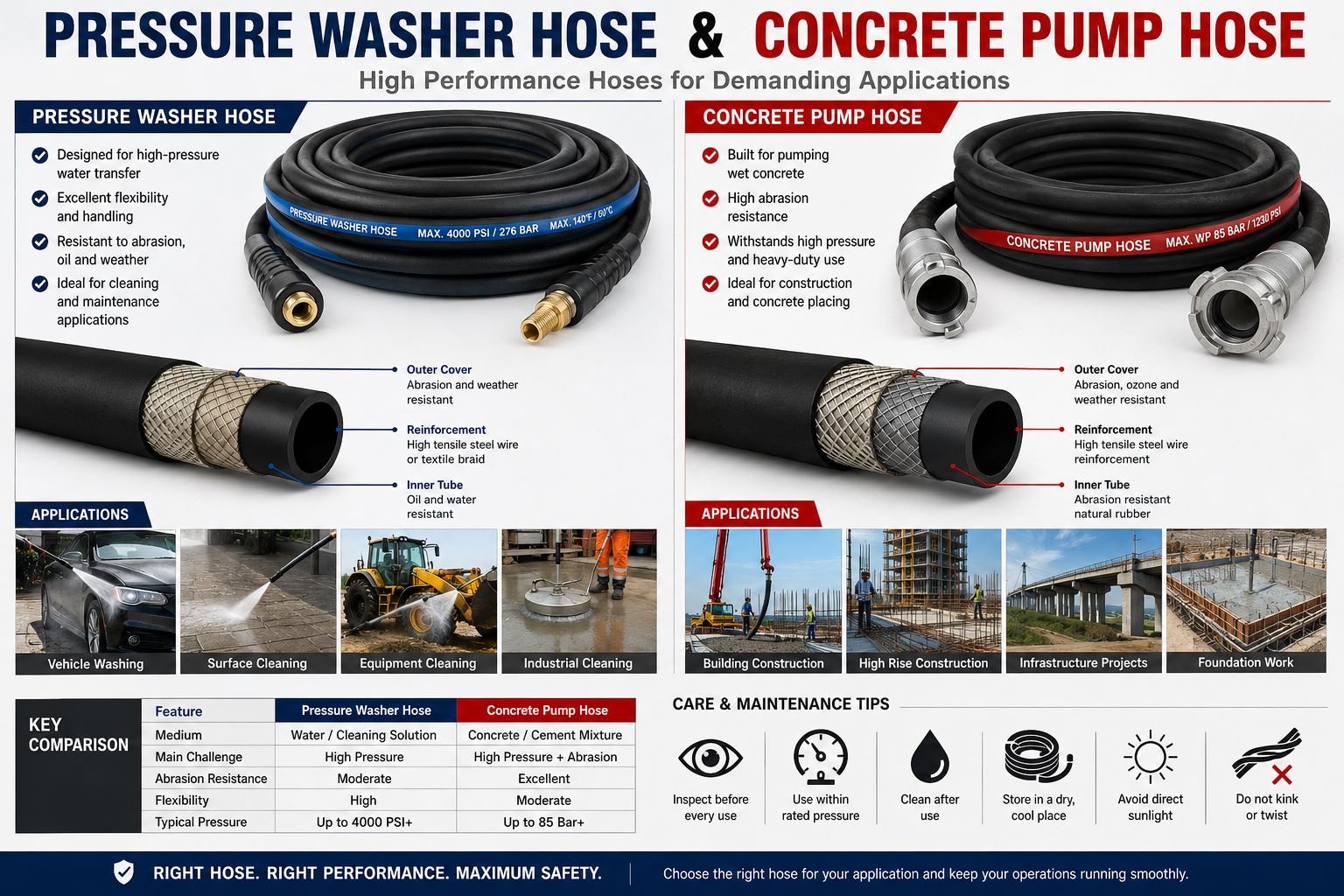
The industrial hose sector is witnessing increased interest in application-specific products as businesses seek to improve productivity and reduce equipment interruptions. Among the solutions attracting attention are Pressure Washer Hose and Concrete Pump Hose, two products designed for very different but equally demanding operating environments.
Industry users are increasingly evaluating hoses based on working pressure, reinforcement, temperature capability, abrasion resistance, flexibility, and connection reliability rather than making decisions primarily on price.
High-Pressure Applications Drive Demand for Specialized Hoses
Industrial hoses frequently operate in environments where conventional flexible tubing would be unsuitable. Internal pressure is only one part of the challenge.
Hoses can also experience continuous movement, bending, vibration, surface abrasion, temperature variations, and exposure to demanding workplace conditions.
The growing focus on equipment reliability means operators are considering several specifications before selecting a hose:
- Rated working pressure
- Internal diameter
- Hose length
- Reinforcement construction
- Temperature range
- Abrasion resistance
- Flexibility
- Fitting compatibility
Correct specification can influence both equipment performance and hose service life.
Pressure Washer Hose Becomes Essential for Professional Cleaning
The use of high-pressure cleaning systems continues across transportation, construction, manufacturing, agriculture, property maintenance, and industrial facilities.
At the center of these systems is the Pressure Washer Hose, which transfers pressurized water from the pump to the spray gun.
Unlike an ordinary water hose, it must resist significant internal pressure while remaining manageable during cleaning operations.
Commercial Cleaning Applications Continue to Expand
Pressure washing systems are frequently used for:
- Heavy machinery cleaning
- Truck and fleet washing
- Agricultural equipment
- Construction vehicles
- Factory floors
- Building exteriors
- Workshops
- Industrial maintenance
These environments can expose hoses to dirt, oils, abrasive surfaces, detergents, weather, and repeated movement.
Hose Engineering Focuses on Multiple Protective Layers
A professional Pressure Washer Hose generally relies on a layered construction to deliver reliable performance.
Inner Tube Handles Fluid Contact
The innermost layer carries pressurized water and approved cleaning agents. It should be suitable for the temperature and fluids involved in the application.
Reinforcement Controls Pressure
A reinforcement structure provides strength against internal pressure and helps prevent excessive expansion.
Textile braiding, steel wire, or other reinforcement technologies may be used depending on the hose design.
Outer Cover Protects Against Damage
The external cover helps protect internal reinforcement against abrasion and environmental exposure.
Flexibility Remains a Purchasing Priority
Cleaning professionals often work around corners, machinery, vehicles, and equipment. Excessively rigid hoses can make these tasks more difficult.
Manufacturers therefore need to balance pressure strength with practical flexibility.
Concrete Pump Hose Responds to Tough Construction Demands
While cleaning hoses primarily deal with pressurized water, concrete pumping hoses face an additional challenge: extreme abrasion.
A Concrete Pump Hose transfers wet concrete and compatible cement-based mixtures from pumping equipment toward the placement location.
Concrete contains solid materials such as sand and aggregate. These particles continuously rub against the internal tube during pumping.
As a result, concrete hose design requires particular attention to abrasion resistance.
Concrete Pumping Supports Hard-to-Reach Projects
Flexible hose sections can help construction teams deliver concrete precisely where it is needed.
A Concrete Pump Hose is commonly associated with:
- Foundations
- Floors
- Concrete slabs
- Columns
- Structural walls
- Residential developments
- Commercial construction
- Infrastructure projects
- Difficult-access locations
The ability to position the final discharge point provides practical advantages on complex sites.
Internal Wear Emerges as a Key Maintenance Concern
Concrete pumping creates progressive internal wear that may not always be immediately visible from the outside.
Abrasion-Resistant Inner Lining
The inner tube is the surface directly exposed to the concrete mixture. It therefore requires suitable abrasion-resistant properties.
Reinforcement Handles Mechanical Stress
Reinforcement helps the Concrete Pump Hose withstand pumping pressure and movement.
Outer Cover Faces Construction-Site Hazards
Construction environments can expose hoses to gravel, concrete surfaces, reinforcing steel, vehicles, and equipment.
Heavy-Duty Does Not Mean Maintenance-Free
Even highly durable hoses require regular inspection. Wear can accumulate gradually until the hose is no longer suitable for continued operation.
How the Two Industrial Hoses Compare
| Feature | Pressure Washer Hose | Concrete Pump Hose |
| Primary medium | Pressurized water | Concrete mixture |
| Main sector | Cleaning | Construction |
| Main engineering challenge | Pressure | Pressure and abrasion |
| Internal abrasion | Limited to moderate | Severe |
| Flexibility requirement | Operator mobility | Concrete positioning |
| Reinforcement | Pressure-dependent | Heavy-duty |
| Main maintenance concern | Leakage and damage | Wear and blockage |
| Typical operating site | Cleaning facilities | Construction projects |
The technical differences demonstrate why industrial hoses should always be selected according to their intended application.
Working Pressure Takes Priority Over Burst Pressure
Pressure terminology can sometimes cause confusion among equipment users.
Working pressure represents the rated pressure at which a hose is designed to operate during normal specified service.
Burst pressure refers to a much higher pressure associated with destructive testing and structural failure.
Normal Operation Should Follow Working Limits
Operators should never use burst pressure as the target for everyday equipment operation.
A Pressure Washer Hose should be compatible with the maximum pressure generated by the cleaning equipment.
A Concrete Pump Hose should similarly meet the pressure requirements of the concrete pumping system.
Diameter Selection Can Influence Material Flow
Another specification receiving greater attention is internal diameter.
For pressure washing, an appropriate hose diameter supports the required water flow characteristics.
Concrete pumping requires careful diameter selection because the hose must accommodate the pumping arrangement and concrete mixture.
Incorrect sizing can negatively influence equipment operation.
Length should also be evaluated because unnecessarily long hose runs may affect handling and system characteristics.
Hot-Water Pressure Washing Creates Additional Requirements
Some professional cleaning systems use heated water to improve cleaning effectiveness.
In these situations, a Pressure Washer Hose must be rated for the expected water temperature as well as operating pressure.
Using a hose outside its specified temperature range can contribute to premature deterioration.
Users should therefore confirm both ratings rather than considering pressure alone.
Regular Inspection Gains Importance Across Industries
Preventive inspection can help identify problems before they interrupt operations.
Users should examine hoses for:
- Surface cracks
- Cuts
- Bulging
- Severe abrasion
- Flattened areas
- Exposed reinforcement
- Leaking fittings
- Damaged couplings
- Loose connections
- Unusual deformation
Particular attention should be given to hose sections close to fittings because these areas can experience repeated bending.
Daily Handling Has a Direct Impact on Hose Life
Industry professionals recognize that premature deterioration is not always related to the hose itself.
Incorrect handling can dramatically shorten service life.
Dragging hoses over sharp edges, repeatedly twisting them, allowing severe kinks, crushing them beneath equipment, or pulling them by fittings can cause unnecessary damage.
Proper handling should therefore be considered part of preventive maintenance.
Cleaning Procedures Differ Between Applications
After using a Pressure Washer Hose, operators should depressurize the system according to equipment procedures. Appropriate flushing may also be required when approved detergents have been used.
Concrete hoses require a different approach.
A Concrete Pump Hose should be cleaned according to approved procedures before residual concrete has an opportunity to harden.
Hardened material can restrict the internal passage and potentially make the hose unusable.
Storage Conditions Influence Long-Term Performance
Industrial hoses may spend considerable time in storage between projects.
Poor storage can accelerate deterioration even when the hose is not operating.
Hoses should generally be protected against:
- Extreme temperatures
- Prolonged sunlight
- Aggressive chemicals
- Sharp objects
- Crushing loads
- Excessive bending
Proper coiling can also help prevent unnecessary deformation.
Buyers Increasingly Consider Total Lifecycle Cost
The lowest purchase price does not necessarily represent the best economic choice.
A poorly matched hose can create indirect expenses through equipment downtime, replacement labour, delayed projects, maintenance requirements, and repeated purchasing.
Choosing the correct Pressure Washer Hose or Concrete Pump Hose based on technical requirements can potentially provide better value throughout its service life.
Frequently Asked Questions
What is a Pressure Washer Hose?
A Pressure Washer Hose is a reinforced hose that carries high-pressure water from a pressure washer to the spray gun.
Can an ordinary garden hose handle pressure washer discharge?
No. Garden hoses are generally not designed for the high-pressure discharge side of pressure washing equipment.
What determines pressure washer hose quality?
Working pressure, reinforcement, temperature capability, flexibility, outer-cover durability, and fitting compatibility are important factors.
What is a Concrete Pump Hose?
A Concrete Pump Hose is designed to transport wet concrete, grout, and compatible cement-based materials during pumping operations.
Why does concrete create significant hose wear?
Sand and aggregate continuously contact the inner lining, creating abrasive friction throughout the pumping process.
Can the two hoses be used for the same applications?
No. Their construction and performance requirements are specifically designed around different transported materials.
Why is working pressure important?
It defines the pressure range intended for normal operation under the manufacturer’s specified conditions.
What are common warning signs of hose failure?
Bulges, cracks, exposed reinforcement, leaks, severe abrasion, fitting damage, and abnormal deformation require attention.
Can hot water damage Pressure Washer Hose?
It can if the operating temperature exceeds the hose’s specified temperature rating.
Why must Concrete Pump Hose be cleaned after use?
Residual concrete can harden inside the hose and create restrictions or complete blockage.
How should industrial hoses be stored?
They should be properly coiled and protected from heat, sunlight, chemicals, sharp surfaces, and crushing loads.
How can businesses improve hose service life?
Correct selection, regular inspection, proper handling, appropriate cleaning, suitable storage, and operation within rated limits are essential.