
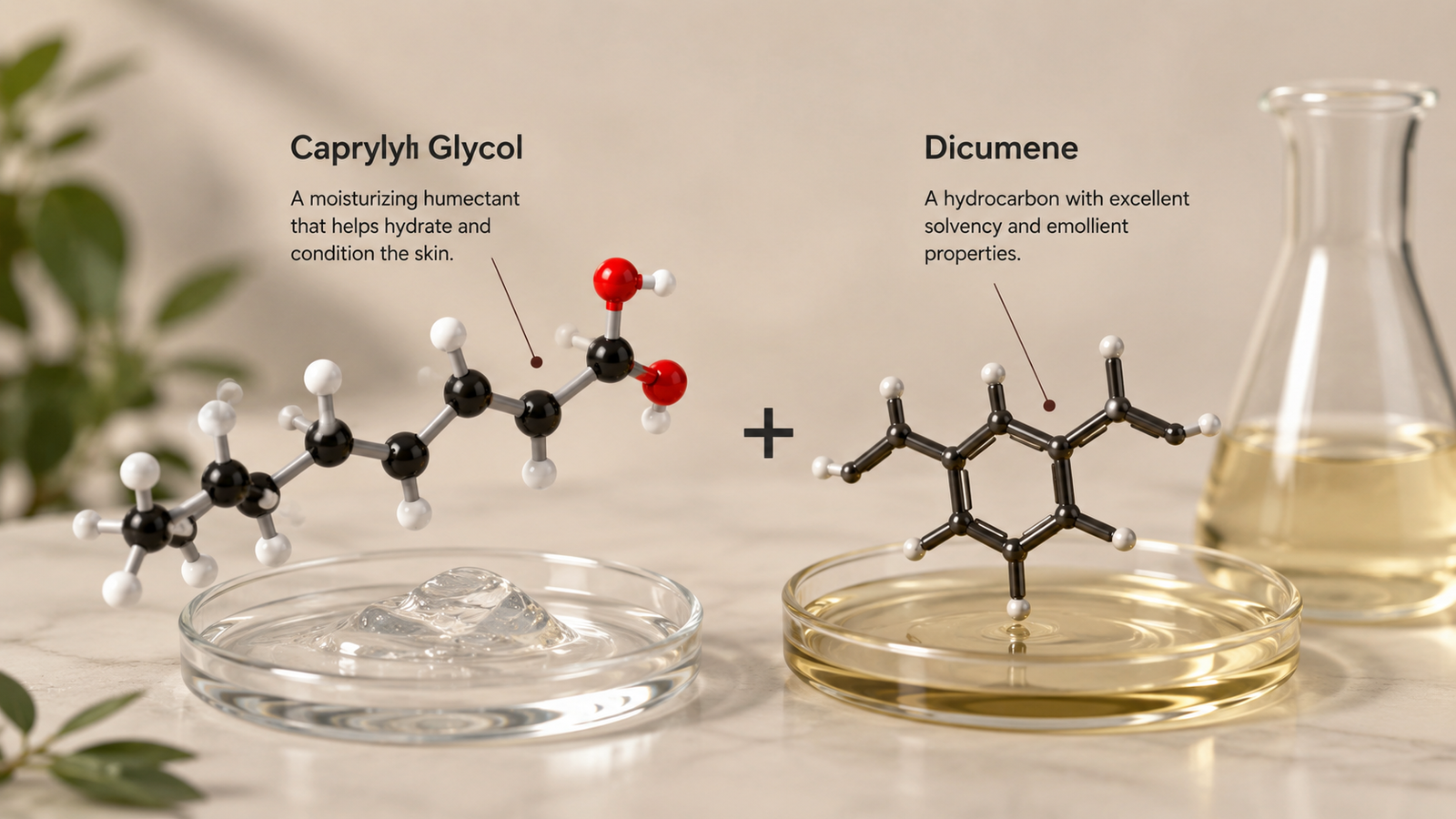
A moisturizing cream and an engineered plastic component may appear to have nothing in common. Yet both depend on specialty chemistry to achieve specific performance characteristics. This is where Caprylyl Glycol and Dicumene provide an interesting comparison.
These chemicals belong to completely different application environments. Caprylyl Glycol is a multifunctional ingredient widely associated with cosmetics and personal care. Dicumene, or 2,3-dimethyl-2,3-diphenylbutane, is primarily associated with polymer processing and specialized flame-retardant systems.
For formulators, manufacturers, chemical distributors, and procurement teams, understanding what these materials actually do is essential for selecting the right product for the right application.
Why Modern Products Depend on Specialty Chemistry
Manufacturing has moved beyond simply combining basic raw materials.
Today’s products are expected to satisfy multiple requirements simultaneously. A skincare cream should provide hydration while maintaining pleasant texture and microbiological stability. A plastic compound may need suitable mechanical properties while also meeting specific processing and fire-performance targets.
Specialty chemicals allow manufacturers to fine-tune these characteristics.
Rather than defining the entire formulation, they often perform focused functions that can significantly influence final performance.
Caprylyl Glycol Is More Than a Supporting Cosmetic Ingredient
Caprylyl Glycol is valued in personal-care formulation because it can perform several functions.
It belongs to the glycol family and is commonly incorporated into skincare, hair-care, cleansing, and cosmetic products.
Its major formulation roles can include:
- Humectant functionality
- Skin conditioning
- Sensory support
- Preservation enhancement
- Formulation optimization
This combination explains why multifunctional ingredients have become attractive to modern cosmetic developers.
How Caprylyl Glycol Supports Moisture Management
Hydration is one of the most familiar skincare claims, but developing an effective moisturizing formulation involves much more than simply adding water.
Humectants are commonly incorporated to help manage moisture.
Caprylyl Glycol possesses humectant characteristics and can contribute to the conditioned feeling consumers expect from modern skincare formulations.
Why Skin Feel Deserves Attention
Consumers often make rapid judgments about personal-care products based on how they feel.
Important sensory considerations include:
- Spreadability
- Absorption
- Smoothness
- Stickiness
- Residue
- After-feel
A product may contain impressive ingredients but still disappoint consumers if the application experience is poor.
Formulation Is About the Complete Experience
Modern formulators therefore evaluate ingredients not only according to individual technical functions but also according to how they contribute to the complete product.
This makes multifunctionality particularly valuable.
The Preservation-Supporting Side of Caprylyl Glycol
One of the most interesting characteristics of Caprylyl Glycol is its contribution to preservation strategies.
Many cosmetic products contain water, nutrients, and other ingredients that can make microbial control an important consideration.
Caprylyl Glycol is commonly incorporated as a preservative booster.
This means it can support an appropriately designed antimicrobial system rather than necessarily functioning as the sole preservative.
Why Preservation Cannot Depend on One Ingredient
Cosmetic preservation is influenced by numerous interconnected factors.
These include:
- Product pH
- Water activity
- Packaging
- Manufacturing hygiene
- Ingredient interactions
- Storage temperature
- Consumer handling
Manufacturers must therefore evaluate the finished formulation rather than making preservation decisions based solely on an individual ingredient.
Appropriate stability testing and preservative efficacy testing remain essential.
Where Caprylyl Glycol Fits Into Personal Care
The multifunctionality of Caprylyl Glycol makes it relevant to a wide range of products.
Possible applications include facial creams, lightweight moisturizers, body lotions, facial serums, cleansing products, shampoos, conditioners, deodorants, sunscreens, makeup, and other personal-care formulations.
Its exact role and concentration depend on the product design and compatibility with other ingredients.
Dicumene Tells a Very Different Chemical Story
Moving from a cosmetic laboratory to a plastics manufacturing facility completely changes the technical requirements.
Here, Dicumene becomes relevant.
Dicumene is commonly identified chemically as 2,3-dimethyl-2,3-diphenylbutane. It is an organic specialty chemical associated primarily with polymer applications.
Instead of contributing moisturization or cosmetic preservation, its value is connected to polymer modification and certain flame-retardant systems.
Why Polymer Manufacturers Use Specialty Additives
A base polymer does not always possess every characteristic required by its final application.
Manufacturers therefore combine polymers with additives to influence properties such as:
- Processing behavior
- Thermal performance
- Mechanical characteristics
- Stability
- Fire performance
- End-use functionality
Dicumene can become relevant when manufacturers need particular radical-based or synergistic effects within a polymer formulation.
Dicumene and Flame-Retardant Synergy
One notable application of Dicumene involves certain flame-retardant systems.
Flame-retardant polymer technology is rarely as simple as adding one chemical and obtaining universal protection. Formulations can involve multiple components working through complementary mechanisms.
What Does Synergistic Action Mean?
A synergist supports the performance of other ingredients within a system.
In suitable polymer formulations, Dicumene can therefore be incorporated to complement flame-retardant technologies.
Why More Additive Is Not Always Better
Polymer formulation requires balance.
Excessive quantities of additives can potentially influence processing, mechanical characteristics, appearance, or other material properties.
The objective is therefore to develop an optimized system rather than simply maximize additive concentration.
Where Can Dicumene Be Applied?
Potential applications for Dicumene span several polymer categories.
These can include:
- Polypropylene
- Polyethylene
- Polystyrene
- High-impact polystyrene
- Expandable polystyrene
- ABS
- SAN
- Masterbatch systems
- Modified thermoplastic compounds
Performance should be evaluated within each specific polymer system because processing conditions and additive interactions vary considerably.
Dicumene Has a Role Beyond Flame Performance
Another area of interest is polymer modification.
Dicumene has relevance to certain radical-driven chemical processes and may be associated with grafting, initiation, and cross-linking applications.
Why Is Polymer Modification Useful?
Instead of creating an entirely new polymer, manufacturers can sometimes modify an existing material to target particular characteristics.
Polymer modification may influence:
- Material compatibility
- Processing properties
- Thermal behavior
- Mechanical characteristics
- Functional performance
This gives polymer engineers greater flexibility when developing materials for specialized applications.
Caprylyl Glycol and Dicumene Compared
| Area | Caprylyl Glycol | Dicumene |
| Main industry | Cosmetics and personal care | Plastics and polymers |
| Core role | Multifunctional formulation ingredient | Specialty polymer additive |
| Key functionality | Humectancy and preservation support | Synergistic and modification functions |
| Common applications | Creams, serums, shampoos | PP, PE, PS, ABS |
| Performance target | Moisture, conditioning, stability | Polymer functionality |
| Typical users | Cosmetic formulators | Polymer compounders |
This comparison highlights an important point: Caprylyl Glycol and Dicumene cannot replace one another. Their chemistry and applications are fundamentally different.
Why Chemical Specifications Matter as Much as Chemical Names
Knowing which chemical is required is only the beginning of responsible sourcing.
Industrial manufacturers need predictable quality because variations in raw materials can influence production performance.
When evaluating Caprylyl Glycol or Dicumene, buyers should review:
- Purity and assay
- Technical specifications
- Certificate of Analysis
- Safety Data Sheet
- Batch consistency
- Packaging
- Storage recommendations
- Regulatory documentation
- Supplier technical support
- Supply capability
A dependable supplier should be able to provide clear documentation and consistent material specifications.
Frequently Asked Questions
What is Caprylyl Glycol?
Caprylyl Glycol is a multifunctional glycol commonly incorporated into cosmetic and personal-care formulations.
Why is Caprylyl Glycol used in skincare?
It can support moisturization, conditioning, sensory properties, and cosmetic preservation strategies.
Is Caprylyl Glycol a humectant?
Yes. It possesses humectant properties that can contribute to moisture management in suitable formulations.
Does Caprylyl Glycol replace preservatives?
Not necessarily. It is frequently used as a preservative booster alongside other suitable preservation components.
Can Caprylyl Glycol be used in hair products?
Yes. Applications may include shampoos, conditioners, and other suitable hair-care formulations.
What is Dicumene?
Dicumene is an organic specialty chemical commonly identified as 2,3-dimethyl-2,3-diphenylbutane.
What is Dicumene used for?
Its applications are primarily associated with polymers, including certain flame-retardant and modification systems.
Can Dicumene be used in polypropylene?
Yes. Polypropylene is one of the polymer systems associated with Dicumene applications.
Does Dicumene work with polystyrene?
It can be relevant to certain polystyrene, high-impact polystyrene, and related formulations.
Are Caprylyl Glycol and Dicumene the same?
No. They have different chemical structures, functions, markets, and industrial applications.
Why should chemical buyers request a Certificate of Analysis?
It provides batch-specific quality information that helps buyers verify whether supplied material meets required specifications.
Why These Chemicals Represent a Bigger Industry Trend
The significance of Caprylyl Glycol and Dicumene extends beyond their individual applications.
Both illustrate how manufacturing is becoming increasingly specialized.
Cosmetic companies want multifunctional ingredients that help them build sophisticated formulations. Polymer companies want additives that allow greater control over material characteristics.
The common factor is precision.
Manufacturers increasingly want to understand exactly what each ingredient contributes and whether it consistently performs according to specification.
https://newsgrow.blogspot.com/2026/08/ethylhexylglycerin-emerges-as-key.html