
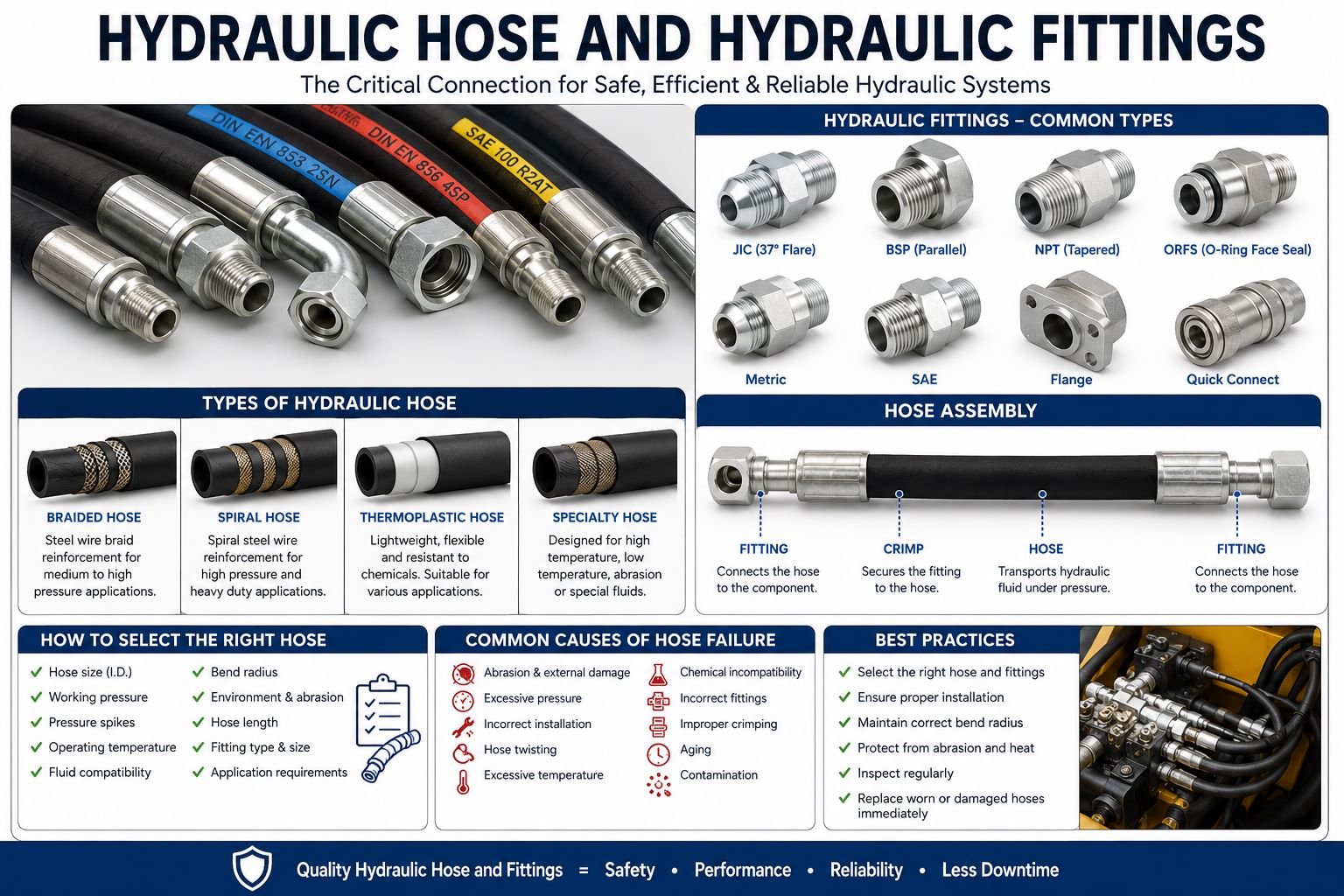
A hydraulic machine can only perform reliably when pressurized fluid reaches the right component at the right pressure. Pumps may generate flow and cylinders may create movement, but the connection between them is equally important. That connection largely depends on Hydraulic Hose and Hydraulic Fittings.
From construction sites and manufacturing plants to farms and mining operations, hydraulic connections operate continuously under pressure, vibration, movement, heat, and environmental exposure. A small problem with a hose or fitting can quickly become a larger issue involving leakage, downtime, reduced efficiency, or equipment damage.
So, what should you know before selecting hydraulic hoses and fittings? This practical guide explains the key considerations.
How Hydraulic Hose Supports Fluid Power Systems
A Hydraulic Hose provides a flexible passage for hydraulic fluid. Unlike rigid tubing, it can accommodate movement between machine components, making it especially useful in mobile and articulated equipment.
Hydraulic hoses typically contain three structural elements:
- An inner tube that carries hydraulic fluid
- Reinforcement that provides pressure resistance
- An outer cover that protects against external damage
Reinforcement may include textile fibers, braided steel wire, spiral steel wire, or specialized materials depending on pressure and application requirements.
The construction is important because a hose must simultaneously remain flexible and withstand considerable internal force.
Why Hydraulic Fittings Are More Than Simple Connectors
Hydraulic Fittings join hoses to components throughout the hydraulic circuit.
These components can include pumps, cylinders, motors, valves, filters, manifolds, and other fluid lines.
The connection must remain secure while machinery experiences vibration, pressure cycles, and movement.
Several fitting standards are commonly encountered, including:
- JIC
- BSP
- NPT
- SAE
- ORFS
- Metric
- Flange
- Quick-connect couplings
Each standard may have different threads, sealing surfaces, and connection characteristics.
Using a fitting because it “looks right” is therefore a risky approach.
Why One Hydraulic Hose Cannot Suit Every Machine
Consider the difference between a hydraulic line inside factory equipment and one installed on an excavator.
The factory hose might operate in a relatively controlled environment. An excavator hose could experience mud, sunlight, continuous movement, impact, abrasion, vibration, and changing temperatures.
Their requirements are clearly different.
Common hose constructions include:
Wire Braided Hose
Wire braid provides reinforcement while retaining useful flexibility. These hoses are widely used across general industrial and mobile hydraulic applications.
Spiral Reinforced Hose
Multiple spiral-wire reinforcement layers are typically associated with demanding high-pressure and high-impulse applications.
Thermoplastic Hose
Thermoplastic constructions may provide advantages where lightweight design, chemical resistance, or compact routing is required.
Selecting Hydraulic Hose should therefore begin with the application rather than simply the hose appearance.
Seven Questions to Ask Before Choosing a Hydraulic Hose
A practical selection process starts by answering seven questions:
- What fluid will travel through the hose?
- What is the required flow rate?
- What maximum pressure will occur?
- What temperatures will the hose experience?
- How much movement will occur?
- What fitting connections are required?
- What external conditions will affect the hose?
Answering these questions helps narrow down the appropriate construction, dimensions, pressure capability, and materials.
Why Internal Diameter Matters More Than It Seems
A common selection mistake is focusing on external hose dimensions while overlooking the internal diameter.
Fluid needs sufficient internal space to move efficiently.
If the Hydraulic Hose is undersized, fluid velocity may become excessive. This can contribute to pressure losses, additional heat generation, and reduced efficiency.
An unnecessarily oversized hose can create other disadvantages, including additional weight, cost, and space requirements.
| Hose Condition | Possible Result |
| Diameter too small | Higher velocity and pressure loss |
| Excessive length | Increased flow resistance |
| Tight bending | Mechanical stress |
| Wrong material | Fluid incompatibility |
| Poor routing | Abrasion and premature damage |
Correct sizing should be based on system requirements and technical specifications.
Understanding Hydraulic Pressure Correctly
Hydraulic systems can operate under substantial pressure, but pressure may also change rapidly during operation.
For example, sudden load changes or valve movements can create pressure fluctuations.
The selected hose assembly must be suitable for the maximum expected working conditions.
Importantly, the pressure capability of a complete assembly is not determined only by the Hydraulic Hose.
Hydraulic Fittings, adapters, and other components also have operating limitations.
The lowest-rated component can determine the acceptable pressure capability of the assembly.
Why Temperature Should Never Be an Afterthought
Temperature affects hydraulic hose materials over time.
Excessively hot hydraulic fluid may accelerate deterioration of the inner tube. External heat from engines, exhaust systems, furnaces, or manufacturing processes can damage the hose cover.
Cold environments can create different challenges by affecting flexibility.
Both fluid temperature and ambient temperature should therefore be considered.
Where excessive heat cannot be avoided, heat shielding or alternative routing may help protect the assembly.
The Wrong Fluid Can Damage the Right Hose
A high-quality hose is not automatically compatible with every hydraulic fluid.
Modern machinery may operate with petroleum-based hydraulic oils, synthetic formulations, biodegradable fluids, water-glycol solutions, or specialized media.
If the inner-tube material is incompatible with the fluid, deterioration can occur internally before obvious external damage becomes visible.
Potential symptoms include:
- Swelling
- Softening
- Hardening
- Cracking
- Internal deterioration
- Seal damage
- Leakage
Always verify fluid compatibility using reliable manufacturer documentation.
Good Routing Can Add Years to Hydraulic Reliability
Correct hose routing is one of the simplest ways to reduce unnecessary wear.
A hose should have enough length to accommodate equipment movement but should not be excessively loose.
Avoid twisting the hose during installation.
Sharp bends should also be prevented because bending below the manufacturer’s specified minimum radius can place additional stress on the reinforcement.
Another major consideration is abrasion.
A Hydraulic Hose continuously rubbing against a metal bracket, machine frame, or another hose can gradually lose its protective cover.
Improved routing, clamps, guards, and protective sleeves can help control these risks.
What Your Damaged Hydraulic Hose May Be Telling You
Hose damage can sometimes act like a diagnostic tool.
A worn section on one side may indicate repeated rubbing. Damage close to the fitting can point toward excessive bending or tension. A hardened or cracked cover could suggest temperature exposure or aging.
Instead of immediately throwing away a failed hose, maintenance teams should consider why it failed.
Correcting the underlying problem may prevent repeated failures and unnecessary maintenance expenses.
Why Hydraulic Fittings Leak Even When They Feel Tight
One of the most common misconceptions is that every leaking fitting needs additional tightening.
Leakage can have several causes, including:
- Damaged seals
- Incorrect fitting combinations
- Contaminated sealing surfaces
- Damaged threads
- Corrosion
- Incorrect assembly
- Excessive vibration
- Worn fitting seats
Overtightening certain Hydraulic Fittings can damage threads or sealing surfaces.
Proper inspection and diagnosis should therefore come before additional tightening.
When Should Hydraulic Hose Be Replaced?
There is no single replacement interval that applies to every hydraulic hose.
Service life depends on operating hours, pressure cycles, temperature, movement, environmental exposure, installation quality, and maintenance practices.
However, certain warning signs require attention:
- Significant cracking
- Fluid leakage
- Severe abrasion
- Exposed reinforcement
- Blistering
- Crushed sections
- Damaged fittings
- Corrosion
- Unusual deformation
- Heat damage
Preventive inspection can identify these conditions before an unexpected breakdown occurs.
A Simple Hydraulic Maintenance Checklist
Maintenance teams can improve reliability by creating a consistent inspection routine.
Check hose routing and look for unwanted movement. Examine connection points for fluid leakage. Inspect outer covers for cuts and abrasion. Verify that protective sleeves remain correctly positioned.
Also monitor areas close to heat sources and locations where hoses bend during machine operation.
High-use and severe-duty equipment may require more frequent inspections than machinery operating occasionally in controlled environments.
Hydraulic Safety Is Not Optional
High-pressure hydraulic systems require appropriate safety procedures.
A pinhole leak can release a narrow stream of fluid at extremely high pressure. Never use bare hands to locate suspected hydraulic leaks.
Pressurized hydraulic fluid can penetrate the skin and cause serious injection injuries.
Machinery should be isolated and safely depressurized before repair. Appropriate protective equipment and approved maintenance procedures should always be followed.
Frequently Asked Questions
1. What is the main function of Hydraulic Hose?
Hydraulic Hose transports hydraulic fluid between components while providing flexibility for equipment movement and vibration.
2. Why are Hydraulic Fittings necessary?
Hydraulic Fittings provide secure connections between hoses, pumps, valves, cylinders, motors, and other hydraulic components.
3. Which hose is suitable for high-pressure equipment?
The correct choice depends on working pressure, impulse conditions, temperature, fluid, hose size, and manufacturer specifications.
4. Can any hydraulic fitting fit any hose?
No. Fittings must be compatible with the hose construction, dimensions, assembly method, pressure requirements, and connection standard.
5. What is the most common reason for hose damage?
Abrasion is a frequent problem, although heat, excessive pressure, incorrect routing, aging, and improper installation can also cause damage.
6. Does hose length affect hydraulic performance?
Yes. Excessive hose length can contribute to pressure loss and can complicate routing.
7. Why should hydraulic hose not be twisted?
Twisting places unwanted stress on reinforcement and may reduce hose reliability and service life.
8. What causes Hydraulic Fittings to leak?
Damaged seals, incorrect threads, contamination, corrosion, improper installation, or damaged sealing surfaces can cause leakage.
9. Can a damaged hydraulic hose be repaired?
Critical damage generally requires professional evaluation and appropriate hose assembly replacement rather than improvised repair.
10. How can hydraulic hose life be improved?
Correct selection, professional installation, proper routing, abrasion protection, temperature management, and regular inspection can improve reliability.
https://newsgrow.blogspot.com/2026/08/industrial-hose-technology-evolves-as.html
https://freeseobacklinks.info/hydraulic-hose-and-hydraulic-fittings-what-every-industry-should-know/