
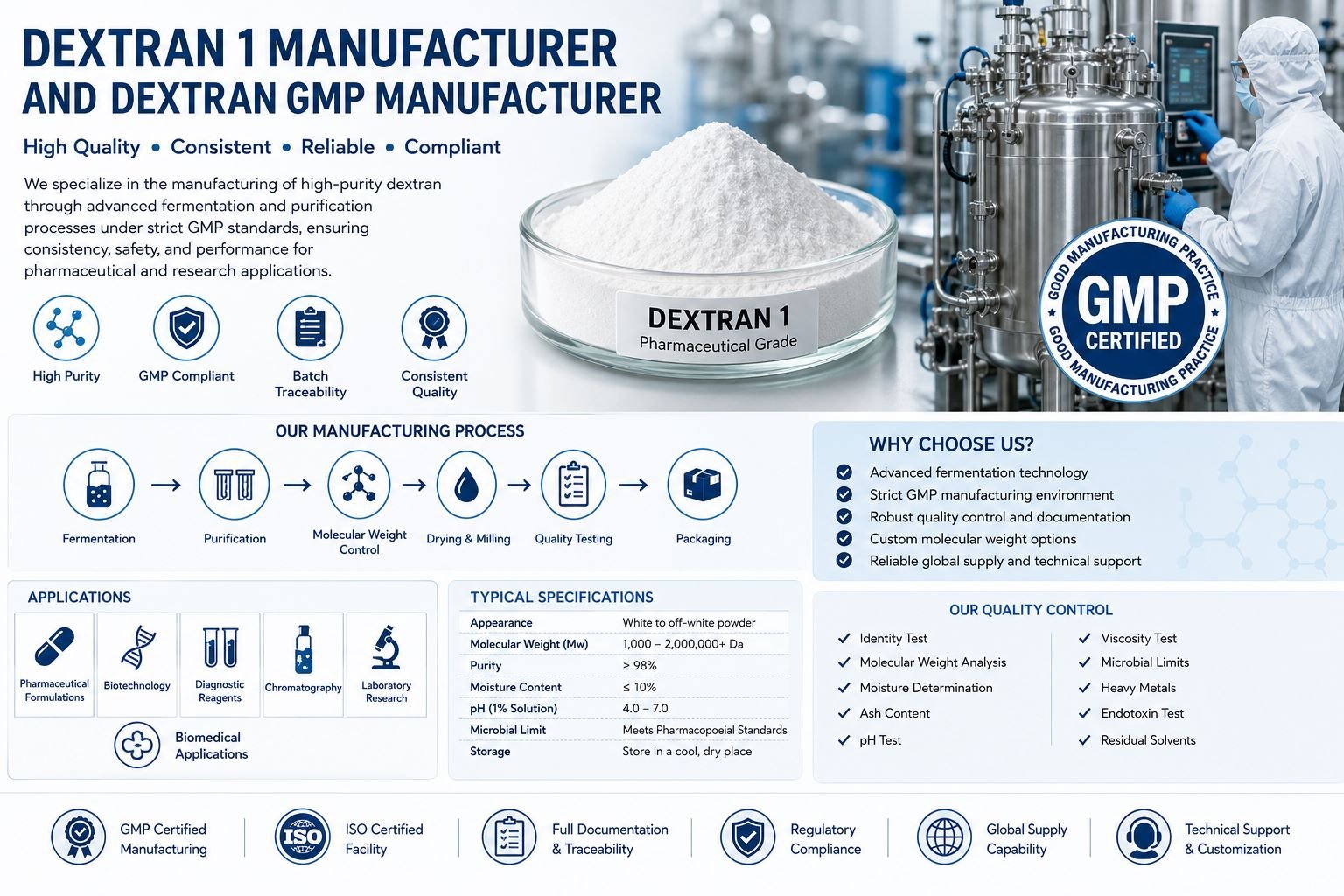
As pharmaceutical, biotechnology, diagnostic, and life-science organizations strengthen their raw-material qualification programs, dextran manufacturing is gaining greater attention across regulated and research-focused supply chains. Companies are increasingly seeking a dependable dextran 1 manufacturer capable of providing consistent specifications, controlled production, analytical documentation, and reliable commercial supply.
At the same time, demand for an experienced dextran GMP manufacturer is becoming increasingly relevant for applications where Good Manufacturing Practice, traceability, documentation, and structured quality management are essential.
Industry procurement strategies are consequently shifting away from supplier selection based primarily on price. Technical capability, manufacturing consistency, quality systems, analytical expertise, and long-term supply reliability are becoming central considerations.
Dextran Manufacturing Gains Importance Across Life Sciences
Dextran is a branched polysaccharide primarily composed of glucose units. It is commonly produced through microbial fermentation followed by downstream purification and processing.
Its characteristics can vary according to manufacturing processes and targeted product specifications.
Important quality parameters may include:
- Molecular weight
- Molecular weight distribution
- Purity
- Solubility
- Viscosity
- Moisture
- Microbial characteristics
- Physical properties
- Relevant impurities
These characteristics make supplier qualification particularly important.
A professional dextran 1 manufacturer should be capable of clearly defining product specifications and demonstrating consistency across production batches.
Controlled Fermentation Supports Consistent Production
Commercial dextran manufacturing generally begins with carefully controlled microbial fermentation.
Process Control Starts at the Production Stage
Suitable microorganisms are cultivated using an appropriate carbohydrate-containing substrate under defined manufacturing conditions.
Important parameters can include:
- Temperature
- pH
- Substrate concentration
- Nutrient conditions
- Fermentation duration
- Culture environment
Maintaining control over these parameters can help manufacturers achieve consistent production outcomes.
For pharmaceutical and biotechnology customers, understanding these controls can form an important part of manufacturer evaluation.
Advanced Purification Remains Central to Dextran Quality
Following fermentation, the resulting mixture can contain the desired dextran together with microbial components, residual nutrients, proteins, salts, and other process-related materials.
Manufacturers therefore need suitable downstream processing strategies.
Potential stages can include filtration, precipitation, separation, washing, concentration, membrane processing, additional purification, drying, and final powder processing.
Purity and Consistency Work Together
A manufacturer must not only achieve a targeted purity level but also reproduce the required characteristics consistently.
This is particularly relevant when companies are evaluating a dextran GMP manufacturer for pharmaceutical supply.
Quality Cannot Depend on Final Testing Alone
Modern quality systems emphasize controlling manufacturing processes rather than relying exclusively on testing finished batches.
Final testing confirms quality specifications, while manufacturing controls help create the conditions necessary to achieve them consistently.
Molecular Weight Becomes a Critical Purchasing Specification
Molecular weight remains one of the most significant technical considerations in dextran procurement.
Different molecular characteristics can influence:
- Viscosity
- Solubility
- Diffusion behavior
- Processing characteristics
- Functional performance
As a result, buyers increasingly require more detailed molecular information from their dextran 1 manufacturer.
Molecular weight distribution can also be relevant because polymer materials generally contain a range of molecular sizes.
Reliable characterization therefore provides customers with a clearer understanding of the material being purchased.
GMP Standards Strengthen Manufacturing Confidence
Good Manufacturing Practice provides a systematic quality framework for manufacturing operations.
For customers working in regulated environments, a qualified dextran GMP manufacturer can offer additional controls across production and quality management.
| GMP Area | Quality Objective |
| Raw Materials | Control incoming material quality |
| Personnel | Maintain appropriate training |
| Equipment | Support controlled manufacturing |
| Production | Follow documented procedures |
| Cleaning | Manage contamination risks |
| Testing | Confirm established specifications |
| Documentation | Maintain traceable records |
| Deviations | Investigate unexpected events |
| Change Control | Assess manufacturing modifications |
| Batch Release | Review quality before distribution |
GMP therefore represents a broader manufacturing philosophy rather than a single finished-product test.
Pharmaceutical Companies Increase Focus on Traceability
Traceability has become an important element of raw-material supply-chain management.
When quality questions arise, companies need the ability to identify relevant information associated with individual production batches.
Appropriate batch records can help connect finished products with manufacturing activities, testing information, and other relevant quality documentation.
A reliable dextran GMP manufacturer should maintain appropriate traceability within its quality system.
For pharmaceutical customers, this can support investigations, supplier management, and ongoing quality oversight.
Analytical Testing Remains Essential
Analytical testing helps determine whether dextran meets established product specifications.
Testing programs can vary depending on the grade and intended use.
Potential parameters include:
- Identification
- Appearance
- Molecular weight
- Molecular weight distribution
- Moisture
- Solubility
- pH
- Viscosity
- Microbial characteristics
- Relevant impurities
A capable dextran 1 manufacturer should maintain suitable analytical capabilities and clearly communicate product specifications to customers.
Documentation Takes Center Stage in Supplier Qualification
Pharmaceutical buyers increasingly expect documentation to accompany technical performance.
Depending on the product and application, suppliers may provide:
- Certificate of Analysis
- Product specification
- Safety Data Sheet
- Batch information
- Storage recommendations
- Quality statements
- Manufacturing information
- Retest or expiry information
- Relevant regulatory documentation
The Certificate of Analysis remains particularly important because it typically provides batch-specific analytical information.
However, companies increasingly evaluate such documentation alongside the manufacturer’s complete quality-management approach.
Dextran Supports Diverse Scientific Applications
Depending on grade, specifications, and suitability, dextran can have relevance across multiple areas of life sciences.
Potential applications include:
- Pharmaceutical development
- Biotechnology processes
- Diagnostic research
- Biomedical applications
- Laboratory reagents
- Analytical processes
- Chromatography-related applications
- Specialized formulation research
Manufacturers and buyers must ensure that the selected grade matches the intended application.
Material suitable for general research should not automatically be considered suitable for regulated pharmaceutical manufacturing.
GMP and Standard Dextran Address Different Requirements
Different applications require different levels of manufacturing control.
| Consideration | Standard Dextran | GMP Dextran |
| Research Use | Common | Available where needed |
| Documentation | Varies | More structured |
| Traceability | Supplier dependent | Strongly emphasized |
| Manufacturing Records | Variable | Controlled |
| Change Management | May vary | Formal process |
| Deviations | General approach | Documented investigation |
| Quality Review | Variable | Structured |
| Regulated Applications | Requires assessment | Often more appropriate |
Companies should determine the required standard based on intended use, regulatory expectations, and internal quality requirements.
Supply Capacity Becomes Part of Manufacturer Selection
Pharmaceutical projects often begin with small development quantities before progressing toward larger commercial requirements.
This creates another important question: can the supplier grow with the customer?
Companies evaluating a dextran 1 manufacturer are increasingly considering:
- Manufacturing capacity
- Scale-up capability
- Lead times
- Batch consistency
- Quality systems
- Technical support
- Documentation availability
- Packaging capabilities
- Supply continuity
- Commercial production readiness
Evaluating these factors early can help organizations establish more sustainable supply relationships.
Frequently Asked Questions
What is dextran?
Dextran is a glucose-based polysaccharide commonly manufactured through microbial fermentation followed by purification and processing.
What does a dextran 1 manufacturer do?
A dextran 1 manufacturer produces and supplies dextran according to defined molecular, purity, physical, and quality specifications.
What is a dextran GMP manufacturer?
A dextran GMP manufacturer produces dextran within an applicable Good Manufacturing Practice quality and manufacturing framework.
Why is GMP important for dextran?
GMP supports controlled production, documentation, traceability, personnel training, deviation management, testing, and quality review.
Why does molecular weight matter?
Molecular weight can influence dextran’s viscosity, solubility, diffusion, processing behavior, and functional characteristics.
How is dextran manufactured?
Commercial production commonly involves fermentation followed by separation, purification, downstream processing, drying, testing, and packaging.
Is every dextran product pharmaceutical grade?
No. Product suitability depends on specifications, purity, manufacturing standards, testing, documentation, and intended application.
What documentation should buyers request?
Buyers may request specifications, Certificates of Analysis, Safety Data Sheets, storage information, batch details, and relevant quality documentation.
What is batch traceability?
Batch traceability connects finished material with relevant production, analytical, and quality information.
Does every project require GMP dextran?
No. The appropriate standard depends on intended application, regulatory requirements, and organizational quality expectations.
How should a dextran manufacturer be evaluated?
Review technical expertise, specifications, quality systems, analytical capabilities, documentation, traceability, capacity, and supply reliability.
Why is long-term manufacturing capacity important?
Adequate capacity helps suppliers support projects as requirements move from development quantities toward larger commercial volumes.
https://newsgrow.blogspot.com/2026/08/the-science-behind-reliable-dextran-gmp.html
https://newsgrow.blogspot.com/2026/08/new-procurement-priorities-drive.html