
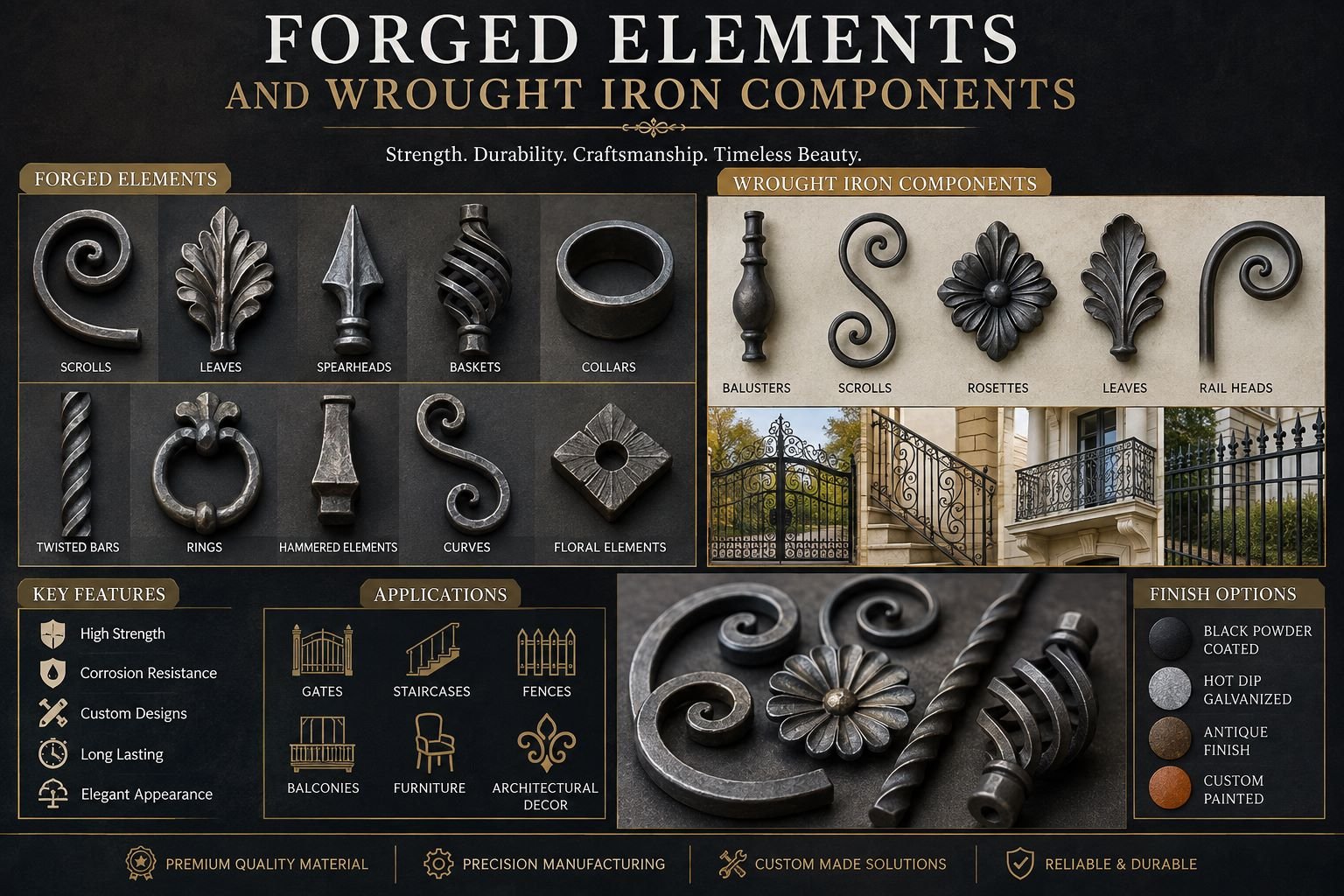
Metal has always occupied a special place in architecture. It can provide security, carry structural loads, survive demanding environments, and at the same time become an artistic feature. Few categories demonstrate this versatility better than Forged Elements and Wrought Iron Components.
Look closely at an ornamental gate, luxury staircase, decorative balcony, garden fence, or handcrafted-style furniture piece. The visual appeal often comes from individual metal details—scrolls, baskets, leaves, collars, flowers, balusters, and railheads—carefully arranged into a complete composition.
Modern technology has made these elements easier to reproduce consistently without eliminating the character associated with traditional metal craftsmanship. For architects, fabricators, contractors, and designers, understanding how these components are created can lead to better design and purchasing decisions.
A Piece of Metal Has to Go Through a Journey
Before becoming an elegant scroll or decorative basket, metal begins as relatively simple raw material.
The transformation involves controlled shaping.
Forged Elements are generally created by applying compressive forces to metal. Depending on the process, the workpiece may first be heated and then hammered, pressed, rolled, twisted, or formed using dedicated tooling.
The production journey may include:
- Selecting the metal grade
- Cutting raw material
- Heating when required
- Forming or forging
- Trimming
- Correcting dimensions
- Cleaning the surface
- Applying a finish
- Inspecting the finished component
Every stage influences the final result.
A beautifully shaped product with incorrect dimensions can create fabrication problems, just as a precisely manufactured component without adequate surface protection can deteriorate prematurely outdoors.
Forging Is About More Than Creating a Shape
It is easy to think of forging simply as a way of bending or shaping metal. The process has deeper engineering significance.
Controlled deformation can influence the internal grain flow of the material. With appropriate design, temperature, material selection, and manufacturing control, forged parts can achieve useful combinations of strength and toughness.
This is why Forged Elements are not limited to decorative applications.
Forging technologies are also widely relevant to engineering components where mechanical performance is important.
For architectural metalwork, however, the process provides an additional benefit: it can create shapes that give otherwise plain structures considerable personality.
Why Wrought Iron Components Never Really Went Out of Style
Architectural trends continuously change, yet ornamental ironwork has remained relevant for generations.
The reason is adaptability.
Wrought Iron Components can look highly traditional when arranged into detailed floral patterns. The same category of components can appear contemporary when designers use cleaner curves, geometric repetition, and minimal decoration.
Typical products include:
- Scrolls
- Balusters
- Decorative baskets
- Leaves
- Flowers
- Rosettes
- Collars
- Railheads
- Spear points
- Ornamental panels
These individual elements act almost like building blocks for metal fabricators.
Different combinations can produce entirely different finished designs.
One Material Term That Buyers Should Understand
There is an important technical detail surrounding the phrase “wrought iron.”
Traditional wrought iron is a specific low-carbon iron material historically manufactured with characteristic slag inclusions. It was valued because it could be repeatedly worked into decorative shapes.
Many modern Wrought Iron Components, however, are actually manufactured from mild steel.
This does not automatically indicate poor quality. Mild steel is widely used because it provides practical characteristics such as good formability, weldability, availability, and cost efficiency.
The important point is transparency.
When material composition matters, buyers should request the actual material specification rather than assuming that a product name describes its precise metallurgy.
Where Forged Metal Makes Architecture More Interesting
A major strength of ornamental metalwork is its ability to improve everyday architectural structures.
Gates That Do More Than Provide Security
A plain metal gate can perform its security function perfectly well. Add forged scrolls, leaves, baskets, decorative bars, and customized ornaments, and the same gate becomes part of the property’s identity.
Forged Elements can support classical, luxury, rustic, traditional, or contemporary entrance designs.
Staircases That Become Interior Features
Staircases occupy significant visual space inside many buildings.
Decorative balusters and ornamental metal inserts can transform them from functional circulation structures into important interior design features.
Balconies That Define a Façade
Repeated balcony railings can strongly influence the appearance of apartments, villas, hotels, and resorts.
Consistent Wrought Iron Components allow designers to repeat patterns across multiple balconies while maintaining a unified architectural style.
Gardens That Gain Character
Pergolas, garden gates, benches, fencing, screens, and landscape structures can all benefit from ornamental metal details.
Forged Elements vs Wrought Iron Components
The categories are related, but understanding their typical focus is useful.
| Aspect | Forged Elements | Wrought Iron Components |
| Main concept | Metal shaped through forging | Decorative metal components |
| Primary value | Strength, shape and versatility | Ornamentation and design |
| Applications | Functional and decorative | Mainly architectural |
| Typical products | Bars, rings, fittings, scrolls | Balusters, baskets, flowers, panels |
| Customization | High | Very high |
| Bulk manufacturing | Possible | Possible |
| Finishing | Functional or decorative | Usually protective and decorative |
A single architectural project can easily use both categories.
Customization Is Where Things Become Interesting
Catalog products are convenient, but custom manufacturing gives designers far greater freedom.
Imagine restoring an old villa where several original railing ornaments are missing. A manufacturer may be able to reproduce components based on surviving samples.
Alternatively, a new hotel might require decorative metal patterns designed exclusively for its architectural concept.
Custom Forged Elements can be developed using CAD drawings, sketches, dimensions, physical samples, or approved reference designs.
From Idea to Finished Component
The development process typically involves:
- Understanding the application
- Selecting suitable material
- Creating technical specifications
- Developing required tooling
- Manufacturing a sample
- Checking dimensions
- Approving the design
- Beginning production
For large projects, prototype approval can prevent expensive mistakes during mass manufacturing.
Why the Finish Is Just as Important as the Metal
Outdoor metal has an unavoidable enemy: corrosion.
Rain, moisture, humidity, industrial pollution, and coastal salts can attack inadequately protected ferrous surfaces.
Several protective options are available for Wrought Iron Components:
- Galvanizing
- Powder coating
- Industrial paint systems
- Electroplating
- Blackening
- Polishing
- Specialized protective coatings
There is no single finish suitable for every project.
Indoor decorative railing and coastal outdoor fencing face completely different environmental conditions. The coating system should therefore match the actual installation environment.
Small Dimensional Errors Can Become Big Problems
Consider a fabricator producing 200 identical railing panels.
Each panel requires six decorative components. That means 1,200 pieces must fit correctly.
If the components vary significantly in dimensions, workers may need to bend, grind, trim, or reposition them manually.
This is why quality control for Forged Elements matters even when the products are primarily decorative.
Important Quality Checks Include
Manufacturers should consider:
- Material verification
- Dimensional accuracy
- Tolerances
- Surface condition
- Pattern consistency
- Cracks or defects
- Straightness
- Coating coverage
- Final appearance
Consistency can save substantial fabrication time on large projects.
Ready-Made Components Can Change Workshop Economics
Creating every decorative piece manually requires skilled labor and time.
Ready-made Wrought Iron Components provide fabricators with another option.
A workshop can purchase standardized baskets, scrolls, collars, leaves, and railheads before assembling them into custom designs.
This approach can offer:
- Shorter manufacturing times
- Better pattern consistency
- Less repetitive manual forming
- Easier quantity planning
- Faster repeat orders
- Greater design flexibility
- More efficient workshop operations
The final structure can still be highly customized because fabricators decide how individual elements are arranged.
Buying Forged Components Requires More Than Comparing Prices
The lowest-priced component is not necessarily the most economical option.
Poor dimensional accuracy can increase fabrication costs. Inadequate coatings can create maintenance expenses. Incorrect materials can affect performance.
Before purchasing Forged Elements, buyers should confirm:
- Material grade
- Dimensions
- Tolerances
- Manufacturing method
- Surface finish
- Customization capability
- Sample availability
- Quality inspection
- Packaging
- Production capacity
A clear technical specification creates a much stronger basis for comparing suppliers.
FAQ About Forged Elements and Wrought Iron Components
What exactly are Forged Elements?
Forged Elements are metal components shaped using controlled compressive forces such as pressing, hammering, rolling, or die forging.
What are Wrought Iron Components used for?
They are commonly incorporated into gates, staircases, balconies, fencing, railings, furniture, garden structures, and architectural decoration.
Is wrought iron the same as mild steel?
No. They are technically different materials, although mild steel is frequently used for modern wrought-style decorative products.
Are forged components strong?
Properly designed and manufactured forged components can offer excellent strength, toughness, and mechanical reliability.
Can decorative components be customized?
Yes. Manufacturers can customize dimensions, shapes, profiles, patterns, thicknesses, textures, and finishes.
Are Forged Elements suitable for exterior applications?
Yes, provided the material and protective finishing system are appropriate for the environment.
Why is galvanizing used?
Galvanizing applies a protective zinc coating that helps protect steel against corrosion.
Can wrought-style components suit modern architecture?
Yes. Simple geometric forms and minimal ornamental patterns can complement contemporary architectural designs.
Can manufacturers reproduce an existing decorative component?
Often yes. Physical samples, accurate drawings, or detailed specifications can support reproduction, depending on manufacturing capabilities.
What makes a good supplier?
Consistent materials, accurate dimensions, reliable manufacturing, customization capability, quality control, appropriate finishing, and dependable delivery are key factors.
https://gosarkarijobs.com/why-wrought-iron-components-are-redefining-modern-decorative-iron-work/
https://shopnets.com/a-complete-guide-to-wrought-iron-components-for-beautiful-decorative-iron-work/
https://newsgrow.blogspot.com/2026/08/wrought-iron-components-see-renewed.html
https://newsgrow.blogspot.com/2026/08/from-functional-railings-to-statement.html