
Industrial hose technology is taking on greater importance as construction companies, machinery manufacturers, mining operators, and infrastructure contractors seek components capable of performing under increasingly demanding conditions.
Two categories attracting particular attention are Hydraulic Hose China products used to transfer pressurized hydraulic fluids and Concrete Pump Hose solutions developed for moving abrasive concrete mixtures. Rising expectations for machinery uptime and efficient material handling are pushing buyers to examine hose quality more carefully than ever.
Rather than treating hoses as basic replacement parts, industrial users are increasingly considering them critical components that can influence equipment performance, maintenance requirements, and project productivity.
Heavy Equipment Growth Creates Stronger Demand for Hydraulic Hose
Hydraulic power remains central to construction and industrial machinery.
Excavators rely on hydraulics to control booms and buckets. Cranes use hydraulic systems for lifting and positioning. Agricultural equipment uses hydraulic pressure for steering and attachments, while industrial facilities depend on hydraulic presses and material-handling systems.
The Hydraulic Hose China sector serves these applications by manufacturing flexible connections capable of transporting hydraulic fluid between pumps, cylinders, valves, motors, and related components.
Unlike rigid piping, hoses can move with machinery while accommodating vibration and changes in equipment position.
Hose Construction Becomes an Important Purchasing Factor
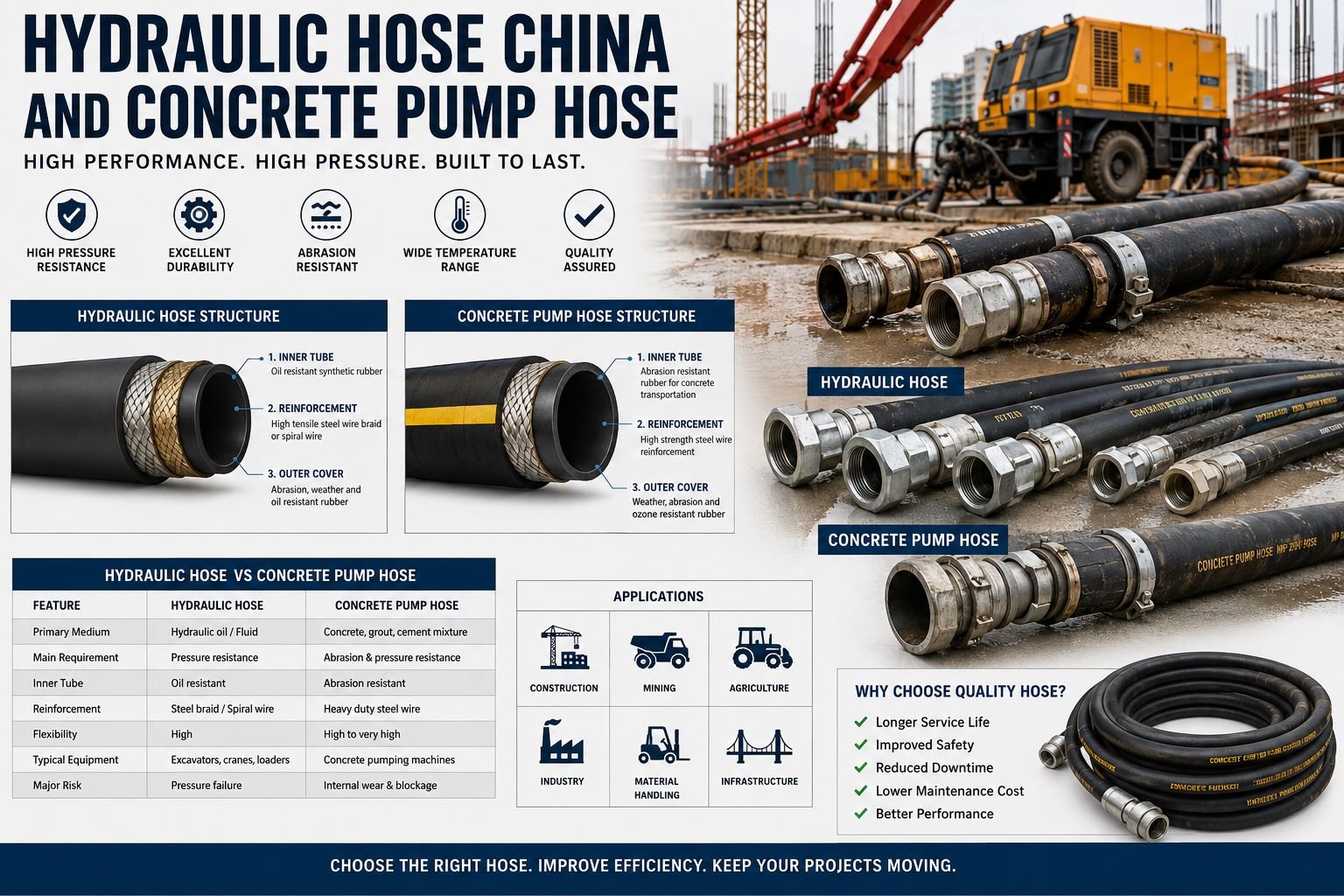
Industrial buyers are paying closer attention to what exists beneath the outer surface of a hydraulic hose.
Inner Tube Must Match the Hydraulic Medium
The inner tube directly contacts hydraulic fluid. Material compatibility is therefore essential.
A suitable compound must maintain performance within the intended fluid and temperature conditions.
Reinforcement Helps Manage Internal Pressure
Around the tube sits a reinforcement structure designed to provide strength.
Depending on the application, Hydraulic Hose China manufacturers may use textile reinforcement, steel-wire braid, or multiple spiral-wire layers.
The appropriate reinforcement depends on hose size, working pressure, machinery requirements, and operating conditions.
Outer Cover Protects Against Working Environments
The exterior cover provides protection from surrounding conditions.
Construction and mining equipment may expose hoses to dirt, friction, oil, sunlight, weather, and mechanical contact. Appropriate cover construction can therefore be an important part of product selection.
Chinese Suppliers Face Increasing Technical Expectations
China’s established industrial manufacturing ecosystem has helped the country become a major source of hoses and hydraulic components.
However, international buyers are increasingly demanding more than competitive pricing.
Procurement teams evaluating Hydraulic Hose China manufacturers are looking for evidence of production control, raw-material consistency, pressure testing, dimensional accuracy, applicable standards, technical documentation, and product traceability.
OEM buyers may additionally require custom branding, specific hose dimensions, specialized packaging, fittings, or other application-specific configurations.
This shift is encouraging suppliers to compete through engineering capability as well as production scale.
Concrete Pump Hose Market Follows Construction Expansion
At construction sites, another hose category faces a completely different challenge.
A Concrete Pump Hose transfers fresh concrete and grout through concrete pumping equipment. It is particularly important where direct mixer-truck access is limited or concrete must be delivered to elevated, distant, or restricted locations.
Concrete pumping systems are widely associated with:
- High-rise developments
- Bridges
- Foundations
- Tunnels
- Commercial buildings
- Residential projects
- Industrial facilities
- Infrastructure construction
Flexible hose sections help workers direct the final concrete flow toward the required placement area.
Abrasive Concrete Creates Unique Engineering Demands
Concrete delivery differs significantly from hydraulic fluid transfer.
Concrete contains cement, water, sand, and aggregate. During pumping, these materials travel along the internal surface of the hose.
Continuous contact can create significant abrasion.
Inner Tube Technology Targets Wear
A Concrete Pump Hose typically requires an inner tube designed specifically for abrasive material transfer.
The goal is to provide suitable wear resistance while maintaining the flexibility and other properties needed for concrete pumping.
Reinforcement Supports Pumping Operations
Concrete must often be pushed considerable distances or heights.
The hose therefore requires reinforcement capable of handling its specified working pressure.
Flexibility Remains Important
The final hose may be manually repositioned as concrete placement progresses.
A balance between strength and flexibility can make the hose more practical for construction-site operations.
Hydraulic Hose and Concrete Pump Hose Cannot Be Treated the Same
Despite belonging to the broader industrial hose market, their performance priorities differ considerably.
| Performance Factor | Hydraulic Hose | Concrete Pump Hose |
| Main Material | Hydraulic fluid | Concrete and grout |
| Core Challenge | Pressure transfer | Abrasion and pressure |
| Tube Requirement | Fluid compatibility | Wear resistance |
| Reinforcement | Braid, textile or spiral | Heavy-duty construction |
| Main Equipment | Hydraulic machinery | Concrete pumps |
| Typical Wear | Pressure, bending, heat | Internal material abrasion |
| Flexibility | Equipment dependent | Important for placement |
| Major Markets | Multiple industries | Construction |
Industry professionals advise buyers to verify technical specifications before selecting any industrial hose for a particular application.
Equipment Downtime Changes How Buyers Calculate Hose Cost
Purchase price alone does not represent the true cost of a hose.
When a component requires premature replacement, businesses may also face labor expenses, equipment downtime, lost production, project delays, and additional maintenance.
This has contributed to greater interest in lifecycle value.
For companies sourcing Hydraulic Hose China, a slightly different purchasing strategy is emerging: compare not only price, but also manufacturing consistency, specifications, expected operating conditions, technical support, and supplier reliability.
The same principle applies to concrete delivery hoses.
Pressure Rating Becomes a Critical Selection Point
Working pressure is among the most important specifications for industrial hoses.
Hydraulic systems can experience repeated pressure cycles as machinery performs different functions.
Concrete pumping systems also generate substantial force to move dense material through delivery pipelines.
Selecting an appropriately rated Concrete Pump Hose or hydraulic hose therefore requires accurate information about the equipment and operating environment.
Buyers should avoid selecting a hose simply because its diameter and external appearance match an existing product.
Hose Diameter Can Influence System Performance
Diameter is another important specification.
In hydraulic applications, hose dimensions influence fluid flow characteristics and installation compatibility.
For concrete delivery, internal diameter must correspond with the pumping system, concrete characteristics, and pipeline arrangement.
Incorrect sizing can create unnecessary operating challenges.
Manufacturers and equipment documentation should be consulted when determining the appropriate hose specification.
Coupling Technology Receives Greater Industry Attention
Hose performance depends not only on rubber and reinforcement.
Fittings and couplings form critical connection points within the system.
A properly selected Hydraulic Hose China product still requires compatible fittings and correct assembly practices.
Likewise, a Concrete Pump Hose depends on appropriate coupling systems to maintain dependable connections during material delivery.
Operators should include fittings and couplings in routine inspections rather than focusing exclusively on the hose body.
Preventive Inspection Helps Identify Developing Problems
Industrial users are increasingly adopting preventive maintenance strategies instead of waiting for visible failure.
Potential warning signs include:
- Surface cracking
- Excessive abrasion
- Exposed reinforcement
- Fluid leakage
- Bulging
- Flattening
- Kinking
- Damaged fittings
- Coupling deterioration
- Unusual hose deformation
For concrete hoses, internal abrasion deserves additional attention because external appearance may not always indicate the full condition of the inner tube.
Inspection procedures should follow equipment and hose manufacturer recommendations.
Hydraulic Hose China Manufacturers Invest in Customization
Customization is becoming increasingly important in global industrial sourcing.
OEM companies may require hoses designed around specific machinery layouts, branding requirements, pressure categories, or packaging standards.
As a result, some Hydraulic Hose China manufacturers are expanding services involving private labeling, custom printing, hose assemblies, fittings, packaging, and product specifications.
This can be particularly valuable for distributors developing their own product lines.
However, customized products should still undergo appropriate technical evaluation before being placed into service.
Concrete Pump Hose Development Targets Longer Wear Performance
Concrete pumping businesses have a strong incentive to improve hose durability because internal abrasion is unavoidable.
Manufacturers are therefore focusing development efforts on rubber compounds capable of resisting wear from cement, sand, and aggregates.
Modern Concrete Pump Hose engineering also considers reinforcement, flexibility, cover durability, and coupling reliability.
Actual service life still varies according to pumping conditions, concrete composition, aggregate characteristics, handling, maintenance, and application intensity.
Frequently Asked Questions
Why is Hydraulic Hose China widely sourced?
Hydraulic Hose China products are manufactured across a broad industrial supply base serving OEM, aftermarket, distribution, and machinery applications.
What is the main function of hydraulic hose?
It transfers pressurized hydraulic fluid between components while providing flexibility for machinery movement.
What makes Concrete Pump Hose different?
A Concrete Pump Hose is specifically designed to transport abrasive concrete and grout while handling pumping pressure.
Why is reinforcement necessary?
Reinforcement provides structural strength and helps the hose contain specified internal pressure.
Why does concrete hose need abrasion resistance?
Sand and aggregate continuously contact the inner tube, creating mechanical wear during pumping.
What affects hydraulic hose life?
Pressure, temperature, bending, installation, fluid compatibility, abrasion, equipment movement, and maintenance can all influence durability.
Can hydraulic hoses be customized?
Many manufacturers offer custom dimensions, branding, printing, fittings, packaging, and OEM configurations.
How should buyers compare hose manufacturers?
Compare specifications, materials, testing, quality control, technical documentation, production capability, and supplier experience.
How is Concrete Pump Hose inspected?
Operators should follow manufacturer procedures and monitor the hose, reinforcement, couplings, deformation, external damage, and internal wear.
Is price the most important purchasing factor?
No. Application compatibility, product consistency, maintenance requirements, technical performance, and supplier reliability should also be considered.
Industrial Hose Market Moves Toward Smarter Product Selection
The industrial hose market is becoming increasingly application-driven.
Instead of asking only, “What size hose do we need?” buyers are asking more detailed questions about pressure, media compatibility, reinforcement, temperature, abrasion, flexibility, fittings, testing, and expected operating conditions.
This approach is influencing both Hydraulic Hose China suppliers and manufacturers serving the concrete pumping industry.
As machinery becomes more advanced, demand is likely to grow for hoses engineered around specific equipment and operating environments rather than general-purpose applications.
https://newsgrow.blogspot.com/2026/08/industrial-hose-technology-evolves-as.html
https://freeseobacklinks.info/hydraulic-hose-and-hydraulic-fittings-what-every-industry-should-know/
https://newsgrow.blogspot.com/2026/08/growing-industrial-demand-highlights.html