
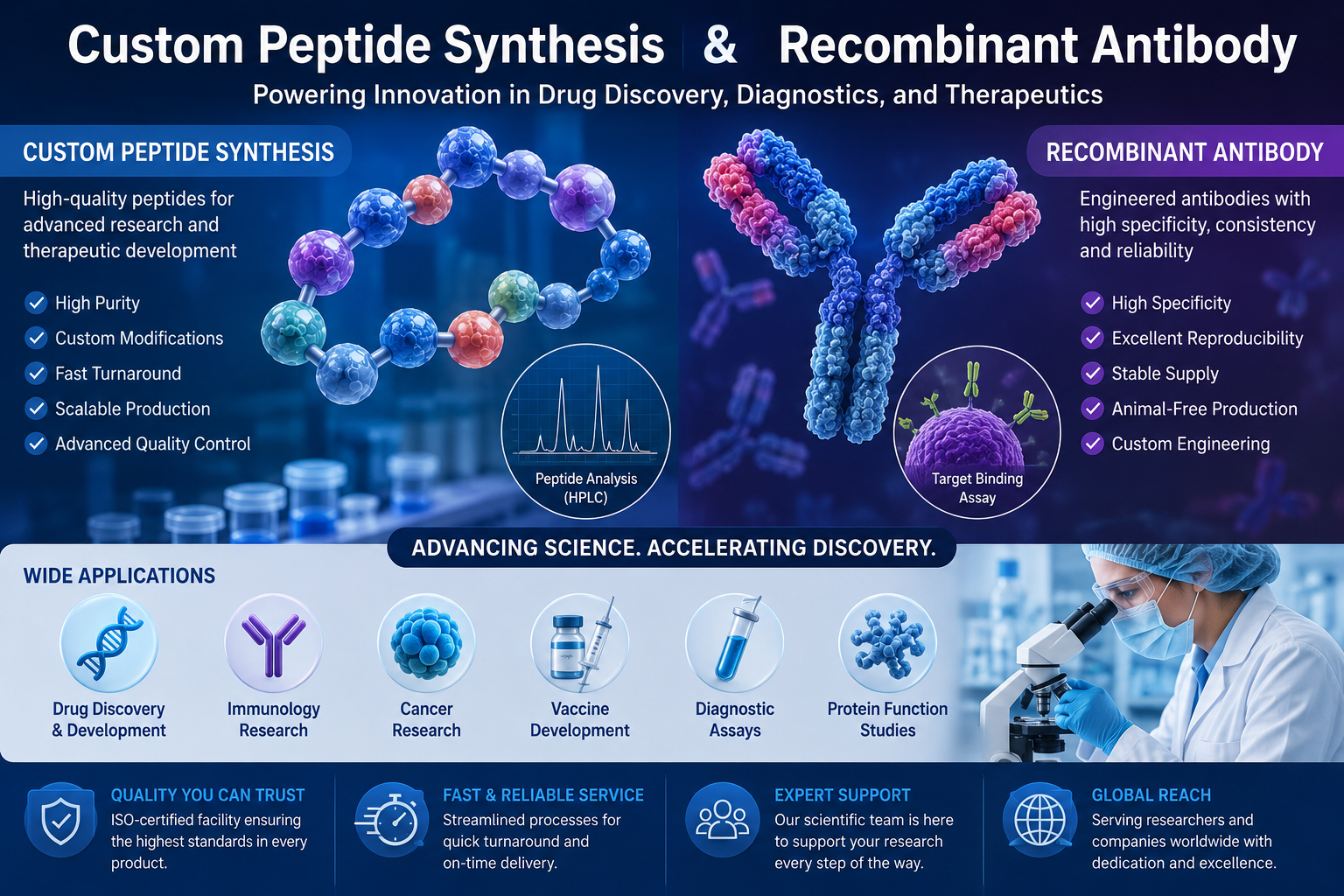
Custom peptide synthesis has become an important research tool for laboratories, biotechnology companies, pharmaceutical researchers and diagnostic developers that need peptides designed for a specific scientific purpose.
Instead of relying only on commercially available peptides, researchers can order sequences tailored to their requirements, including modifications, purification levels, quantities and analytical specifications.
At the same time, peptide-based research often sits alongside other protein technologies, including recombinant antibody development, immunoassay research and protein–protein interaction studies.
This guide explains how custom peptide synthesis works, what researchers can customise, how to select a reliable synthesis partner, and where peptides can support antibody and biotechnology research.
What Is Custom Peptide Synthesis?
Custom peptide synthesis is the process of producing a peptide with a specific amino acid sequence according to a customer’s research requirements.
A peptide is a short chain of amino acids. By specifying the desired sequence and technical requirements, researchers can obtain material designed for applications such as antibody generation, assay development, epitope mapping, drug discovery and biochemical research.
A custom peptide order may involve more than simply specifying a sequence. Depending on the application, researchers may also need to define:
- Peptide sequence
- Peptide length
- Quantity
- Purity
- Terminal modifications
- Chemical modifications
- Conjugation requirements
- Solubility considerations
- Analytical testing
- Storage and handling requirements
The appropriate specifications depend heavily on the intended application.
Why Choose Custom Peptide Synthesis Instead of an Off-the-Shelf Peptide?
Commercially available peptides can be useful when the required sequence and specifications are already available. However, research projects frequently require sequences or modifications that are not part of standard catalogues.
Custom synthesis allows researchers to specify the material they actually need.
For example, a research team studying a particular protein may require a peptide representing a selected region of that protein rather than purchasing a generic peptide. Similarly, an antibody-development project may require several overlapping peptides for epitope mapping.
The main advantages include:
1. Sequence flexibility
Researchers can request a specific amino acid sequence rather than adapting an experiment to an existing catalogue product.
2. Application-specific modifications
Some projects require modifications to improve stability, facilitate conjugation or investigate a particular biological mechanism.
3. Controlled purity
Different research applications require different purity specifications. Analytical and functional requirements should determine the appropriate level rather than automatically choosing the highest available specification.
4. Flexible quantities
Custom peptide synthesis can support projects ranging from early-stage laboratory experiments to larger research programmes.
5. Support for specialised research
Custom peptides can be useful in areas where standard commercial peptides cannot adequately match the experimental design.
How Does Custom Peptide Synthesis Work?
A professional peptide synthesis project generally follows several stages.
Step 1: Define the peptide sequence
The first step is establishing the exact amino acid sequence required for the experiment.
Researchers should check the sequence carefully before placing an order because even a single amino acid difference can affect experimental results.
Step 2: Review synthesis feasibility
Not every peptide sequence behaves in the same way during chemical synthesis.
Factors such as sequence length, amino acid composition, hydrophobicity, aggregation tendencies and structural characteristics can influence synthesis and purification.
A technically experienced supplier should therefore review challenging sequences before production.
Step 3: Select modifications
Depending on the research objective, the peptide may require modifications such as terminal changes, conjugation-related chemistry or other specialised modifications.
The modification should be selected based on the intended experimental use rather than simply added as a specification.
Step 4: Peptide synthesis
Custom peptides are commonly produced using solid-phase peptide synthesis (SPPS).
During SPPS, amino acids are sequentially added to a growing peptide chain attached to a solid support. Following synthesis, the peptide is cleaved from the support and processed for purification.
Step 5: Purification
Purification removes unwanted synthesis-related impurities and produces peptide material at the required purity level.
High-performance liquid chromatography (HPLC) is commonly used for peptide purification and analysis.
Step 6: Characterisation and quality control
Depending on the supplier and project, analytical testing may include techniques such as mass spectrometry and chromatographic analysis.
These checks help confirm that the supplied material corresponds to the requested peptide and meets the agreed specifications.
What Can Be Customised?
One of the biggest benefits of custom peptide synthesis is the ability to tailor the product to the application.
Common customisation options include:
| Requirement | Why it may matter |
| Amino acid sequence | Defines the peptide being studied |
| Purity | Supports application-specific experimental requirements |
| Quantity | Matches project scale |
| Terminal modification | Can influence peptide properties or downstream use |
| Conjugation | Useful for selected immunisation and assay applications |
| Label or tag | Can support detection or experimental tracking |
| Special chemistry | Enables certain research applications |
| Analytical testing | Helps verify identity and quality |
The exact options available depend on the synthesis provider and the peptide itself.
Applications of Custom Peptide Synthesis
Custom peptides are used across several areas of life-science research.
Antibody Development
One of the best-known applications is antibody research.
Researchers may use selected protein-derived peptides as immunogens or as research tools when developing antibodies against specific targets.
A peptide can represent a selected region, or epitope, of a target protein. Researchers can then investigate whether antibodies recognise that region.
However, peptide immunogenicity and antibody recognition depend on the biological context. A peptide does not automatically reproduce the structure of the complete native protein.
Epitope Mapping
Custom peptides can help researchers investigate where an antibody binds to a target.
For example, overlapping peptides covering a region of a protein can be tested to identify which sequence is recognised by an antibody.
This can provide useful information during antibody characterisation and assay development.
ELISA and Immunoassay Development
Synthetic peptides may be incorporated into immunoassay research when a defined antigenic sequence is required.
The peptide can serve as a research antigen or assay component depending on the experimental design.
Protein–Protein Interaction Studies
Specific peptide sequences can be used to investigate binding interactions between proteins, peptides and other biomolecules.
This can be particularly useful when researchers want to examine a small functional region of a larger protein.
Drug Discovery
Peptide-based research can contribute to early-stage drug discovery by helping researchers investigate biological targets, binding regions and structure–activity relationships.
Diagnostic Research
Custom peptides can also support the development and evaluation of research assays where specific antigenic sequences are relevant.
Custom Peptide Synthesis and Recombinant Antibody Research
Custom peptide synthesis and recombinant antibody technology address different biological materials, but they can complement each other within a research workflow.
A recombinant antibody is produced using recombinant DNA technology to express an antibody or antibody fragment in a suitable expression system.
Researchers may use custom peptides alongside recombinant antibodies for:
- Epitope characterisation
- Binding studies
- Assay development
- Antibody screening
- Specificity testing
- Protein interaction research
- Antigen–antibody studies
For example, a research programme investigating an antibody against a particular protein may use synthetic peptides corresponding to different protein regions to help determine the antibody’s binding specificity.
This illustrates why choosing a research partner with experience across peptide and protein technologies can be valuable.
Custom Peptides vs Recombinant Proteins
The choice between a synthetic peptide and a recombinant protein depends on the research question.
A custom peptide is generally useful when a defined sequence or smaller protein region is sufficient for the experiment.
A recombinant protein may be more appropriate when the research requires a larger protein, specific folding, multiple domains or structural characteristics that a short peptide cannot reproduce.
Neither approach is universally better.
The correct choice depends on the biological target, experimental method, required structure and intended application.
How Much Does Custom Peptide Synthesis Cost?
There is no single price for custom peptide synthesis.
The final cost can depend on factors including:
- Peptide length
- Amino acid sequence
- Sequence complexity
- Purity requirement
- Quantity
- Chemical modifications
- Conjugation
- Labelling
- Purification requirements
- Analytical testing
- Production scale
A short, straightforward peptide with standard specifications will generally have different production requirements from a longer or highly modified peptide.
For this reason, requesting a project-specific quotation is more useful than relying on a generic price list.
How to Choose a Custom Peptide Synthesis Provider
Selecting a supplier based solely on price can create problems if the material does not meet the requirements of the experiment.
Before placing an order, consider the following:
Technical expertise
Look for a provider that can explain synthesis feasibility and potential challenges rather than simply accepting an order.
Purification and analytical capabilities
Ask what purification and analytical methods are available and what documentation is supplied with the final material.
Experience with difficult sequences
Some sequences are more challenging to synthesise than others. Experience with difficult or modified peptides can be an important consideration.
Clear specifications
A quotation should clearly state the peptide sequence, quantity, purity, modifications and relevant analytical requirements.
Communication
Good communication is particularly important for custom research products because specifications may need to be reviewed before synthesis begins.
Application knowledge
A supplier that understands the intended application can help researchers select practical specifications without unnecessarily increasing project costs.
Common Mistakes to Avoid When Ordering Custom Peptides
Choosing purity without considering the application
Higher purity is not automatically necessary for every experiment. The appropriate specification should reflect the intended use.
Ignoring peptide solubility
Some peptides have poor aqueous solubility because of their sequence characteristics. Solubility should be considered during project planning.
Ordering before confirming the sequence
Always verify the sequence, orientation and required modifications before production.
Focusing only on price
A low initial quotation may not represent the total project cost if additional purification, modification or analytical requirements are needed later.
Not discussing difficult sequences
If a sequence is long, highly hydrophobic or otherwise challenging, discuss its feasibility with the synthesis provider before ordering.
Frequently Asked Questions
What is custom peptide synthesis?
Custom peptide synthesis is the production of a peptide with a specified amino acid sequence and defined technical requirements for a particular research or development application.
What is custom peptide synthesis used for?
It can be used for antibody development, epitope mapping, immunoassays, protein interaction studies, drug discovery and other life-science research applications.
How long does peptide synthesis take?
Production time varies according to peptide length, complexity, modifications, purification requirements and supplier capacity. A project-specific quotation should provide the expected turnaround time.
Can custom peptides be used for antibody production?
Yes. Selected peptides can be used in certain antibody-development workflows as immunogens or research antigens. The suitability depends on the target and intended antibody application.
What is a recombinant antibody?
A recombinant antibody is an antibody produced using recombinant DNA technology. Recombinant antibody production can provide defined antibody sequences and support applications such as research, diagnostics and therapeutic development.
Are synthetic peptides the same as recombinant proteins?
No. Synthetic peptides are chemically produced sequences, while recombinant proteins are produced through biological expression systems. The appropriate option depends on the experimental objective.
How do I order a custom peptide?
Typically, you provide the desired sequence, quantity, purity, modifications and intended application. The synthesis provider can then review feasibility and provide a quotation.