
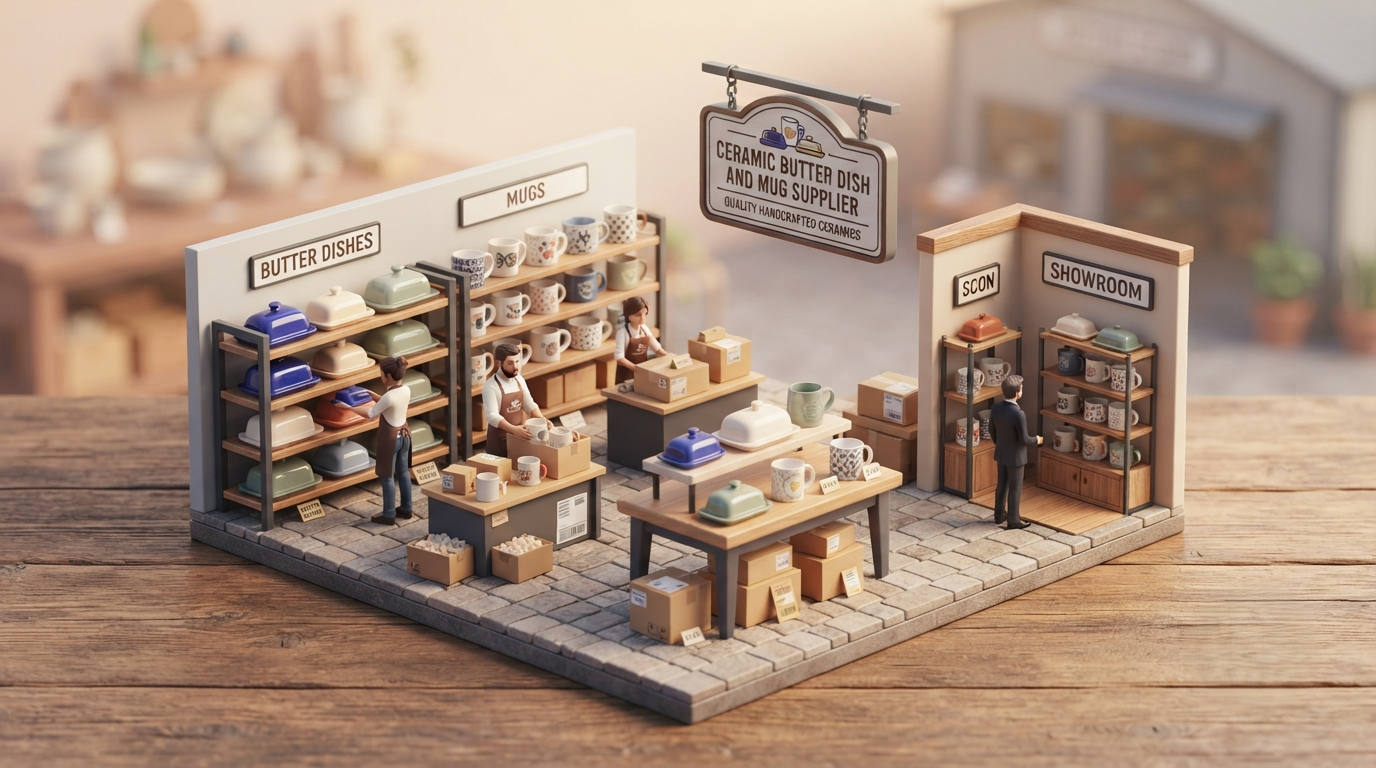
Ceramic tableware has moved beyond being purely functional. Today, buyers expect products that combine durability, comfortable everyday use, attractive presentation and distinctive design. This is particularly true for products such as a Ceramic Butter Dish and ceramic mugs, which are equally at home on breakfast tables, café counters, hotel buffets and retail shelves.
For wholesalers, retailers, hospitality businesses and private-label brands, selecting the right Ceramic Mug Supplier is an important sourcing decision. Product quality must remain consistent across hundreds or thousands of pieces, while colours, glazing, dimensions and packaging need to match agreed specifications.
Understanding how these ceramic products are designed, manufactured and evaluated can help buyers make better purchasing decisions.
From Clay to Table: What Defines Quality Ceramicware?
The quality of ceramic tableware begins long before glazing or decoration. Raw material selection, forming, drying, firing and finishing all influence the final product.
Different ceramic compositions can produce different characteristics in terms of weight, strength, colour and surface appearance. After forming, products must be dried carefully before firing. Glazing and additional firing processes then create the finished surface.
For commercial buyers, quality can be evaluated through factors such as:
- Uniform shape and dimensions
- Smooth and consistent glazing
- Stable bases
- Properly finished rims and edges
- Consistent colours across a production batch
- Comfortable handling
- Appropriate food-contact materials
- Secure protective packaging
A visually attractive ceramic product can still perform poorly if these fundamentals are overlooked.
Why the Ceramic Butter Dish Deserves More Attention
A Ceramic Butter Dish appears simple, but its design involves several practical considerations. The base must provide sufficient room for the intended butter size, while the cover needs adequate clearance and should sit securely.
The design should also make it easy to lift the lid without making it unnecessarily bulky.
Functional Design Matters
When evaluating a butter dish, buyers should consider:
- Internal dimensions
- Lid clearance
- Base stability
- Ease of handling
- Surface smoothness
- Overall weight
- Cleaning convenience
These considerations are particularly important for retailers developing products for specific regional markets because butter packaging dimensions can vary.
Style Creates Retail Value
A Ceramic Butter Dish can also function as a decorative kitchen accessory. Minimal white finishes work well in contemporary collections, while embossed patterns, reactive glazes and hand-finished appearances can suit rustic or artisan-inspired ranges.
Brands can therefore position butter dishes at different price points by varying shape, decoration, packaging and presentation.
What Makes a Professional Ceramic Mug Supplier Different?
A reliable Ceramic Mug Supplier should provide more than an extensive catalogue. Commercial buyers need consistency, communication and dependable quality management.
If 2,000 mugs are ordered for a restaurant chain, for example, significant differences in handle shape, colour or logo placement can create problems even when each individual mug remains usable.
A professional supplier should therefore be capable of maintaining approved specifications throughout production.
The Anatomy of a Well-Designed Ceramic Mug
Consumers may judge mugs visually, but everyday satisfaction depends heavily on ergonomics.
Handle Comfort
The handle needs enough space for comfortable holding while remaining structurally appropriate for the mug body. Its position can also influence balance when the mug is full.
Rim Design
A smooth, properly finished rim contributes to drinking comfort. Irregular or rough edges can negatively affect the user experience.
Base Stability
The mug should sit securely on a flat surface without rocking. Consistency becomes particularly important for commercial hospitality applications.
Capacity and Proportion
A good Ceramic Mug Supplier should clearly communicate capacity and dimensions. Buyers should not rely only on descriptions such as small, medium or large.
Ceramic Butter Dish vs Ceramic Mug: Key Buying Considerations
| Buying Factor | Ceramic Butter Dish | Ceramic Mug |
| Primary function | Butter storage and serving | Hot and cold beverage service |
| Key design concern | Base and lid compatibility | Handle, rim and balance |
| Common finishes | Glossy, matte, patterned | Glossy, matte, reactive, printed |
| Branding potential | Logos, patterns, packaging | Logos, artwork, messages |
| Typical market | Kitchenware and gifting | Retail, hospitality and promotions |
| Important measurement | Internal space and lid clearance | Capacity and dimensions |
Understanding these differences prevents buyers from applying the same quality criteria to every ceramic product.
Customisation Opportunities for Businesses
Custom ceramicware can help brands create products that are recognisable rather than interchangeable with generic alternatives.
A Ceramic Mug Supplier may provide options such as:
- Custom body colours
- Logo application
- Printed artwork
- Decals
- Special surface finishes
- Custom gift boxes
- Coordinated product sets
Similarly, a Ceramic Butter Dish can be customised through colours, patterns, lid details and branded packaging.
The available customisation depends on production quantities, manufacturing methods and design complexity, so requirements should be discussed before ordering.
How Businesses Should Evaluate Ceramic Samples
Never evaluate samples based solely on appearance.
A practical sample review should examine the product from several perspectives.
Step 1: Inspect the Surface
Look for obvious cracks, rough areas, pinholes, inconsistent glazing or unwanted marks.
Step 2: Check Dimensions
Compare actual dimensions against the agreed specification.
Step 3: Test Stability
Place the product on a level surface and check whether it sits properly.
Step 4: Assess Everyday Handling
Hold the mug by its handle. Open and close the butter dish. Think about how a real customer would interact with each product.
Step 5: Examine Decoration
If branding is included, inspect positioning, clarity and consistency.
Why Packaging Is Critical for Ceramic Products
Ceramic products face a completely different logistics challenge from soft or flexible goods.
Individual pieces may need protective wrapping, inserts, partitions or appropriately sized cartons. Export orders can require additional attention because products may pass through multiple handling stages before reaching their destination.
Packaging should balance protection with commercial presentation. Retail-ready products may need attractive individual boxes, whereas bulk hospitality orders may prioritise transportation efficiency.
Discuss packaging with your Ceramic Mug Supplier before confirming final pricing because packaging specifications can affect overall sourcing costs.
Choosing a Supplier for Wholesale and Private-Label Orders
Supplier evaluation should combine product quality with commercial capability.
Before placing a significant order, ask:
- What ceramic products do you specialise in?
- What customisation options are available?
- What are the minimum order requirements?
- Can you provide pre-production samples?
- How are colours and dimensions controlled?
- What packaging options are available?
- How are quality issues handled?
- What information can you provide regarding relevant product testing or compliance?
Clear answers help buyers distinguish between simple traders and suppliers capable of supporting ongoing product programmes.
Frequently Asked Questions
What is a Ceramic Butter Dish?
A Ceramic Butter Dish is a covered tableware item designed for storing and presenting butter conveniently.
Why choose ceramic instead of plastic?
Ceramic offers a substantial feel, attractive appearance and extensive possibilities for glazing, colours and decorative designs.
What should I look for in a Ceramic Mug Supplier?
Consider production consistency, samples, customisation, quality control, packaging, communication and experience with commercial orders.
Can ceramic mugs be customised?
Yes. Depending on the supplier, mugs can feature customised colours, logos, artwork, decals and packaging.
Can butter dishes be private-labelled?
Many manufacturers offer private-label options, subject to minimum quantities and production capabilities.
Which glaze is best for ceramic tableware?
There is no single best option. Glossy, matte and reactive finishes provide different appearances and should be selected according to the product concept.
Are ceramic mugs suitable for corporate gifting?
Yes. Custom branding and gift packaging make ceramic mugs a popular choice for corporate merchandise and promotional programmes.
Why should I order samples before bulk production?
Samples help verify dimensions, colours, ergonomics, glazing, decoration and overall workmanship before committing to larger quantities.
How important is packaging for ceramicware?
It is extremely important because appropriate protective packaging helps reduce the risk of chips and breakage during handling and transportation.
Can a supplier create matching ceramic collections?
Depending on manufacturing capabilities, suppliers may produce coordinated mugs, dishes, plates, bowls and other tableware.
What information should I send when requesting a quotation?
Provide quantities, dimensions, capacity, colours, artwork, packaging requirements, delivery destination and expected customisation.
Is the cheapest ceramic supplier always the best option?
No. Buyers should consider total value, including consistency, quality, packaging, communication and suitability for repeat orders.
https://newsgrow.blogspot.com/2026/08/ceramic-coaster-and-ceramic-canister.html
https://newsgrow.blogspot.com/2026/08/ceramic-butter-dish-and-ceramic-mug.html