
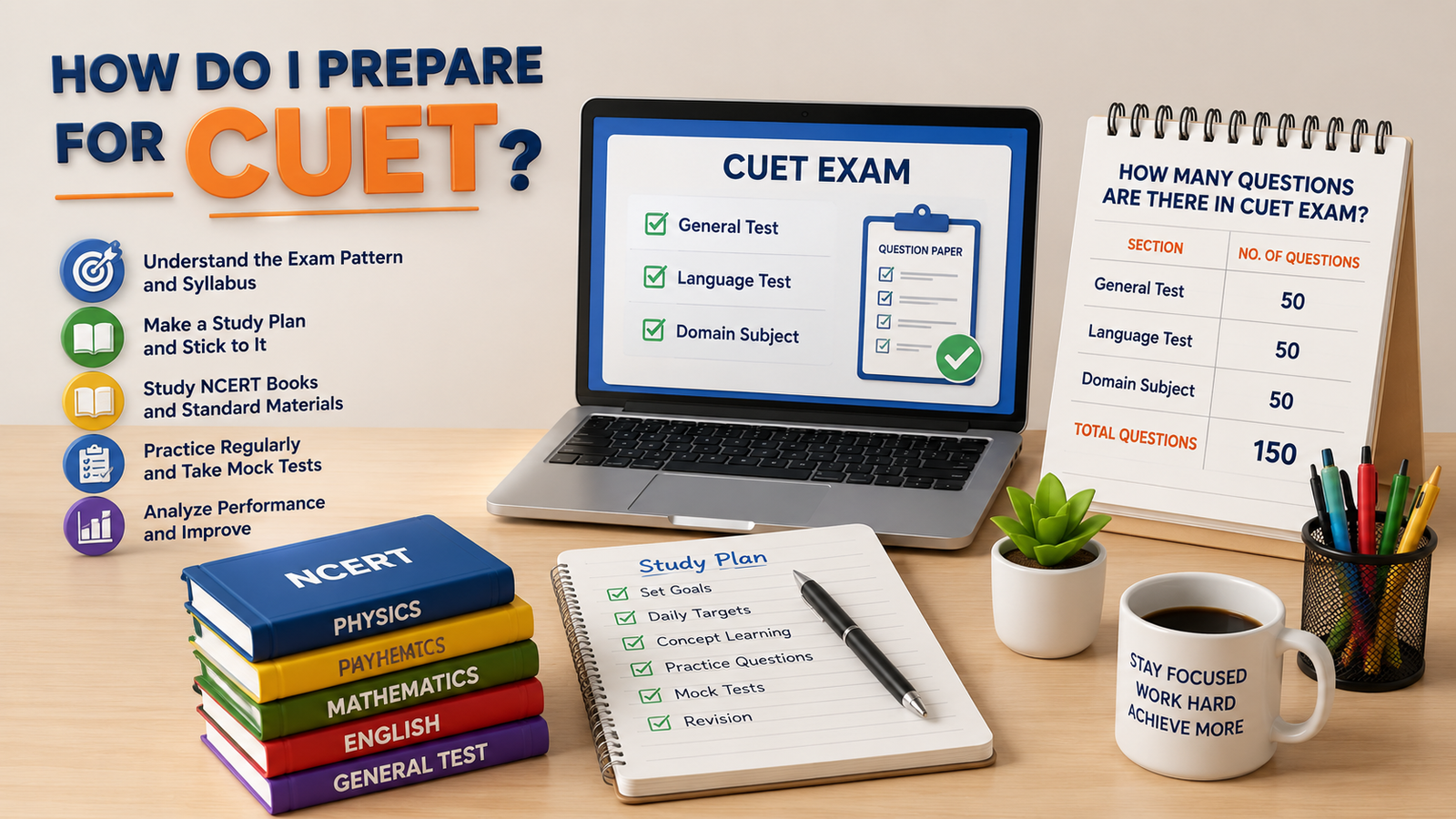
Preparing for CUET becomes much easier when you stop treating it as one large exam and start breaking it into manageable parts: understanding the syllabus, strengthening concepts, practising questions, improving speed and analysing mock-test performance.
If you are asking “how do I prepare for CUET?”, the most effective approach is to begin with the official syllabus and current exam pattern, build a realistic study timetable and combine concept revision with regular question practice. Your preparation should also reflect the subjects and university programmes you intend to apply for.
This guide explains how to organise your CUET preparation, how to approach different sections, how to use mock tests effectively and what mistakes to avoid.
How Do I Prepare for CUET Effectively?
Start by understanding the latest CUET syllabus and exam structure, then create a subject-wise preparation plan based on your strengths, weaknesses and available time. Focus on concept clarity first and gradually increase timed practice and mock tests.
A practical preparation process looks like this:
1. Identify the CUET subjects required for your preferred courses.
2. Download the latest official syllabus.
3. Assess your current level in every subject.
4. Create daily and weekly study targets.
5. Strengthen fundamental concepts.
6. Solve topic-wise questions.
7. Practise under timed conditions.
8. Take full-length or section-wise mock tests.
9. Analyse every test instead of simply checking the score.
10. Revise weak areas repeatedly.
The key is consistency. Studying for a manageable number of focused hours every day is generally more productive than irregular, exhausting study sessions.
Understand the CUET Exam Before Starting Preparation
One of the biggest preparation mistakes is beginning with random books, videos or mock tests before understanding what the examination actually requires.
CUET, or the Common University Entrance Test, is used for admission to participating universities and programmes. The exact subjects a student needs can depend on the eligibility requirements of the course and institution.
Before creating your study plan, verify:
· Subjects required for your target programme
· Current CUET syllabus
· Latest examination pattern
· Question format
· Duration applicable to your chosen papers
· Marking scheme
· University-specific eligibility requirements
Important: CUET rules and examination patterns can change between admission cycles. Always verify the current year’s information through the official NTA CUET information bulletin rather than relying entirely on old preparation material.
Suggested internal link: CUET Exam Pattern and Syllabus
How Many Questions Are There in CUET Exam?
Students searching “how many questions are there in CUET exam” should check the latest NTA information bulletin for their examination year and selected subjects.
The number of questions, duration and paper structure can be revised by the examination authority. Therefore, an older blog, coaching video or previous-year question paper should not be treated as definitive evidence of the current pattern.
A better preparation strategy is to understand three things together:
number of questions + available time + marking scheme
This tells you how quickly you need to work and how carefully you need to manage uncertain answers.
For example, if a paper requires you to answer many objective questions within a limited period, knowing the subject alone is not enough. You also need quick reading, decision-making and question-selection skills.
Suggested internal link: Latest CUET Exam Pattern
Create a Realistic CUET Study Plan
A good CUET timetable should be built around your actual preparation level rather than somebody else’s study routine.
Divide subjects into three categories:
| Preparation Level | Recommended Approach |
| Strong | Regular revision and timed question practice |
| Average | Concept revision followed by topic-wise tests |
| Weak | More time for fundamentals and repeated practice |
Suppose you are comfortable with English but struggle with a particular domain subject. Giving both subjects exactly the same amount of preparation time would not be efficient.
Allocate additional time to weak but high-priority areas while continuing to revise stronger subjects.
Example of a Daily CUET Preparation Routine
A student with four to five hours available might divide the day into concept study, question practice, revision and error analysis.
For example, the first session could cover a difficult domain subject, followed by language practice. A later session could focus on another subject, with the final part of the day reserved for timed questions and revision.
The exact number of hours is less important than maintaining concentration and completing measurable targets.
Instead of writing:
“Study CUET for two hours”
use a specific target such as:
“Revise two chapters and solve 40 related questions.”
Specific targets make progress easier to measure.
How Should I Prepare for CUET Domain Subjects?
Prepare domain subjects by following the prescribed syllabus closely, revising core concepts and solving objective questions after each topic.
Do not assume that reading a chapter repeatedly means you have mastered it.
After completing a topic:
Step 1: Understand the Concept
Study the topic carefully and identify important definitions, principles, formulas, processes or relationships.
Step 2: Recall Without Looking
Close your notes and try to explain the concept yourself.
Active recall reveals gaps that passive reading often hides.
Step 3: Solve Questions
Practise objective questions related to the topic. Pay attention to questions you answer incorrectly and questions where you guessed.
Step 4: Revise Again
Return to weak concepts after a few days.
This combination of learning, retrieval and practice is far more useful than repeatedly reading the same material.
How Should I Prepare for the CUET Language Section?
Language preparation should combine comprehension, vocabulary and practical question-solving skills according to the current syllabus.
Regular reading can improve your ability to understand passages quickly. However, reading alone is not sufficient.
Practise:
· Reading comprehension
· Vocabulary in context
· Grammar concepts included in the syllabus
· Verbal ability where applicable
· Timed language questions
While practising comprehension, avoid reading passages mechanically. Identify the central argument, tone, supporting details and relationship between ideas.
Suggested internal link: CUET English Preparation Tips
How Should I Prepare for the CUET General Aptitude Test?
If the General Aptitude Test is relevant to your chosen programme, preparation should be systematic rather than based on random question sets.
Depending on the current syllabus, preparation may involve areas such as quantitative ability, logical or analytical reasoning, general knowledge and current affairs.
For quantitative topics, create a formula and shortcut notebook.
For reasoning, practise recognising recurring question patterns.
For current affairs and general awareness, short daily revision is usually more manageable than trying to cover several months of information immediately before the examination.
Most importantly, check the latest syllabus before deciding what to study.
Are NCERT Books Enough for CUET Preparation?
NCERT textbooks can be an important foundation for relevant domain subjects, but effective CUET preparation normally also requires objective-question practice and timed tests.
Conceptual knowledge and examination performance are related but different skills.
You may understand a chapter perfectly and still lose marks because you:
· misread the question;
· take too long;
· confuse similar options;
· forget a factual detail; or
· make avoidable calculation errors.
Use textbooks and syllabus-aligned resources for understanding concepts, then reinforce that knowledge through appropriate practice material.
How Important Are CUET Mock Tests?
Mock tests are extremely useful because they measure not only what you know but how effectively you can apply that knowledge under examination conditions.
Start with topic-wise and sectional tests during the learning stage. Move towards more comprehensive timed tests as your preparation progresses.
Do not judge a mock test only by its score.
After every test, analyse your mistakes under four categories:
| Error Type | What It Means | Action |
| Concept error | You did not understand the topic | Study the concept again |
| Memory error | You knew it but could not recall it | Schedule revision |
| Speed error | You took too long | Increase timed practice |
| Careless error | You misread or calculated incorrectly | Improve checking habits |
This analysis turns mock tests into a learning tool rather than simply a performance report.
Suggested internal link: CUET Mock Test Preparation Guide
Keep a CUET Mistake Notebook
One simple technique can make revision considerably more focused: maintain an error log.
Whenever you get an important question wrong, record the topic, reason for the mistake and correct approach.
For example:
Topic: Percentage
Mistake: Used the wrong base value
Correction: Identify the original quantity before calculating percentage change.
Review this notebook regularly.
Over time, you will begin noticing patterns. Perhaps most lost marks come from calculation errors rather than lack of knowledge. Or perhaps one particular chapter repeatedly causes difficulty.
Once the pattern becomes visible, preparation becomes more targeted.
Common CUET Preparation Mistakes to Avoid
Studying Without Checking Course Eligibility
Your subject selection should align with the requirements of the universities and programmes you plan to apply to.
Depending Entirely on Previous-Year Patterns
Previous papers are useful for practice, but current examination rules should always come from official information.
Collecting Too Many Books
More resources do not automatically produce better preparation. A smaller number of reliable resources studied thoroughly is often more effective.
Taking Mock Tests Without Analysis
Completing ten tests without reviewing mistakes can be less valuable than completing five and carefully analysing each one.
Ignoring Revision
Without scheduled revision, information studied several weeks earlier may become difficult to recall during the examination.
Preparing Every Subject Equally
Your study time should reflect your weaknesses, course priorities and current performance.
How to Prepare for CUET in 3 Months
With three months available, divide preparation into concept building, intensive practice and final revision.
During the first month, focus primarily on syllabus coverage and concept clarity.
During the second month, increase topic-wise questions, sectional tests and revision.
During the final month, shift towards timed mock tests, error correction and rapid revision.
Avoid starting completely new, low-priority resources close to the examination unless they address an important weakness.
How to Prepare for CUET in One Month
A one-month preparation strategy needs stricter prioritisation.
Begin by identifying topics as:
Strong: revise quickly
Moderate: practise extensively
Weak but important: study selectively
Weak and low priority: avoid spending disproportionate time
At this stage, solving questions and analysing mistakes should occupy a significant part of your preparation.
Do not attempt to compensate for limited time by studying continuously without rest. Fatigue reduces concentration and increases avoidable errors.
Self-Study vs CUET Coaching: Which Is Better?
Neither option is automatically better for every student.
Self-study may suit students who are disciplined, understand concepts independently and can maintain a structured timetable.
Guided preparation may be useful for students who need:
· A structured learning sequence
· Regular doubt resolution
· Performance monitoring
· Mock-test analysis
· Accountability
· Help identifying weak areas
Before joining any CUET preparation programme, examine the faculty, teaching methodology, syllabus coverage, practice material and doubt-support system rather than relying solely on promotional claims.
CTA: If you are unsure where to begin, consider taking a diagnostic assessment first. Understanding your current strengths and weaknesses can help you choose an appropriate preparation plan instead of spending time on topics you have already mastered.
Expert Tips for Improving Your CUET Preparation
Effective preparation becomes easier when you measure performance rather than simply counting study hours.
Track indicators such as mock-test accuracy, questions attempted within the available time, weak chapters and repeated mistakes.
Also practise under realistic conditions as the examination approaches. Timed practice helps you learn when to move past a difficult question instead of spending excessive time trying to solve it.
Finally, protect your revision time. Completing the syllabus once is only the beginning; repeated recall is what helps make knowledge usable during the examination.
Frequently Asked Questions About CUET Preparation
How do I prepare for CUET from scratch?
Start with the latest official syllabus and programme eligibility requirements. Build concepts first, then introduce topic-wise questions, revision and mock tests progressively.
How many questions are there in CUET exam?
The applicable question structure can depend on the current CUET examination pattern and paper. Check the latest official NTA CUET information bulletin for the exact number applicable to your examination cycle.
When should I start preparing for CUET?
Start as early as reasonably possible. More preparation time allows you to build concepts gradually and complete multiple revision and mock-test cycles.
Can I prepare for CUET without coaching?
Yes. Students with good study discipline and reliable resources can prepare independently. Coaching is primarily useful when structured guidance, doubt support or performance monitoring is needed.
Is NCERT important for CUET?
NCERT can provide a strong conceptual foundation for relevant domain subjects. However, students should follow the prescribed CUET syllabus and combine textbook revision with objective-question practice.
How many hours should I study for CUET every day?
There is no universal number. Choose focused study hours that fit your school or college commitments, preparation level and remaining time.
Should I solve previous-year CUET questions?
Yes. Previous questions can help you understand question styles and identify areas requiring additional practice. Use the current official pattern as the final reference for examination structure.
How can I improve my CUET score?
Focus on concept clarity, revision, timed practice and detailed mock-test analysis. Reducing repeated errors can be just as important as learning additional topics.
How should I revise for CUET?
Use short notes, formulas, active recall, flashcards where appropriate, error logs and topic-wise questions. Give weaker topics more frequent revision.
What should I do in the final week before CUET?
Prioritise revision, familiar questions, important concepts and error notes. Avoid unnecessarily overloading yourself with completely new resources.