
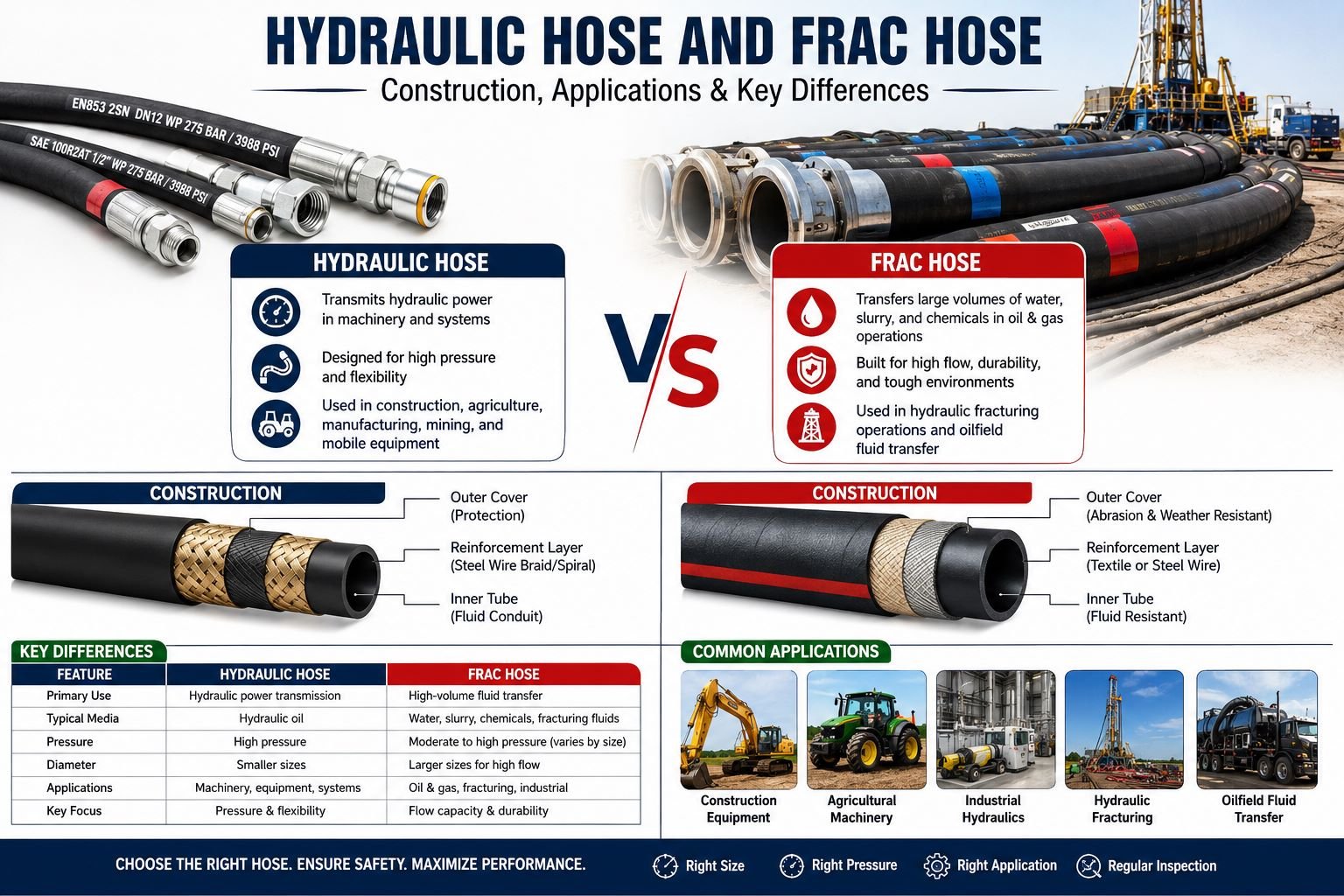
Modern industrial operations depend heavily on safe and efficient fluid transfer. Whether hydraulic power is operating heavy machinery or large volumes of fluid are moving across an oilfield, the hose connecting different parts of the system plays a critical role. Hydraulic Hose and frac hose are designed for demanding applications, but each serves a distinct purpose.
A better understanding of their materials, pressure capabilities, applications, maintenance requirements and selection criteria can help businesses improve equipment reliability while reducing unnecessary downtime.
Understanding Hydraulic Hose Technology
A Hydraulic Hose is an engineered flexible conduit that carries pressurised fluid within a hydraulic system. Instead of simply transporting liquid, it forms part of a power-transmission system.
When hydraulic fluid is pressurised by a pump, the hose carries that energy to components such as cylinders and motors. This enables machines to lift, push, rotate, clamp or move heavy loads.
Hydraulic hoses are commonly found in:
- Excavators and loaders
- Cranes and lifting equipment
- Agricultural machinery
- Mining equipment
- Injection moulding machines
- Industrial presses
- Material-handling systems
- Construction machinery
- Mobile hydraulic equipment
Flexibility makes hoses particularly valuable where rigid piping cannot accommodate vibration, movement or complicated routing.
How a Hydraulic Hose Is Engineered
A quality Hydraulic Hose is normally constructed using three functional sections.
Inner Tube
The inner tube comes into direct contact with the hydraulic fluid. Its material must therefore be compatible with the intended oil or fluid.
Reinforcement
Reinforcement gives the hose its ability to withstand internal pressure. Depending on application requirements, manufacturers may use textile braid, steel-wire braid or spiral-wire reinforcement.
Outer Cover
The external cover protects the reinforcement from abrasion, oil, moisture, weather and other environmental influences.
The combination of these layers determines how effectively the hose performs under its specified operating conditions.
Understanding the Role of Frac Hose
A frac hose is primarily associated with fluid-transfer operations in the oil and gas sector, particularly hydraulic fracturing sites.
Fracturing operations can involve moving substantial quantities of water and specially prepared fluids between storage equipment, blending systems, pumps and other wellsite equipment.
Unlike many conventional hydraulic lines, frac applications may demand large internal diameters and substantial flow capacity.
A frac hose may be selected for handling:
- Water
- Fracturing fluids
- Chemical mixtures
- Slurries
- Oilfield fluids
- Other compatible industrial media
The exact hose specification depends on the fluid being transported and its operating environment.
Why Frac Hose Requires Heavy-Duty Construction
Oilfield environments can be mechanically demanding. Hoses may encounter dirt, mud, sunlight, temperature variations, abrasion and frequent handling.
For this reason, an appropriate frac hose needs more than flexibility.
Important characteristics can include:
- Abrasion resistance
- Chemical compatibility
- Suitable working pressure
- Large-volume flow capability
- Strong reinforcement
- Durable external covering
- Reliable end connections
- Resistance to environmental exposure
Not every frac application has identical requirements. Specifications should always be matched to actual operating conditions.
Hydraulic Hose vs Frac Hose
| Selection Factor | Hydraulic Hose | Frac Hose |
| Primary function | Hydraulic power transmission | Bulk fluid transfer |
| Common sector | Industrial and mobile machinery | Oil and gas operations |
| Typical fluids | Hydraulic oils and compatible media | Water, slurry and fracturing fluids |
| Flow requirement | Depends on hydraulic circuit | Often high-volume |
| Typical environment | Machinery and industrial plants | Demanding wellsite conditions |
| Important characteristic | Pressure and flexibility | Flow, durability and compatibility |
| Common concern | Pressure pulses and abrasion | Abrasion, chemicals and field handling |
The key difference is therefore not simply pressure. It is the complete operating duty expected from the hose.
Pressure Rating Is Critical for Hose Safety
Pressure should never be treated as an approximate specification.
A hose assembly must be suitable for the system’s intended working pressure. Hydraulic systems can also experience pressure spikes and pulsation, making correct selection particularly important.
Potential consequences of unsuitable hose selection include:
- Fluid leakage
- Hose deformation
- Reinforcement failure
- Coupling separation
- Unexpected equipment shutdown
- Personal safety hazards
The working pressure printed or documented by the manufacturer should not be confused with burst pressure. Burst pressure is not the normal operating limit of the hose.
Hose Diameter and Flow Performance
Internal diameter directly influences fluid velocity and pressure loss.
If a Hydraulic Hose is too small for the required flow, the increased velocity can create excessive pressure drop and heat. This may reduce overall hydraulic efficiency.
The same principle becomes particularly important with a frac hose, where significant volumes of fluid may need to move efficiently.
Correct sizing should consider:
- Required flow rate
- Internal hose diameter
- Fluid characteristics
- Hose length
- Operating pressure
- Acceptable pressure loss
Selecting by fitting size alone may result in an inefficient system.
Fluid Compatibility Should Never Be Ignored
Different hose compounds respond differently to oils, chemicals, water-based fluids and additives.
An unsuitable inner tube can deteriorate through swelling, hardening, cracking or softening.
Before selecting a Hydraulic Hose or frac hose, identify the complete fluid composition rather than only its general category.
For example, a water-based mixture containing chemical additives may require different material characteristics from ordinary water.
Temperature Can Change Hose Performance
Both internal and external temperatures influence hose life.
High fluid temperatures can accelerate material ageing, while extremely low temperatures can affect flexibility. External heat from engines, exhaust systems or industrial processes can also damage a hose even when fluid temperature remains acceptable.
For oilfield applications, environmental temperature must also be considered because a frac hose may remain exposed outdoors for extended periods.
Understanding Bend Radius
Every engineered hose has a recommended minimum bend radius.
Installing a Hydraulic Hose in a tighter bend than recommended can place unnecessary stress on its reinforcement. It may also restrict fluid movement.
Correct routing should avoid:
- Sharp bends
- Twisting
- Unnecessary tension
- Crushing
- Contact with moving components
- Abrasive surfaces
Where movement occurs, sufficient hose length should be provided without creating excessive slack.
The Importance of Hose Fittings
The hose itself represents only part of a complete assembly.
Fittings and couplings must be compatible with the hose construction, system pressure and connection requirements. Incorrect fitting selection or poor assembly procedures can compromise an otherwise suitable hose.
Technicians should verify fitting type, dimensions, thread specifications, materials and assembly procedures before installation.
Why Proper Crimping Matters
For crimped Hydraulic Hose assemblies, the crimp must meet the hose and fitting manufacturer’s specified dimensions.
Under-crimping can produce inadequate retention or sealing, while excessive crimping may damage the hose structure.
Common Causes of Premature Hose Failure
Many hose failures are associated with application or installation conditions rather than a single material defect.
Typical causes include:
- Excessive working pressure
- Incorrect fluid compatibility
- Severe abrasion
- Improper bend radius
- Excessive temperature
- Incorrect fittings
- Poor routing
- Twisted installation
- External mechanical damage
- Age-related deterioration
Understanding the root cause is important. Simply replacing a failed hose without correcting the underlying problem may result in repeated failure.
Inspection and Maintenance Strategy
Routine inspection helps identify deterioration before it develops into a more serious problem.
What Should Be Inspected?
Check hoses for:
- Cracking
- Cuts
- Blisters
- Severe abrasion
- Exposed reinforcement
- Leakage
- Damaged fittings
- Corrosion
- Kinks
- Unusual deformation
When Should a Hose Be Replaced?
Replacement decisions should follow manufacturer recommendations, applicable standards and site-specific maintenance procedures.
A hose showing serious structural damage or leakage should not simply remain in service because it is still functioning.
Choosing the Correct Hydraulic Hose
The selection process should begin with application data.
A useful approach is to identify:
- Size: Required internal diameter and overall length
- Temperature: Fluid and surrounding temperatures
- Application: Equipment type and operating environment
- Media: Fluid or chemical being transferred
- Pressure: Normal and maximum system requirements
- Connections: Required fittings and interfaces
These details allow a supplier or engineer to identify an appropriate hose construction rather than relying on appearance.
Choosing the Correct Frac Hose
Selecting a frac hose requires particular attention to operating conditions at the wellsite.
Consider:
- Required flow volume
- Fluid composition
- Solids or abrasive particles
- Working pressure
- Ambient temperature
- Hose length
- Connection system
- Frequency of movement
- External abrasion
- Installation layout
A product suited to water transfer should not automatically be assumed suitable for every chemical or slurry application.
Why Quality Hose Selection Supports Productivity
Hoses may represent relatively small components compared with pumps, excavators, drilling equipment or production machinery, but their failure can interrupt an entire operation.
Appropriate hose selection can contribute to:
- Reliable fluid transfer
- Reduced unplanned maintenance
- Better equipment availability
- More predictable service schedules
- Reduced fluid leakage
- Improved operational safety
The objective should therefore be application suitability and lifecycle value rather than simply finding the lowest initial price.
Frequently Asked Questions
1. What is a Hydraulic Hose?
A Hydraulic Hose is a flexible reinforced conduit used to carry pressurised hydraulic fluid between components within hydraulic machinery and equipment.
2. Where are hydraulic hoses commonly used?
They are widely used in construction, agriculture, manufacturing, mining, material handling, transport and industrial machinery.
3. What exactly is a frac hose?
A frac hose is a heavy-duty fluid-transfer hose used in hydraulic fracturing and related oilfield operations.
4. What fluids can a frac hose transfer?
Depending on its construction, it may handle water, slurry, fracturing mixtures, chemicals and other compatible oilfield fluids.
5. Is a frac hose a hydraulic hose?
Not necessarily. Although both may operate with pressurised fluids, their design purposes, dimensions and application requirements can differ.
6. Why is hydraulic hose reinforcement necessary?
Reinforcement helps the hose resist internal pressure while maintaining the flexibility required for hydraulic machinery.
7. How do I determine the correct hose size?
Consider required flow rate, internal diameter, pressure drop, fluid characteristics, hose length and system specifications.
8. What is the most common reason for hose damage?
There is no single cause. Abrasion, incorrect installation, excessive pressure, heat, incompatible fluids and poor routing are common factors.
9. Can I use any fitting with a Hydraulic Hose?
No. Fittings should be compatible with the specific hose construction, dimensions, pressure requirements and manufacturer’s assembly system.
10. Why does bend radius matter?
Excessively tight bending can damage reinforcement, restrict fluid flow and reduce hose service life.
Read more – https://newsgrow.blogspot.com/2026/08/hydraulic-hose-manufacturer-and.html
https://newsgrow.blogspot.com/2026/08/hydraulic-hose-and-frac-hose-deep.html