
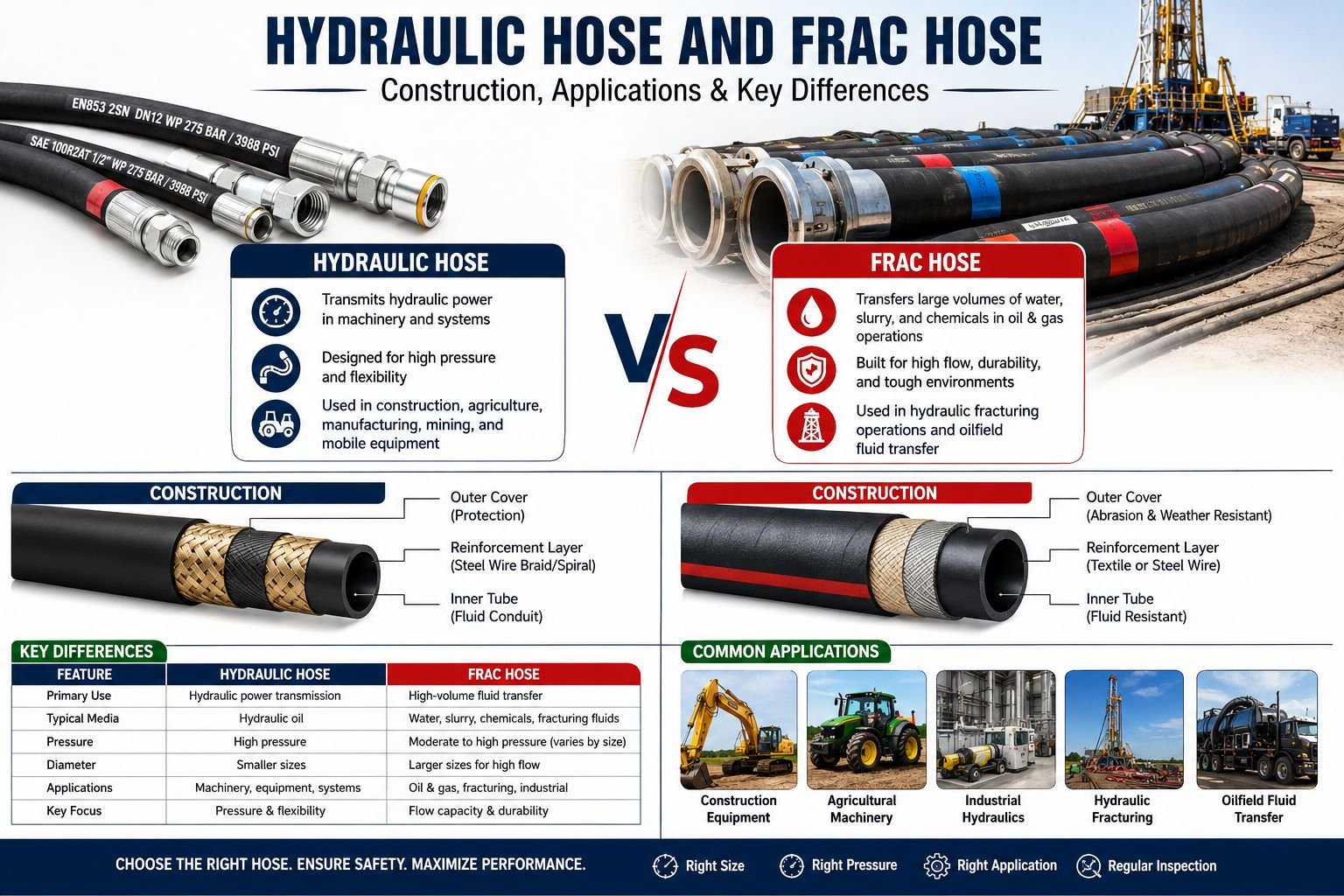
Industrial fluid systems are expected to work reliably in environments where pressure, movement, heat, chemicals and abrasion are part of everyday operation. In these systems, hoses perform a demanding task: they must remain flexible while safely transporting the required media from one point to another.
A Hydraulic Hose is primarily used to transfer pressurised hydraulic fluid in machinery, whereas a frac hose is commonly used for fluid movement in hydraulic fracturing and related oilfield operations. Their roles may sound similar, but the engineering priorities behind them can be very different.
Understanding those differences is important when choosing hoses for construction equipment, mining machinery, industrial plants or oilfield applications.
From Hydraulic Pressure to Machine Movement
The easiest way to understand a Hydraulic Hose is to look at what happens when an operator moves the control lever of an excavator.
The hydraulic pump pressurises fluid. Control valves direct that fluid through the hydraulic circuit. The fluid reaches a cylinder, which converts hydraulic energy into mechanical movement. The excavator’s boom then rises or lowers.
Throughout this process, hoses provide flexible connections between moving components.
This same principle is used in:
- Loaders and excavators
- Tractors and agricultural machines
- Forklifts
- Cranes
- Mining machinery
- Industrial presses
- Production equipment
- Material-handling systems
Because these machines move repeatedly, hoses must handle much more than static fluid pressure.
What Happens Inside a Hydraulic Hose?
A hydraulic hose is usually built around three functional layers.
The tube forms the internal fluid pathway. It needs to remain compatible with the hydraulic oil or other specified media.
The reinforcement provides strength against pressure. Depending on the hose design, textile braid, steel-wire braid or spiral-wire reinforcement may be used.
The cover protects the internal construction from external wear.
Each layer solves a different problem. If the inner tube deteriorates because of chemical incompatibility, external appearance may initially reveal very little. If the cover is destroyed by abrasion, the reinforcement underneath can become vulnerable.
Hose quality therefore needs to be evaluated as a complete construction.
Where Frac Hose Enters the Fluid-Transfer Chain
Hydraulic fracturing creates a very different fluid-handling environment.
Large quantities of water and prepared fluids can move through various stages before reaching their intended destination. Flexible transfer lines may connect storage, blending, pumping and other wellsite equipment.
A frac hose can be designed for specific duties within these operations.
Depending on its specification, the media may include:
- Water
- Fracturing mixtures
- Slurry
- Chemical solutions
- Other compatible oilfield fluids
The important word is “compatible”. A hose designed for one medium should not automatically be assumed suitable for another.
Why Frac Hose Must Be Selected for the Actual Site
Oilfield environments introduce challenges that may not exist inside a conventional manufacturing facility.
A frac hose could be exposed to outdoor weather, mud, rough ground, frequent repositioning and abrasive substances.
These conditions mean that buyers should consider both internal and external performance.
Internally, the hose needs to handle the specified media, temperature, flow and pressure.
Externally, it may require resistance to abrasion, weather exposure and mechanical handling.
The correct hose therefore depends on the complete operating situation rather than one headline specification.
A Different Perspective on Hydraulic Hose vs Frac Hose
| Performance Question | Hydraulic Hose | Frac Hose |
| What does it primarily transfer? | Hydraulic system fluid | Oilfield process fluids |
| Why is flexibility required? | Machine movement and vibration | Field installation and handling |
| What commonly influences sizing? | Hydraulic circuit flow | Transfer volume |
| What can attack it externally? | Heat, rubbing and machine movement | Rough surfaces and field exposure |
| What can affect it internally? | Hydraulic fluid and temperature | Chemicals, slurry and temperature |
| Where is it commonly found? | Mobile and industrial equipment | Fracturing and oilfield operations |
Neither category is inherently “better”. They are engineered for different jobs.
Pressure Rating Is Only the Starting Point
Suppose two hoses are rated for similar working pressures. Does that mean either can be used?
Not necessarily.
One may have an inner tube intended for a particular hydraulic fluid, while another may be designed around different media and flow requirements. Their reinforcement, cover, flexibility and connection systems may also differ.
Working pressure is certainly critical, but it should be evaluated alongside:
- Flow rate
- Fluid composition
- Temperature
- Internal diameter
- Hose length
- Movement
- External conditions
A Hydraulic Hose should be selected according to the hydraulic circuit rather than pressure alone.
The same rule applies to frac hose selection.
Working Pressure and Burst Pressure Are Not Interchangeable
Another important distinction involves working and burst pressure.
Working pressure is associated with the intended operating capability of a hose under specified conditions.
Burst pressure represents a destructive test condition.
It should not be treated as additional operating capacity.
When comparing products, procurement teams should base decisions on the specified working requirements and applicable manufacturer guidance rather than assuming a hose can routinely operate close to its burst value.
Why Flow Can Be as Important as Pressure
Fluid needs sufficient space to move efficiently.
If a hose has an internal diameter that is too small for the required flow, fluid velocity can rise and pressure loss may increase.
For a Hydraulic Hose, an unsuitable diameter can negatively influence hydraulic efficiency and potentially contribute to additional heat.
For a frac hose, flow considerations can become especially important where substantial volumes must be transferred.
Correct sizing typically considers:
- Required flow
- Hose internal diameter
- Hose length
- Fluid properties
- System pressure
- Permissible pressure drop
The connection size alone should not determine the hose diameter.
The Hidden Problem of Fluid Incompatibility
Some hose problems begin where operators cannot see them—inside the tube.
If the transferred fluid is incompatible with the inner material, physical properties can change over time.
Possible deterioration includes swelling, hardening, softening or cracking.
When ordering a Hydraulic Hose, buyers should therefore provide the specific fluid type.
When ordering a frac hose, it may be necessary to provide details of the complete mixture, including chemical additives and abrasive solids.
The phrase “water-based fluid” may not provide enough information when other substances are present.
Temperature Can Attack From Inside and Outside
Hose temperature is not simply the temperature displayed on the machine.
A hose experiences internal fluid temperature and external ambient temperature simultaneously.
For example, a hydraulic line routed close to a hot engine component may experience external heat even if the hydraulic oil remains within its normal operating range.
Oilfield applications create another challenge because hoses can remain outdoors under changing environmental conditions.
Temperature specifications should therefore be reviewed for both the media and the installation environment.
Bend Radius: A Small Specification With Big Importance
A Hydraulic Hose needs to flex, but that does not mean it can be bent without limits.
Manufacturers specify a minimum bend radius for individual hose designs.
Excessively tight bending can place unnecessary stress on the reinforcement. Bending immediately behind a fitting can be particularly problematic.
Proper installation should also avoid:
- Twisting
- Stretching
- Crushing
- Continuous rubbing
- Sharp-edge contact
- Unnecessary heat exposure
Routing should allow the hose to move naturally as the equipment operates.
Hose Connections Deserve the Same Attention
A hose is only one half of the assembly.
Fittings and couplings must correspond with the hose construction, dimensions, pressure requirements and intended service.
For a crimped Hydraulic Hose, correct assembly procedures are especially important. The fitting and hose should form a compatible system according to manufacturer recommendations.
The same concept applies to frac hose couplings.
Choosing a premium hose but ignoring connection compatibility can undermine the entire assembly.
Why Preventive Inspection Should Become Routine
Industrial hoses should be inspected before deterioration becomes a complete failure.
A visual inspection can reveal:
- Cracked covers
- Severe abrasion
- Blisters
- Fluid leakage
- Exposed reinforcement
- Kinks
- Flattened areas
- Corroded fittings
- Loose or damaged connections
- Unusual deformation
Maintenance personnel should also investigate why deterioration occurred.
If a hose repeatedly develops abrasion in exactly the same place, routing may be the underlying problem. Installing another identical hose without correcting the contact point is unlikely to solve it.
Choosing a Hydraulic Hose Using Application Data
A practical selection process starts by answering several questions.
What will flow through the hose?
Identify the exact hydraulic fluid.
How much fluid needs to move?
Determine the required flow.
What pressure will the hose experience?
Establish the system’s operating requirements.
What temperatures are involved?
Consider both internal and external conditions.
How will the hose move?
Evaluate vibration, bending and equipment movement.
Where will it operate?
Consider abrasion, weather, heat and surrounding components.
This application-first approach provides a stronger basis for choosing a Hydraulic Hose.
How to Approach Frac Hose Selection
Frac applications require similar technical information with additional emphasis on transfer volume and field conditions.
Before requesting a quotation, identify:
- Media composition
- Flow requirement
- Working pressure
- Internal diameter
- Hose length
- Temperature
- Abrasive solids
- External abrasion
- Coupling requirements
- Installation conditions
Accurate application information enables a manufacturer or supplier to recommend a frac hose suited to the intended duty.
Frequently Asked Questions
1. What is the main purpose of a Hydraulic Hose?
It transfers pressurised hydraulic fluid between different components of a hydraulic system.
2. What is frac hose commonly used for?
It is used for specific fluid-transfer applications associated with hydraulic fracturing and oilfield operations.
3. Can the same hose be used for hydraulic and frac applications?
Not automatically. The construction and specification must be suitable for the exact application.
4. What is inside a hydraulic hose?
Typical construction includes an inner tube, reinforcement and protective outer cover.
5. Why does hose diameter affect performance?
Internal diameter influences fluid velocity, flow capability and pressure loss.
6. What can cause premature hose wear?
Heat, abrasion, incorrect routing, excessive pressure, incompatible media and mechanical damage are common contributors.
7. Is frac hose suitable for chemical transfer?
Only if the specific hose materials are compatible with the chemical mixture.
8. Why is minimum bend radius important?
It helps prevent excessive mechanical stress when a hose is routed or flexed.
9. Is burst pressure the maximum working pressure?
No. Burst pressure is a destructive-test value and should not be used as the normal operating limit.
10. How can hose abrasion be reduced?
Better routing, avoiding sharp surfaces and using appropriate protection where required can help reduce abrasion.
Read more – https://newsgrow.blogspot.com/2026/08/hydraulic-hose-manufacturer-and.html
https://newsgrow.blogspot.com/2026/08/hydraulic-hose-and-frac-hose-deep.html