
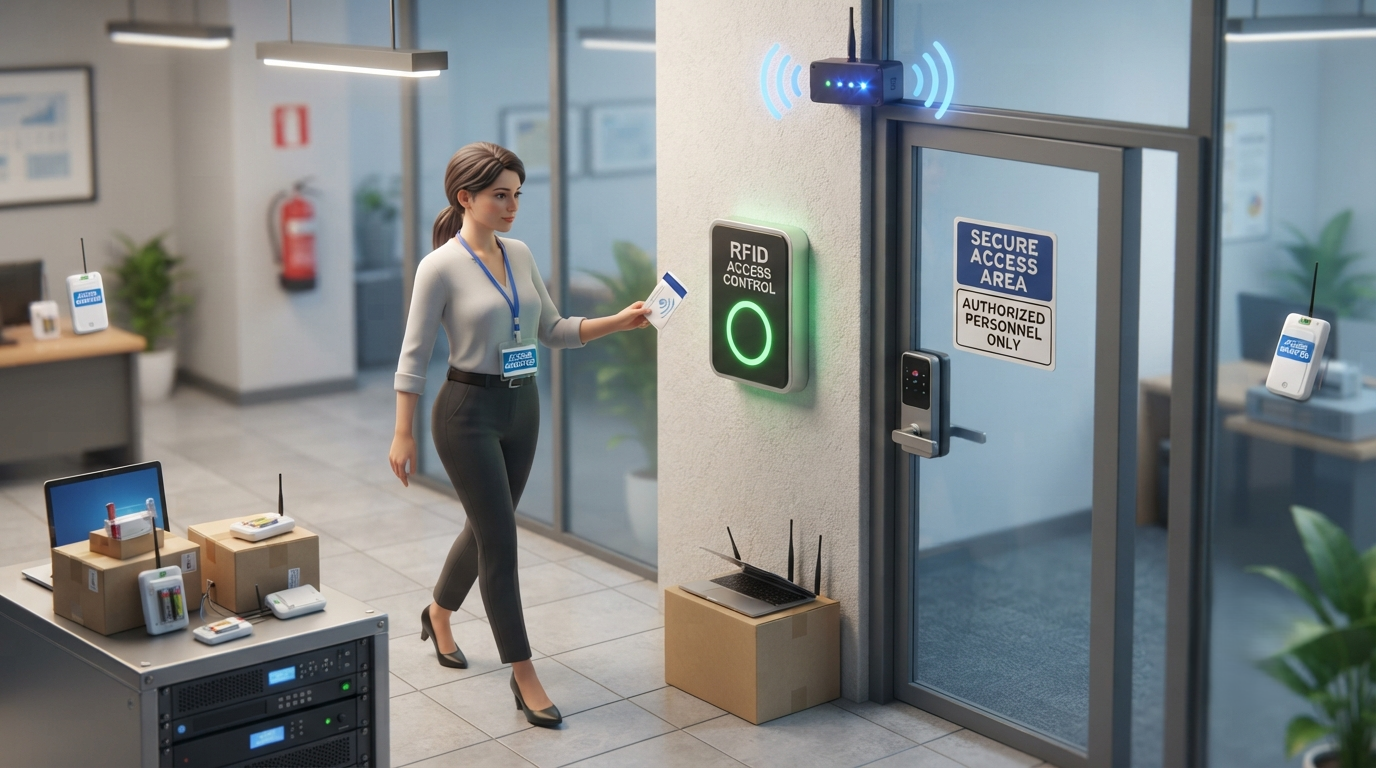
The demand for intelligent identification, automated security, and real-time monitoring solutions has increased significantly across industries. Businesses today require advanced systems that can track valuable assets, manage employee movement, and protect restricted areas efficiently. This is where Active RFID Tags and RFID Access Control technologies provide powerful solutions.
RFID (Radio Frequency Identification) has become a key technology in logistics, healthcare, manufacturing, retail, transportation, and corporate security. While traditional security systems rely on manual processes, RFID-based solutions offer automated identification, accurate data collection, and improved operational control.
Among different RFID technologies, active RFID tags stand out because they provide long-distance communication and continuous tracking capabilities. When combined with RFID access control systems, organizations can create a secure and highly connected environment.
Understanding Active RFID Tags and Their Importance
Active RFID Tags are electronic identification devices equipped with an internal battery that allows them to transmit signals independently. Unlike passive RFID tags, active versions do not require energy from an RFID reader to operate.
These tags continuously send stored information through radio frequency signals, allowing organizations to monitor assets, equipment, and personnel in real time.
An active RFID tag generally contains:
- A rechargeable or replaceable battery
- RFID microchip for data storage
- Wireless communication antenna
- Optional sensors for tracking conditions
- Unique identification information
The combination of independent power and advanced communication technology makes active RFID tags suitable for applications where accuracy, distance, and continuous monitoring are essential.
How Active RFID Tags Work in Real-Time Tracking Systems
The operation of active RFID technology involves communication between tags, readers, and software platforms.
The process includes:
- The active RFID tag automatically broadcasts identification signals.
- RFID readers installed within a specific area receive these signals.
- The collected information is transferred to monitoring software.
- Users analyze location, movement, and activity data.
This automated process eliminates the need for manual scanning and enables organizations to achieve better visibility over their operations.
Key Advantages of Active RFID Tags
Extended Reading Distance
One of the biggest benefits of active RFID tags is their ability to communicate over long distances. This makes them ideal for warehouses, factories, transportation yards, and large commercial facilities.
Continuous Monitoring Capability
Active RFID technology allows businesses to monitor assets and personnel movement continuously rather than relying on occasional scanning.
Improved Asset Management
Companies can quickly locate important equipment, reduce losses, and improve inventory accuracy through real-time tracking.
Advanced Sensor-Based Applications
Many modern active RFID tags include sensors that collect additional information, such as:
- Temperature changes
- Movement detection
- Environmental conditions
- Equipment status
These features support industries that require detailed monitoring.
What Is RFID Access Control and How Does It Work?
RFID Access Control is a modern security system that uses RFID technology to regulate entry into buildings, rooms, and restricted locations. It replaces traditional keys and manual verification methods with electronic authentication.
Users receive RFID-enabled credentials such as:
- Access cards
- Key fobs
- Smart wristbands
- Employee identification tags
When a user presents an RFID credential near a reader, the system verifies the stored information. If access permission is valid, the connected locking mechanism allows entry.
Components of an RFID Access Control System
A complete RFID access control solution includes several important components:
RFID Credentials
These contain unique identification data assigned to individual users.
RFID Readers
Readers capture information from RFID cards, tags, or devices.
Access Control Software
The software manages permissions, user records, and security reports.
Electronic Locking Systems
These devices control physical access to secure locations.
Why Businesses Choose RFID Access Control Systems
Modern organizations are replacing traditional security methods with RFID-based access solutions because of their reliability and flexibility.
Better Protection Against Unauthorized Entry
RFID access control ensures that only approved individuals can enter sensitive areas.
Detailed Access Records
The system automatically records:
- User identity
- Entry and exit timing
- Access location
- Security violations
These records help improve security management.
Simple User Management
Administrators can easily update access permissions without changing physical locks.
Integration With Smart Security Platforms
Advanced RFID access control systems can connect with:
- Video surveillance systems
- Biometric security solutions
- Alarm monitoring platforms
- Smart building systems
Difference Between Active RFID Tags and RFID Access Control
| Category | Active RFID Tags | RFID Access Control |
| Main Function | Tracking and monitoring | Identity verification and security |
| Power Source | Internal battery | RFID reader or built-in battery |
| Primary Use | Asset and personnel tracking | Controlled access management |
| Communication Range | Long range | Short to medium range |
| Common Industries | Logistics, healthcare, manufacturing | Offices, buildings, industrial facilities |
Although both technologies use RFID principles, they solve different business challenges and can complement each other.
Applications of Active RFID Tags Across Industries
Manufacturing and Industrial Operations
Factories use active RFID tags to monitor tools, machines, raw materials, and finished products. This improves workflow efficiency and reduces operational delays.
Healthcare Facilities
Hospitals use RFID tracking systems to locate medical devices, manage equipment availability, and improve patient safety.
Warehousing and Logistics
Supply chain companies depend on active RFID tags for shipment tracking, inventory control, and warehouse automation.
Construction Industry
Construction companies use RFID solutions to monitor expensive tools, machinery, and equipment across large project sites.
Transportation and Fleet Management
Active RFID technology helps organizations track vehicles, containers, and transportation assets effectively.
Applications of RFID Access Control Systems
Corporate Offices
Companies use RFID access control to secure employee-only areas and maintain workplace safety.
Educational Institutions
Schools and universities implement RFID systems to manage campus security and monitor authorized access.
Data Centers
High-security facilities use RFID authentication to protect sensitive information and infrastructure.
Industrial Plants
Factories use RFID access systems to restrict entry to hazardous or controlled zones.
Future Development of RFID Technology
The future of RFID technology is moving toward greater automation and intelligence. Businesses are increasingly combining RFID systems with artificial intelligence, cloud platforms, and Internet of Things (IoT) solutions.
Future advancements may include:
- AI-powered tracking analysis
- Cloud-based RFID management
- Smartphone-based RFID authentication
- Smart sensor integration
- Automated security decision-making
These innovations will make active RFID tags and RFID access control systems even more valuable for modern organizations.
Frequently Asked Questions About Active RFID Tags and RFID Access Control
What are active RFID tags mainly used for?
Active RFID tags are mainly used for real-time tracking of assets, vehicles, inventory, and personnel.
How are active RFID tags different from passive RFID tags?
Active RFID tags use internal batteries and offer longer communication distances, while passive RFID tags depend on reader signals.
Can active RFID tags track assets indoors?
Yes, active RFID tags are commonly used for indoor asset tracking in warehouses, hospitals, and factories.
What is the purpose of RFID access control?
RFID access control manages secure entry by verifying authorized users through RFID-enabled credentials.
Are RFID access systems more secure than traditional keys?
Yes, RFID systems provide better monitoring, access control, and user management compared with traditional keys.
Can RFID access control record entry history?
Yes, RFID access control systems store access logs including user details and timestamps.
How long do active RFID batteries last?
Battery life depends on the tag design and usage frequency, but many active RFID tags can operate for multiple years.
Can RFID technology support large organizations?
Yes, RFID solutions can scale from small offices to large industrial facilities.
Are RFID systems expensive to maintain?
Modern RFID systems are designed for long-term operation and can reduce costs related to security management and asset loss.
Which industries benefit most from RFID technology?
Healthcare, manufacturing, logistics, retail, transportation, and corporate sectors widely benefit from RFID solutions.
Read more – https://newsgrow.blogspot.com/2026/08/long-range-rfid-reader-and-active-rfid.html
https://blogstream.net/long-range-rfid-reader-and-active-rfid-reader-a-smarter-way-to-track-assets/
https://newsgrow.blogspot.com/2026/08/active-rfid-tags-and-rfid-access.html