
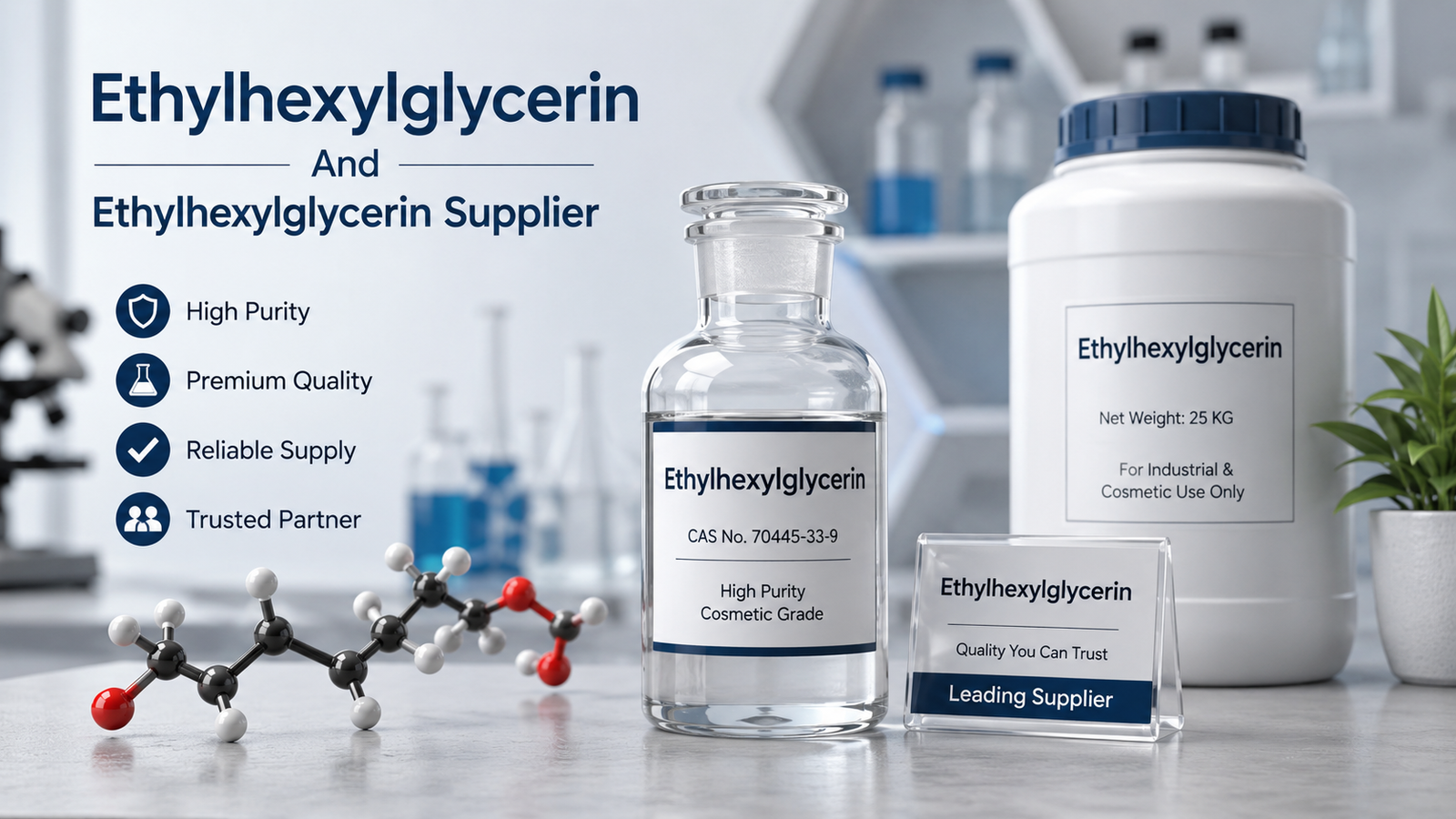
Modern cosmetic formulations require ingredients that do more than perform a single function. Manufacturers increasingly look for multifunctional materials that support product stability, sensory quality, and preservation systems without negatively affecting the consumer experience. Ethylhexylglycerin has become an important ingredient for this reason.
Commonly used in skincare, haircare, cleansing, and personal care formulations, Ethylhexylglycerin is valued primarily as a preservative booster, skin-conditioning ingredient, and deodorising agent. However, consistent performance depends heavily on ingredient quality. Choosing a dependable Ethylhexylglycerin Supplier is therefore an important step for cosmetic manufacturers, formulators, and private-label brands.
What Is Ethylhexylglycerin?
Ethylhexylglycerin is a multifunctional cosmetic ingredient derived from glycerin chemistry. It is widely incorporated into personal care formulations because it can improve skin feel while supporting the effectiveness of certain preservative systems.
Unlike a conventional standalone preservative, Ethylhexylglycerin is often used as a preservative enhancer. It can complement other antimicrobial ingredients and help formulators design efficient preservation strategies.
Its properties make it suitable for products such as facial creams, serums, lotions, shampoos, conditioners, deodorants, cleansing products, wipes, and makeup formulations.
Why Is Ethylhexylglycerin Popular in Cosmetics?
Cosmetic manufacturers continuously balance microbial protection, sensory performance, ingredient compatibility, and consumer expectations. Ethylhexylglycerin offers several formulation advantages within this process.
Its key functions may include:
- Supporting preservation systems and antimicrobial performance
- Providing skin-conditioning and emollient properties
- Improving the sensory feel of cosmetic formulations
- Helping control microorganisms associated with undesirable body odour
- Supporting modern multifunctional formulation strategies
- Working effectively in numerous skincare and personal care applications
Its actual performance depends on concentration, formulation type, pH, accompanying preservatives, manufacturing process, and other ingredients.
How Ethylhexylglycerin Works as a Preservative Booster
Preservation is essential in many water-containing cosmetics because microbial contamination can compromise product quality and consumer safety.
Ethylhexylglycerin is commonly incorporated alongside established preservative ingredients rather than automatically replacing them. In an appropriately designed formulation, it may enhance antimicrobial activity and allow formulators to build a broader preservation strategy.
However, preservation should never be determined simply by copying an ingredient percentage from another product. Finished formulations should undergo appropriate microbial testing and preservative efficacy or challenge testing according to applicable requirements.
Ethylhexylglycerin Applications
The versatility of Ethylhexylglycerin enables its use across several cosmetic categories.
Skincare Products
It can be incorporated into moisturisers, face creams, eye creams, serums, body lotions, sunscreens, and other skincare formulations. Its conditioning properties can complement ingredients intended to create a smooth and comfortable skin feel.
Haircare Products
Shampoos, conditioners, scalp-care products, hair masks, and styling formulations may contain Ethylhexylglycerin as part of their broader conditioning or preservation system.
Cleansing Formulations
Facial cleansers, body washes, liquid soaps, cleansing wipes, and similar water-based products require careful preservation. Ethylhexylglycerin may be combined with compatible preservation ingredients depending on the formulation.
Deodorant Products
Because Ethylhexylglycerin can help address microorganisms involved in odour formation, it is also used in certain deodorant formulations.
Ethylhexylglycerin Compared With Traditional Preservatives
| Feature | Ethylhexylglycerin | Traditional Preservatives |
| Primary role | Multifunctional preservative booster | Direct preservation |
| Skin-conditioning benefit | Commonly associated | Depends on ingredient |
| Antimicrobial contribution | Supports preservation systems | Usually primary function |
| Formulation use | Often used in combinations | May be used alone or combined |
| Application range | Skincare, haircare and personal care | Broad cosmetic applications |
The appropriate choice depends on the complete formulation rather than one ingredient considered in isolation.
How to Choose an Ethylhexylglycerin Supplier
Purchasing cosmetic raw materials involves much more than comparing prices. A professional Ethylhexylglycerin Supplier should provide reliable material quality, documentation, traceability, packaging, and commercial support.
Manufacturers should evaluate a supplier’s ability to provide specifications, certificates of analysis, Safety Data Sheets, batch information, storage recommendations, and other relevant technical documents.
Consistency between batches is particularly important for manufacturers producing products at commercial scale. Unexpected variations in raw-material quality can influence appearance, stability, processing, or finished-product performance.
Important Quality Factors Before Purchasing
Before ordering Ethylhexylglycerin, buyers should consider purity, appearance, specifications, manufacturing source, batch traceability, shelf life, recommended storage conditions, packaging type, minimum order quantity, and documentation availability.
Price should be evaluated alongside total procurement value. A slightly cheaper ingredient can become expensive if inconsistent quality creates formulation failures, production delays, or rejected batches.
For companies purchasing larger quantities, requesting a sample for laboratory evaluation before commercial ordering can be a sensible quality-control step.
Why Technical Documentation Matters
Documentation establishes traceability and helps manufacturers assess whether a raw material meets their internal quality requirements.
A dependable Ethylhexylglycerin Supplier should normally be able to provide relevant product specifications and batch-related information. Buyers may also request additional regulatory or quality documentation depending on the intended market and application.
Cosmetic regulations vary by country, so manufacturers remain responsible for verifying that their finished formulations and ingredients comply with the rules applicable to their target market.
Storage and Handling of Ethylhexylglycerin
Raw materials should be stored according to the supplier’s technical recommendations. Containers should remain properly closed and protected from unsuitable environmental conditions or contamination.
Production personnel should follow appropriate industrial hygiene, handling procedures, and Safety Data Sheet guidance.
Correct warehouse management should also include batch identification and inventory rotation so that older approved material is used appropriately before newer stock.
FAQs About Ethylhexylglycerin
1. What is Ethylhexylglycerin used for?
It is primarily used as a multifunctional cosmetic ingredient offering skin-conditioning properties and supporting preservation systems.
2. Is Ethylhexylglycerin a preservative?
It is commonly described as a preservative booster or antimicrobial-enhancing ingredient rather than automatically being treated as a complete standalone preservation solution.
3. Is Ethylhexylglycerin used in skincare?
Yes. It is found in creams, lotions, serums, cleansers, and numerous other skincare products.
4. Can Ethylhexylglycerin be used in haircare?
Yes. Depending on formulation requirements, it may be used in shampoos, conditioners, masks, and other haircare products.
5. Why do formulators combine it with other preservatives?
Combining compatible ingredients can help create an effective preservation system suited to the finished formulation.
6. Can Ethylhexylglycerin improve skin feel?
Its conditioning and emollient characteristics can contribute to a smoother sensory profile in suitable formulations.
7. How much Ethylhexylglycerin should be used?
The appropriate level depends on the formulation, intended function, supplier recommendations, compatibility, and regulatory requirements. Formulators should rely on validated testing rather than a universal dosage.
8. What should I ask an Ethylhexylglycerin Supplier for?
Request product specifications, COA, SDS, batch traceability, storage information, shelf-life information, packaging details, and other documentation required for your market.
9. Should manufacturers test Ethylhexylglycerin samples?
Laboratory evaluation is advisable when qualifying a new supplier or introducing the material into a new formulation.
10. Is the cheapest supplier always the best choice?
No. Quality consistency, documentation, technical support, reliable delivery, and traceability can be more important than the lowest purchase price.