
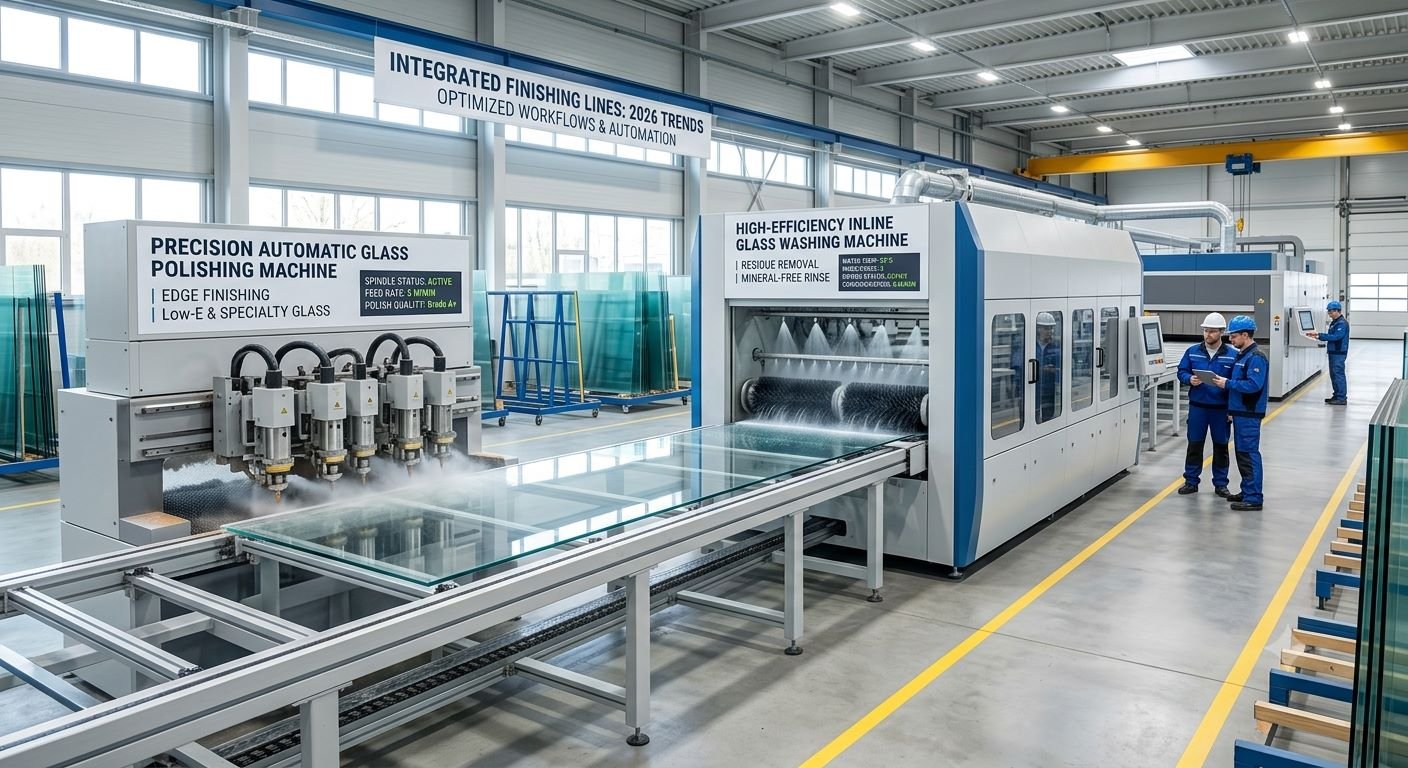
Glass may appear simple when installed in a building, showroom, vehicle, or piece of furniture, but achieving that flawless finish involves several carefully controlled manufacturing stages. Cutting is only the beginning. The glass must often be edged, polished, cleaned, dried, inspected, and prepared for further processing.
Among the equipment responsible for these results, the glass polishing machine and glass washing machine perform particularly important roles. One creates refined edges, while the other prepares a clean surface for subsequent manufacturing.
For glass processors looking to improve consistency, productivity, and finished appearance, understanding these machines is an important step towards building an efficient production line.
Modern Glass Manufacturing Demands Better Finishing
Today’s glass products are used in applications where appearance and dimensional accuracy matter considerably. Frameless doors, mirrors, partitions, tabletops, display units, façades, and shower screens are good examples.
Once a glass sheet has been cut, its edges may remain sharp or visually unfinished. Processing can also leave dust, coolant, fingerprints, and microscopic particles across the surface.
Professional manufacturers therefore focus on two essential objectives:
- Creating smooth, accurately finished edges
- Maintaining clean glass surfaces throughout production
This combination supports better presentation and prepares glass correctly for downstream processes.
The Role of a Glass Polishing Machine
A glass polishing machine transforms a rough glass edge into a controlled, smooth, and attractive finish.
Depending on its configuration, the equipment may perform grinding, edging, chamfering, or polishing operations. Abrasive and polishing wheels progressively work on the glass as it travels through the machine.
Instead of relying heavily on manual finishing, automated machinery helps manufacturers maintain repeatable results across larger batches.
This is particularly useful when processing glass for:
- Furniture and tabletops
- Mirrors
- Interior partitions
- Glass doors
- Shower screens
- Shelving
- Display counters
- Architectural installations
Edge quality is especially noticeable in applications where the glass remains exposed rather than hidden inside a frame.
How the Polishing Process Works
Glass edge finishing generally happens progressively rather than through one aggressive operation.
Initial Grinding
The first stage removes sharp areas and irregularities left by cutting. Appropriate grinding wheels prepare the required edge geometry.
Fine Edge Processing
Finer abrasives refine the surface created during initial grinding and reduce visible processing marks.
Final Polishing
Polishing wheels produce the final smooth appearance according to the required product specification.
Why Machine Settings Matter
Wheel condition, conveyor speed, cooling water, pressure, glass thickness, and spindle positioning can all influence the final result.
Correct adjustment is therefore just as important as selecting good machinery.
Why Cleanliness Is a Production Requirement
An attractive polished edge does not automatically mean the glass is ready for the next operation.
During cutting, drilling, grinding, and polishing, contaminants can remain on the glass. These may include fine particles, water residue, lubricants, fingerprints, or grinding debris.
Leaving such contamination untreated can create complications during subsequent manufacturing.
A glass washing machine addresses this challenge by cleaning and drying the glass under controlled conditions.
Understanding a Glass Washing Machine
Industrial glass washing equipment typically moves sheets through a controlled cleaning section using conveyor rollers.
Depending on machine design, the process may involve spraying water, rotating brushes, filtration systems, rinsing, and high-velocity air drying.
The purpose is not simply to make the glass look clean. Proper washing prepares the surface for processes where contamination can affect final quality.
Common downstream applications include:
- Tempering
- Laminating
- Insulating glass manufacturing
- Ceramic printing
- Digital printing
- Coating
- Mirror production
- Final inspection
For this reason, washing equipment should be considered an integral production machine rather than basic cleaning equipment.
How Polishing and Washing Work Together
The glass polishing machine and glass washing machine perform separate but complementary operations.
| Production Factor | Glass Polishing Machine | Glass Washing Machine |
| Main function | Edge finishing | Surface cleaning |
| Works primarily on | Glass edges | Glass surfaces |
| Removes cutting irregularities | Yes | No |
| Removes processing contamination | Partially | Yes |
| Uses polishing wheels | Yes | No |
| Uses brushes/washing systems | No | Yes |
| Main outcome | Refined edges | Clean, dry glass |
For many applications, glass can move from cutting to edging and polishing, followed by washing and inspection.
This organised workflow can reduce unnecessary handling while keeping production stages clearly defined.
Productivity Benefits of Automated Glass Processing
Automation becomes increasingly valuable as production volumes rise.
Manual glass handling and finishing require skilled labour and can introduce variation between individual pieces. Machines provide greater control over processing parameters and repetitive operations.
Potential operational benefits include:
- More consistent edge finishing
- Faster batch processing
- Reduced dependence on manual polishing
- Better production planning
- Cleaner glass before secondary processing
- Improved repeatability
- Easier integration with conveyors and automated lines
However, the highest-capacity machine is not automatically the best choice. Equipment should correspond to actual production requirements.
Choosing the Right Glass Polishing Machine
Before purchasing polishing equipment, manufacturers should define exactly what they process.
Glass dimensions and thickness are obvious considerations, but edge style and production volume are equally important.
Important specifications to evaluate include:
- Minimum glass dimensions
- Maximum supported thickness
- Processing speed
- Number of grinding spindles
- Number of polishing wheels
- Edge profiles available
- Conveyor construction
- Cooling arrangement
- Control system
- Adjustment options
- Spare-parts availability
Manufacturers planning future expansion should also consider whether the machine can integrate with automated loading and downstream equipment.
Choosing the Right Glass Washing Machine
Washing requirements depend heavily on what happens after cleaning.
Glass destined for laminating, printing, coating, or insulating glass manufacturing may require particularly controlled surface preparation.
When comparing a glass washing machine, consider:
- Maximum processing width
- Supported thickness range
- Minimum glass size
- Brush arrangement
- Water filtration
- Water recycling capability
- Drying technology
- Conveyor speed
- Internal construction materials
- Maintenance accessibility
- Energy requirements
Effective drying is especially important because residual moisture or watermarks can reduce the quality of an otherwise successful washing process.
Maintenance Is Part of Quality Control
Machine maintenance should not begin only after production quality deteriorates.
A preventive programme helps manufacturers identify wear before it creates significant downtime.
For polishing equipment, operators should regularly inspect abrasive wheels, polishing wheels, coolant systems, conveyors, bearings, and spindle alignment.
For washing equipment, attention should be given to brushes, filters, water tanks, spray nozzles, rollers, blowers, and drying sections.
Recording maintenance activities can also help production managers identify recurring issues and determine when components normally require replacement.
Frequently Asked Questions
What is the main purpose of a glass polishing machine?
Its main purpose is to grind and polish cut glass edges, producing a smoother and more controlled finish.
Is glass polishing necessary after every cutting operation?
Not always. The requirement depends on the final application and specified edge quality.
What contaminants can a glass washing machine remove?
It can help remove glass particles, dust, coolant residue, fingerprints, and other processing contamination.
Should glass be washed before laminating?
Clean surfaces are important in laminated glass manufacturing because contaminants between layers can affect appearance and processing quality.
Can polishing machinery process thick glass?
Many industrial machines can process different thicknesses, but supported specifications vary between models.
What causes poor polishing results?
Possible causes include worn wheels, incorrect machine settings, inadequate coolant, excessive processing speed, or improper alignment.
Why does drying matter after glass washing?
Remaining water can create marks or interfere with inspection and subsequent production operations.
Can washing equipment be connected to other machines?
Yes. Many industrial configurations can be incorporated into continuous or automated processing lines.
How can manufacturers improve machine lifespan?
Routine cleaning, preventive maintenance, correct operating parameters, timely component replacement, and proper operator training can support longer service life.
Which machine should a new glass factory purchase first?
The answer depends on the products being manufactured. Production sequence, glass specifications, output requirements, and secondary processes should determine equipment priorities.