
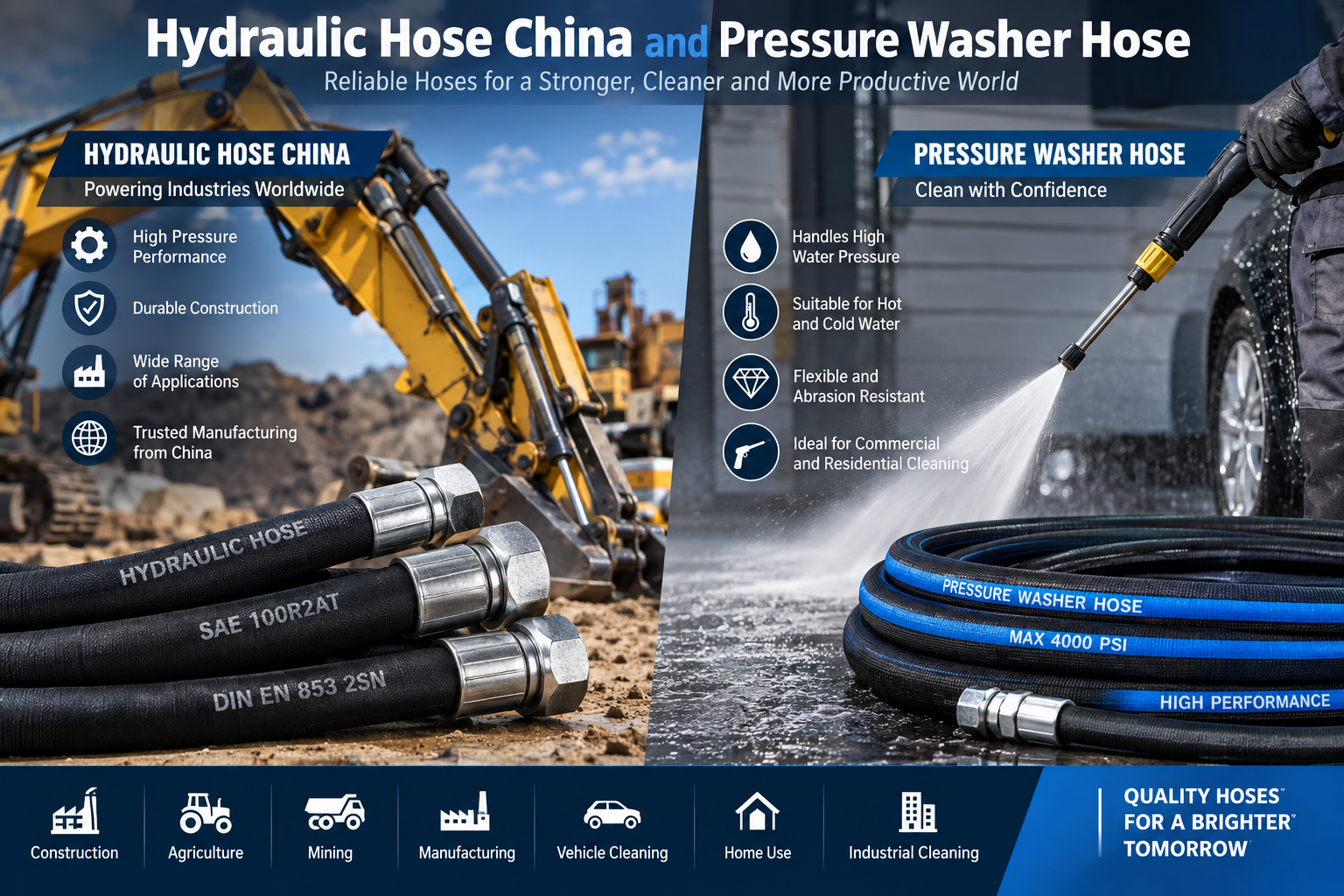
Modern industries rely on controlled fluid movement for everything from lifting heavy machinery to removing stubborn dirt from industrial equipment. Behind many of these operations is a component that often receives little attention until something goes wrong—the hose.
Hydraulic Hose China products are widely used in hydraulic machinery where pressurized oil transfers power between system components. A Pressure Washer Hose, meanwhile, delivers high-pressure water for demanding cleaning applications. Although both hoses operate under pressure, their internal construction, working environment, materials, and intended purposes are quite different.
Understanding these differences helps equipment manufacturers, distributors, maintenance teams, and industrial buyers choose a hose that delivers dependable performance without unnecessary downtime.
Why High-Pressure Hoses Matter in Modern Equipment
A hose may appear to be a simple flexible tube, but high-pressure applications place significant mechanical demands on it. The hose must contain pressurized fluid while dealing with movement, vibration, temperature changes, abrasion, and repeated operating cycles.
In hydraulic machinery, hose failure can interrupt the transfer of power and stop equipment operation. In pressure washing equipment, a damaged hose can reduce cleaning performance and create operational hazards.
For this reason, hose selection should consider the complete application rather than focusing only on price or external appearance.
Important considerations include:
- Maximum working pressure
- Fluid or water temperature
- Hose internal diameter
- Reinforcement construction
- Chemical compatibility
- Bend requirements
- External abrasion
- Connection type
- Operating environment
Matching these characteristics to actual working conditions is fundamental to dependable hose performance.
Understanding Hydraulic Hose China Manufacturing
The Hydraulic Hose China market serves numerous industries and offers products ranging from lightweight textile-reinforced hoses to heavy-duty multi-spiral hydraulic assemblies.
Hydraulic hoses are designed primarily to transfer hydraulic fluids between pumps, cylinders, motors, control valves, and other components.
A conventional hydraulic hose contains three functional sections.
The inner tube carries the hydraulic medium and must resist deterioration caused by the fluid.
The reinforcement layer provides structural strength. Depending on pressure requirements, manufacturers may use textile braid, steel-wire braid, or multiple layers of spiral wire.
Finally, the outer cover protects the reinforcement against environmental damage, including abrasion, oil exposure, weather, and mechanical wear.
Quality Hydraulic Hose China manufacturers may offer different constructions for agricultural, construction, mining, transportation, and industrial machinery.
Where Hydraulic Hoses Are Commonly Used
Hydraulic technology allows equipment to generate and control considerable force within relatively compact systems. Flexible hoses make it possible to transfer hydraulic power between components that move during operation.
Common applications include:
- Excavators and earthmoving machinery
- Tractors and agricultural equipment
- Forklifts and material-handling machines
- Hydraulic presses
- Mining equipment
- Cranes and lifting machinery
- Manufacturing systems
- Mobile hydraulic equipment
Every application can have different requirements. A hose suitable for a moderate-pressure agricultural system may not be appropriate for a severe high-impulse construction application.
How a Pressure Washer Hose Performs
A Pressure Washer Hose connects the high-pressure side of a pressure washer with the spray gun, lance, or other cleaning accessory.
It needs to contain pressurized water while remaining flexible enough for practical movement around the cleaning area.
Pressure washer hoses are used for:
- Car and commercial vehicle washing
- Factory floor cleaning
- Agricultural machinery maintenance
- Building exterior washing
- Construction equipment cleaning
- Workshop maintenance
- Commercial cleaning services
- Industrial surface preparation
Professional cleaning environments can be particularly demanding because the hose may frequently contact concrete, pavement, machinery, or other abrasive surfaces.
For this reason, abrasion resistance can be just as important as flexibility.
Hydraulic Hose China vs Pressure Washer Hose
| Selection Factor | Hydraulic Hose | Pressure Washer Hose |
| Typical medium | Hydraulic oil/fluid | Water |
| Main function | Hydraulic power transmission | High-pressure cleaning |
| Common equipment | Excavators, tractors, presses | Pressure washers |
| Reinforcement | Textile, wire braid, spiral wire | Textile or wire reinforcement |
| Major concern | Pressure, impulse and fluid compatibility | Pressure, temperature and abrasion |
| Typical movement | Machinery articulation | Operator handling |
| Connections | Hydraulic fittings | Washer-specific fittings |
The table highlights an important point: hoses that appear similar should not automatically be substituted for one another.
Always use a hose approved for the intended application.
What Makes a Reliable Hydraulic Hose?
A quality hydraulic hose must perform consistently under its specified operating conditions.
When evaluating Hydraulic Hose China options, examine more than the hose’s stated pressure rating.
The inner tube should be compatible with the hydraulic medium. Reinforcement must provide the required pressure capability, while the outer cover should protect against expected environmental conditions.
Flexibility is also important. A hose that cannot follow the required routing may experience unnecessary mechanical stress.
Buyers should therefore review:
- Hose dimensions
- Working-pressure rating
- Temperature range
- Minimum bend radius
- Fluid compatibility
- Reinforcement construction
- Applicable standards
- Fitting requirements
- Manufacturer testing information
These details make it easier to compare products based on engineering suitability rather than cost alone.
Choosing the Right Pressure Washer Hose
Selecting a Pressure Washer Hose begins with the specifications of the pressure washer itself.
First, identify the equipment’s operating pressure. The selected hose must have an appropriate working-pressure rating for the intended system.
Next, check temperature requirements. A hose intended for cold-water equipment should not automatically be used with a hot-water pressure washer.
Diameter also matters because the internal passage influences water flow.
Connection compatibility is another essential factor. A replacement hose should connect correctly to the machine, spray gun, reel, and accessories.
Finally, consider the working environment. Commercial operators who regularly drag hoses across rough surfaces may benefit from products designed for enhanced abrasion resistance.
Understanding Working Pressure and Burst Pressure
Working pressure and burst pressure describe different characteristics.
Working pressure relates to normal operation within specified conditions. Burst pressure refers to the pressure reached during destructive testing.
A higher burst-pressure figure does not mean the hose should routinely operate at that pressure.
For both Hydraulic Hose China products and Pressure Washer Hose solutions, purchasing decisions should primarily be based on the manufacturer’s specified working conditions and equipment requirements.
Operating beyond rated limits can accelerate deterioration and increase the risk of failure.
Why Hose Routing Is Important
Correct installation can significantly influence hose life.
A correctly selected hose may still fail prematurely if it is twisted, stretched, sharply bent, or constantly rubbed against surrounding components.
During installation:
- Avoid twisting the hose.
- Respect the specified minimum bend radius.
- Provide sufficient length for equipment movement.
- Prevent unnecessary contact with sharp edges.
- Protect the hose from excessive heat.
- Secure routing where appropriate.
- Avoid excessive tension at fittings.
Hydraulic hoses installed on moving machinery deserve particular attention because equipment articulation can repeatedly flex the assembly.
Signs That a Hose Needs Attention
Regular visual inspection is one of the simplest ways to identify developing problems.
Watch for:
- Cracked outer covers
- Fluid or water leakage
- Exposed reinforcement
- Severe abrasion
- Bulges or deformation
- Damaged fittings
- Corrosion around connections
- Kinks
- Unusual stiffness
- Loose connections
A damaged high-pressure hose should be removed from service according to manufacturer and equipment maintenance guidance rather than relying on improvised repairs.
How Buyers Can Evaluate Hydraulic Hose China Suppliers
International sourcing requires careful supplier evaluation.
Before purchasing Hydraulic Hose China products in volume, request detailed technical information and confirm whether the manufacturer can consistently supply the required specifications.
Consider asking about:
- Manufacturing capabilities
- Quality-control procedures
- Relevant product standards
- Pressure and impulse testing
- Raw-material controls
- Product traceability
- Available hose sizes
- Fitting and assembly capabilities
- Packaging options
- Production lead times
Samples may also help buyers verify dimensions, construction, labeling, and compatibility before committing to larger orders.
Frequently Asked Questions
1. What is the primary purpose of a hydraulic hose?
It carries hydraulic fluid between components and enables hydraulic power transmission within machinery.
2. Why are Hydraulic Hose China products popular internationally?
China has a large industrial manufacturing base offering numerous hose constructions, specifications, and production capabilities.
3. What does a Pressure Washer Hose carry?
It primarily carries pressurized water between the pressure washer and cleaning attachment.
4. Are hydraulic and pressure washer hoses interchangeable?
Not automatically. Their intended fluids, construction, temperature limits, fittings, and operating requirements can differ.
5. Why is reinforcement necessary?
Reinforcement helps the hose withstand internal pressure while maintaining structural integrity.
6. What should I check before buying a pressure washer hose?
Check working pressure, temperature, diameter, length, fitting compatibility, flexibility, and abrasion resistance.
7. Why is minimum bend radius important?
Bending a hose too tightly can place excessive stress on its structure and shorten service life.
8. How should hydraulic hoses be maintained?
Inspect them regularly, maintain proper routing, prevent excessive abrasion, and replace damaged assemblies when required.
9. What information should a hydraulic hose supplier provide?
A professional supplier should provide relevant specifications covering dimensions, pressure, temperature, construction, compatibility, and applicable standards.
10. Is the cheapest hydraulic hose always economical?
Not necessarily. Product life, consistency, equipment compatibility, downtime, and replacement costs should also be considered.