
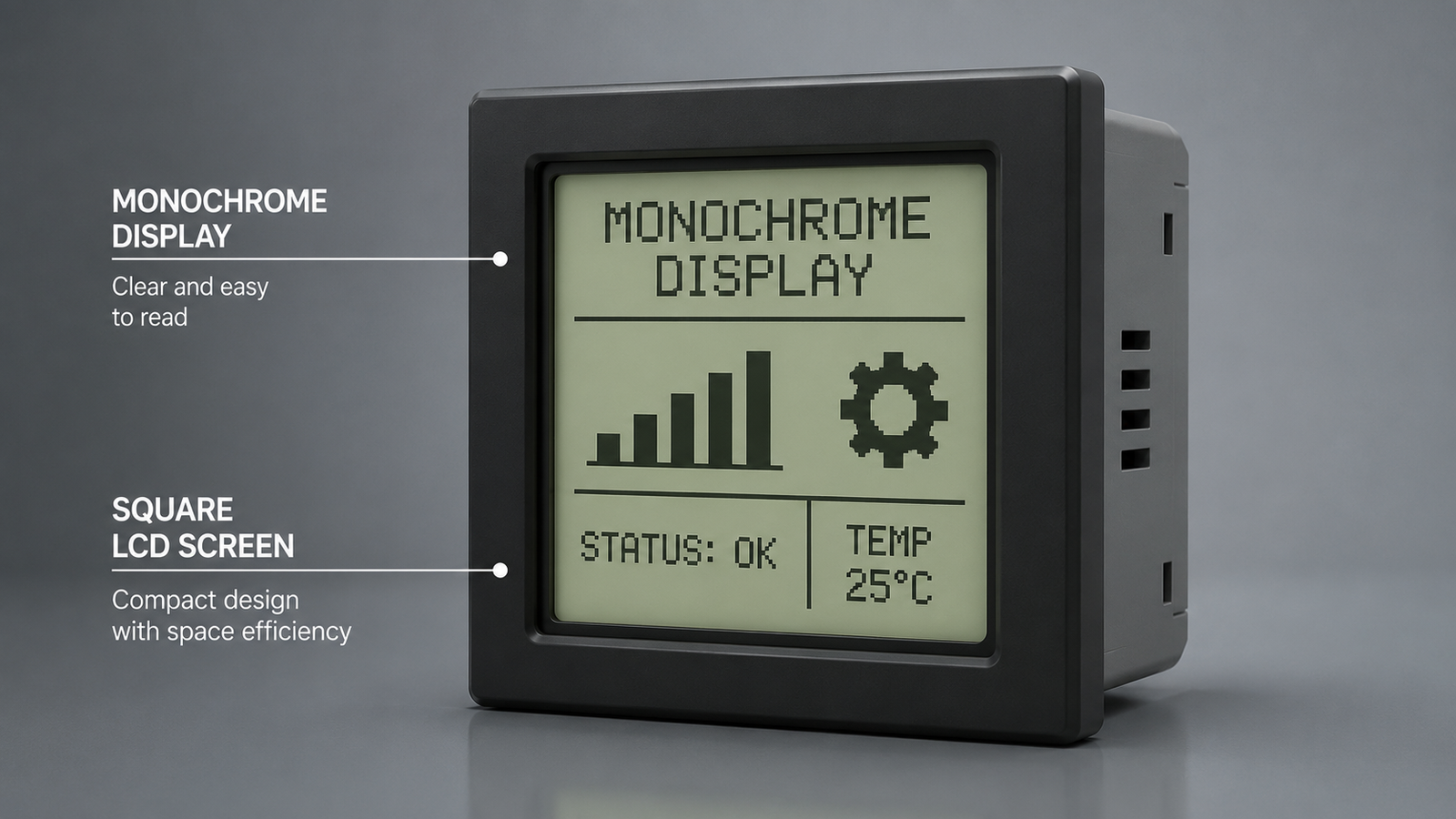
Display technology does not always need millions of colours, ultra-high resolution, or complex graphics. In industrial equipment, medical instruments, smart meters, control panels, handheld electronics, and embedded systems, simplicity, clarity, reliability, and low power consumption often matter more. This is where a Monochrome Display and Square LCD Screen provide significant advantages.
These display solutions can deliver excellent readability while keeping product design compact, energy-efficient, and cost-effective. Understanding their technologies, specifications, benefits, and applications can help engineers and manufacturers select the right display for a particular electronic product.
What Is a Monochrome Display?
A Monochrome Display is designed to present information using primarily one foreground colour against a contrasting background rather than producing full-colour images. Depending on the display technology and backlight, characters or graphics may appear black, white, blue, green, amber, or another selected colour.
Monochrome screens are widely used for displaying:
- Numbers and measurement values
- Text and menus
- Symbols and warning indicators
- Simple graphics
- Equipment operating conditions
- Battery and connectivity status
- Industrial process information
The relatively simple display architecture makes monochrome technology particularly suitable for products where dependable information presentation is more important than multimedia capability.
How Does a Monochrome Display Work?
The operating principle varies according to the underlying display technology. A typical monochrome LCD contains liquid crystal material positioned between transparent conductive layers and polarising filters.
Electrical signals applied to individual pixels alter the orientation of the liquid crystals. This controls the amount of light passing through particular sections of the screen and forms numbers, letters, symbols, or graphics.
Different configurations include reflective, transmissive, and transflective displays.
Reflective screens use surrounding light and can operate without continuous backlighting. Transmissive screens depend primarily on a backlight, while transflective displays combine characteristics of both technologies for flexible indoor and outdoor viewing.
Major Types of Monochrome LCD Technology
Several LCD technologies can be used depending on performance requirements.
TN (Twisted Nematic) technology offers simple construction, relatively fast response, and economical manufacturing. It works well for straightforward displays viewed primarily from a predictable direction.
STN (Super Twisted Nematic) displays generally provide improved contrast and wider viewing characteristics compared with basic TN technology.
FSTN (Film Compensated Super Twisted Nematic) incorporates an additional compensation film to enhance contrast and produce a cleaner appearance.
Graphic monochrome LCD modules use individually controlled pixels, allowing manufacturers to display customised graphics, icons, text, and interface elements instead of relying only on predefined segments.
What Is a Square LCD Screen?
A Square LCD Screen has approximately equal width and height dimensions, producing a balanced display area that differs from conventional widescreen panels.
Square formats can be particularly effective for applications where information needs to be arranged symmetrically. Circular gauges, equipment status indicators, icons, menus, diagrams, numerical readings, and control interfaces can all fit naturally within a square display.
Product designers frequently consider these screens for:
- Industrial controllers
- Smart home devices
- Measurement equipment
- Medical instruments
- Portable electronics
- Laboratory devices
- Communication equipment
- Custom embedded systems
Their geometry can also provide greater flexibility when designing compact front panels.
Monochrome Display vs Colour Display
| Feature | Monochrome Display | Colour Display |
| Colour capability | Single or limited colour | Thousands or millions |
| Power requirements | Generally lower | Generally higher |
| Interface complexity | Relatively simple | Usually more complex |
| Typical content | Text, icons, readings | Images, video, graphics |
| Processing requirement | Lower | Higher |
| Common applications | Instruments and controls | Multimedia interfaces |
| Cost considerations | Often economical | Usually comparatively higher |
Neither option is universally superior. The correct technology depends on what information the product needs to communicate.
For equipment that primarily displays measurements, status information, menus, or basic graphics, a Monochrome Display can avoid unnecessary hardware complexity.
Key Benefits of a Square LCD Screen
A Square LCD Screen offers more than an unusual shape. Its geometry can improve the organisation of graphical information and provide balanced space around interface elements.
Square screens are particularly useful for layouts containing centralised information. Designers can place important measurements in the centre while surrounding them with icons, indicators, or navigation controls.
Depending on the LCD technology, other potential advantages include compact construction, low energy consumption, good readability, simple integration, and compatibility with customised user-interface designs.
This combination makes square displays attractive for both functional industrial equipment and aesthetically focused consumer electronics.
Important Specifications When Selecting a Display
Choosing a display simply by looking at its physical dimensions can lead to integration problems. Engineers should evaluate the entire specification before committing to a screen.
Important considerations include screen size, active viewing area, resolution, operating voltage, viewing direction, contrast ratio, operating temperature, storage temperature, response time, backlight configuration, interface type, connector arrangement, module thickness, controller compatibility, and expected service environment.
For a Square LCD Screen, resolution deserves particular attention because the graphical interface should be designed specifically for the panel’s pixel dimensions.
Outdoor equipment may additionally require improved sunlight visibility, extended operating temperatures, protective construction, and appropriate optical characteristics.
Monochrome Display Applications
The versatility of monochrome technology allows it to appear across many industries.
Industrial equipment uses these displays for machine settings, production data, alarm messages, and operating conditions. Test and measurement devices can show voltage, pressure, temperature, frequency, and other readings clearly.
Medical equipment may use monochrome screens where precise and uncomplicated presentation of operational information is required.
Smart meters, security equipment, communication devices, automotive accessories, vending equipment, office electronics, and battery-powered products can also benefit from their relatively straightforward architecture.
A properly specified Monochrome Display provides exactly the information users need without requiring unnecessary graphical processing.
Custom Monochrome and Square LCD Solutions
Standard display modules work well for many applications, but specialised electronic products may require customised solutions.
Customisation can involve:
- Unique LCD dimensions
- Special viewing areas
- Custom segment patterns
- Different polariser configurations
- Specific backlight colours
- Connector modifications
- Interface requirements
- Custom glass dimensions
- Logo or icon integration
- Special operating-temperature requirements
Manufacturers developing equipment in large quantities should consider customisation early because mechanical design, electronics, firmware, and enclosure development are closely connected to display specifications.
How to Choose Between Standard and Custom Displays
A standard Square LCD Screen is usually suitable when an available module already satisfies mechanical, electrical, environmental, and interface requirements.
Custom development becomes more valuable when the display forms an important part of the product’s identity or when space restrictions prevent standard modules from fitting correctly.
Before deciding, evaluate expected production quantity, development budget, enclosure dimensions, required resolution, interface compatibility, viewing environment, supply continuity, and future product revisions.
Selecting the display early in product development can reduce costly redesign work later.
Frequently Asked Questions
1. What is a Monochrome Display?
It is a display designed primarily to show information using one foreground colour against a contrasting background rather than full-colour graphics.
2. Does monochrome mean only black and white?
No. Depending on the technology and backlight, monochrome displays can appear in blue, green, amber, white, black, or other combinations.
3. What is a Square LCD Screen?
It is an LCD with roughly equal width and height dimensions, creating a square viewing area suitable for balanced interface designs.
4. Are monochrome LCDs energy efficient?
Many monochrome LCD configurations require relatively little power, making them suitable for battery-powered and energy-conscious electronics.
5. Where are monochrome screens commonly used?
Typical applications include industrial controllers, meters, measurement instruments, medical equipment, communication devices, and embedded electronics.
6. Can a monochrome LCD display graphics?
Yes. Graphic monochrome LCD modules can display icons, customised characters, diagrams, menus, and other pixel-based graphics.
7. Can a Square LCD Screen be customised?
Depending on manufacturing capabilities, dimensions, backlighting, interface arrangements, optical properties, connectors, and other specifications may be customised.
8. Which specification is most important when choosing an LCD?
There is no single specification. Resolution, dimensions, interface, voltage, temperature range, viewing conditions, and mechanical compatibility should all be considered.
9. Are monochrome displays suitable for outdoor devices?
They can be, particularly when an appropriate reflective or transflective configuration and suitable operating specifications are selected.
10. Should I choose a monochrome or colour LCD?
Choose monochrome technology when simple information, low power consumption, and straightforward integration are priorities. Choose colour when detailed graphical content or rich visual interfaces are necessary.