
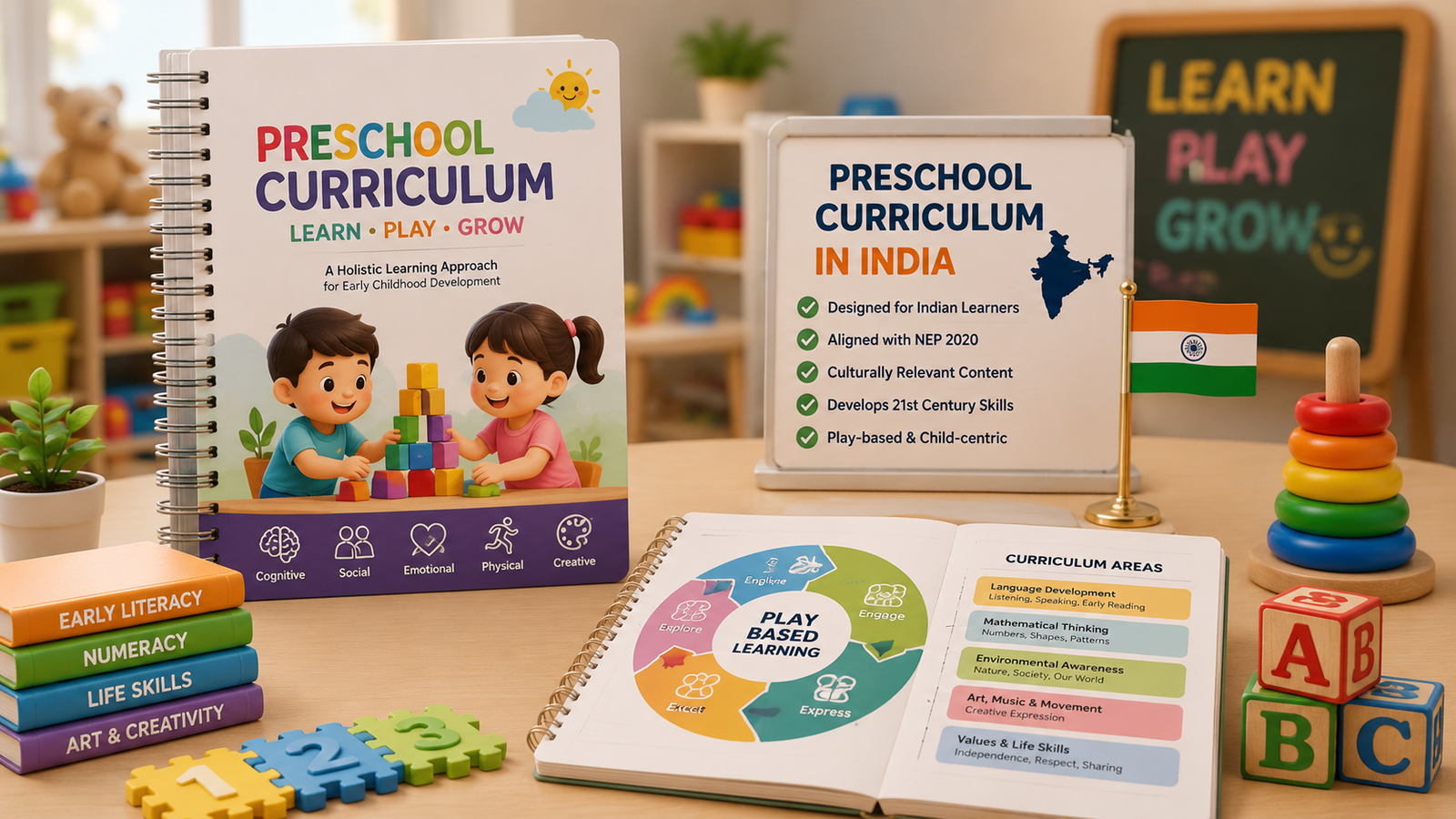
The first few years of education influence how children communicate, solve problems, build relationships and approach learning. A thoughtfully designed preschool curriculum therefore goes beyond teaching letters, numbers and colours. It creates opportunities for children to explore, communicate, play, experiment and gradually become confident learners.
For parents and educators evaluating a preschool curriculum in India, the important question is not simply, “What will the child learn?” It is also, “How will the child learn it?”
A strong early-years programme balances structured learning with play, creativity, movement, social interaction and age-appropriate experiences. It should support the whole child rather than rushing children towards formal academics before they are developmentally ready.
What Is a Preschool Curriculum?
A preschool curriculum is a structured framework that guides learning experiences for young children before they enter formal primary education. It defines the skills, concepts, activities and developmental goals that teachers introduce through classroom experiences.
An effective curriculum generally supports several interconnected areas:
- Language and communication
- Early literacy
- Numeracy and mathematical thinking
- Physical and motor development
- Social and emotional development
- Creativity and imagination
- Environmental awareness
- Problem-solving and logical thinking
- Independence and everyday life skills
For example, sorting colourful blocks may appear to be a simple game. In reality, children can learn about colours, shapes, classification, comparison, counting and decision-making through the same activity.
This integrated approach is one of the reasons play has such an important role in quality early childhood education.
Why Does a Good Preschool Curriculum Matter?
Preschool is often a child’s first experience of learning regularly outside the home. The environment and teaching approach can influence the child’s attitude towards school and learning.
A well-planned preschool curriculum provides consistency while allowing teachers enough flexibility to respond to individual developmental differences.
Instead of focusing exclusively on worksheets or memorisation, children should have opportunities to ask questions, handle objects, listen to stories, participate in conversations and learn through practical experiences.
The objective is not to turn preschool into an early version of primary school. It is to prepare children developmentally for the learning experiences that come next.
What Should a Preschool Curriculum in India Include?
A quality preschool curriculum in India should recognise children’s developmental needs while remaining relevant to their social, cultural and everyday environment.
Several learning areas deserve particular attention.
Language and Early Literacy
Language development begins long before children can independently read or write.
Preschool activities can introduce vocabulary, listening skills, phonological awareness and early literacy through:
- Storytelling
- Picture conversations
- Rhymes and songs
- Show-and-tell sessions
- Role play
- Letter and sound recognition
- Pre-writing activities
Teachers should encourage children to speak, listen and express their ideas rather than simply memorising information.
Suggested internal link: Early Literacy Activities for Preschoolers
Early Numeracy and Mathematical Thinking
Early mathematics should be practical and visual.
Children can explore numbers through toys, classroom objects, puzzles, building blocks and everyday situations. Activities may introduce counting, patterns, shapes, sizes, sequencing, matching and comparison.
For example, asking children to arrange objects from smallest to largest develops mathematical thinking without making the activity feel like a formal lesson.
Suggested internal link: Fun Maths Activities for Preschool Children
Social and Emotional Development
Academic knowledge alone does not prepare a young child for school.
Children also need to learn how to participate in groups, communicate their needs, wait for turns and manage everyday emotions.
Group games, classroom responsibilities, collaborative projects and imaginative play can help develop:
- Cooperation
- Empathy
- Confidence
- Self-expression
- Independence
- Sharing
- Conflict-resolution skills
These abilities contribute to school readiness and healthy classroom participation.
Physical and Motor Development
Young children need regular movement.
Running, balancing, climbing and outdoor games contribute to gross motor development. Drawing, threading beads, building with blocks, folding paper and handling age-appropriate craft materials can strengthen fine motor control.
Fine motor development is particularly important before children are expected to write comfortably.
Creative Learning
Art, music, dance, storytelling and imaginative play should not be treated merely as occasional entertainment.
Creative activities encourage children to make choices, communicate ideas and experiment without always looking for one predetermined answer.
A balanced preschool curriculum therefore provides regular opportunities for drawing, painting, music, movement, pretend play and craft activities.
Suggested internal link: Creative Activities for Early Childhood Development
Play-Based Learning Versus Academic-Heavy Learning
Parents sometimes associate more worksheets and homework with better educational quality. In preschool, however, learning can happen effectively through purposeful play and guided activities.
| Play-Based Learning | Academic-Heavy Approach |
| Encourages exploration | Often emphasises instruction |
| Uses practical experiences | May rely heavily on worksheets |
| Supports imagination | Focuses more on predetermined answers |
| Encourages peer interaction | Can involve more individual desk work |
| Integrates several skills | Often separates learning into subjects |
| Allows active participation | May depend more on repetition |
This does not mean academics should be absent. Children can certainly develop early literacy and numeracy skills. The difference lies in how these concepts are introduced.
A skilled educator can turn an ordinary activity into a meaningful learning experience.
The Role of Teachers in Preschool Learning
Even an excellent curriculum depends heavily on how teachers implement it.
Preschool teachers need to observe children carefully, understand developmental differences and adapt activities when necessary.
One child may confidently participate in storytelling but require additional support with fine motor tasks. Another may recognise numbers quickly but need encouragement during group activities.
Effective teachers use these observations to provide appropriate support rather than expecting every child to progress identically.
Parents evaluating a preschool should therefore ask about teacher training, classroom practices and child assessment—not only the curriculum name.
How Can Parents Evaluate a Preschool Curriculum?
Parents can make better decisions by looking beyond brochures and impressive terminology.
When visiting or speaking with a preschool, consider asking:
- How much of the daily programme involves play and hands-on learning?
- How are language and numeracy introduced?
- How much outdoor or physical activity is included?
- How does the school monitor children’s developmental progress?
- How are parents informed about learning and development?
- What happens when a child learns faster or needs additional support?
- How much homework or worksheet-based work is expected?
- What qualifications or early-years training do teachers receive?
Parents should also observe the classroom environment. Accessible books, puzzles, learning materials, creative resources and child-friendly activity areas can reveal a great deal about how the curriculum works in practice.
Suggested internal link: How to Choose the Right Preschool for Your Child
Financial Considerations When Choosing a Preschool
Cost is understandably an important factor for many families, but preschool fees should be considered alongside the overall educational experience.
Parents should ask exactly what the quoted fee covers. Depending on the institution, additional expenses may include learning materials, uniforms, transport, activities, events or other services.
Instead of comparing schools exclusively on headline fees, evaluate factors such as:
- Teacher quality and classroom support
- Learning resources
- Safety and hygiene practices
- Curriculum structure
- Parent communication
- Activity opportunities
- Location and transport requirements
- Additional charges
The most expensive preschool is not automatically the most suitable, just as the lowest-cost option is not necessarily poor quality.
The objective is to identify a programme that offers appropriate learning experiences within the family’s practical budget.
Local Relevance of Preschool Curriculum in India
India’s linguistic and cultural diversity makes local relevance particularly valuable in early education.
Stories, festivals, songs, nature, family experiences and familiar community examples can make concepts easier for young children to understand.
At the same time, children can gradually be introduced to broader ideas, cultures and environments.
A thoughtfully designed preschool curriculum in India can therefore combine local familiarity with wider exposure, helping children connect classroom learning with the world around them.
For families comparing nearby schools, location also has practical importance. Long daily travel can add time, cost and fatigue. Evaluating curriculum quality alongside distance, transport arrangements, timings and overall affordability can lead to a more practical long-term choice.
What Does School Readiness Actually Mean?
School readiness is broader than being able to write the alphabet or count to a particular number.
A child preparing for primary school benefits from being able to communicate basic needs, listen to instructions, participate in groups, attempt tasks independently and adapt to classroom routines.
Important readiness areas include:
- Communication
- Curiosity
- Attention
- Emotional regulation
- Motor coordination
- Basic literacy awareness
- Early number understanding
- Social interaction
- Independence
A strong preschool curriculum develops these abilities progressively rather than treating school readiness as an academic checklist.
Frequently Asked Questions
What is the main purpose of a preschool curriculum?
Its purpose is to support children’s cognitive, language, physical, social, emotional and creative development through age-appropriate learning experiences.
What should a good preschool curriculum include?
It should include early literacy, numeracy, communication, physical development, creative activities, social-emotional learning and opportunities for exploration.
What is important in a preschool curriculum in India?
It should combine developmentally appropriate learning with culturally and locally relevant experiences while preparing children gradually for formal schooling.
Is play-based learning suitable for preschool children?
Yes. Purposeful play can help children explore concepts, communicate, solve problems and practise social skills through meaningful experiences.
Should preschool children receive homework?
Requirements vary between schools. Parents should evaluate whether home activities are age-appropriate, manageable and genuinely useful rather than repetitive.
How are reading skills introduced in preschool?
They are commonly introduced through storytelling, rhymes, vocabulary development, picture books, sound awareness and gradual letter recognition.
How is mathematics taught at preschool level?
Children can learn mathematical concepts through counting objects, sorting, matching, puzzles, patterns, shapes and practical classroom activities.
How can parents compare preschool programmes?
Compare curriculum approach, teacher quality, classroom environment, safety, communication, learning resources, location, fees and additional costs.
Does an expensive preschool provide a better curriculum?
Not necessarily. Fees alone do not determine teaching quality or whether a programme is appropriate for an individual child.
How important are teachers in implementing the curriculum?
Teachers are central to successful implementation because they observe children’s development, guide activities, encourage participation and adapt learning experiences.
What is school readiness?
School readiness refers to a combination of communication, independence, social skills, emotional development, physical abilities and foundational academic awareness.
How can parents support the preschool curriculum at home?
Reading together, having conversations, counting everyday objects, drawing, playing games and encouraging independent tasks can reinforce classroom learning naturally.