
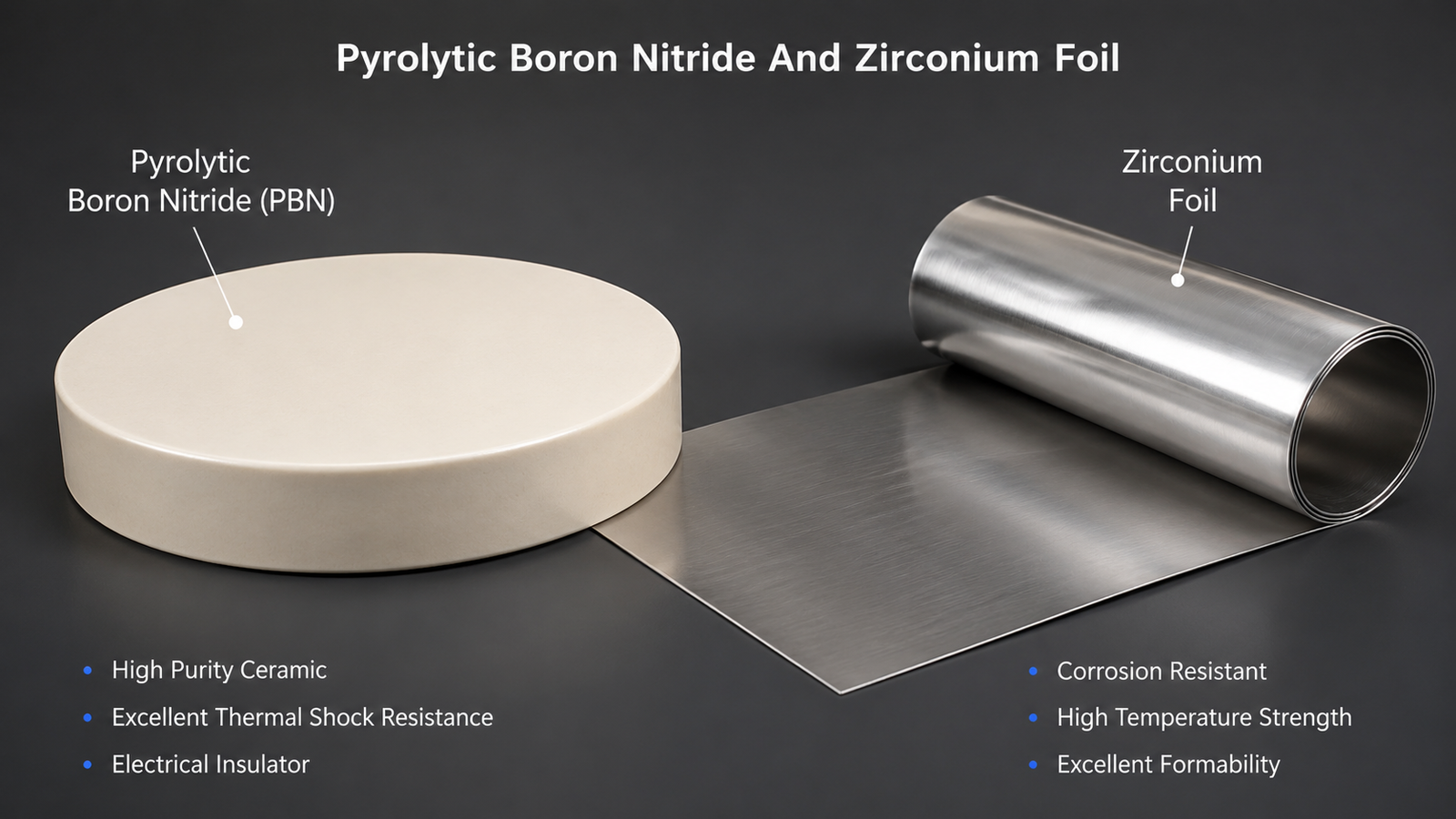
Advanced industries often operate under conditions where ordinary metals, ceramics, and polymers cannot provide reliable performance. High temperatures, vacuum environments, corrosive chemicals, electrical isolation, and strict contamination limits require specialised materials. Pyrolytic Boron Nitride and Zirconium Foil are two important examples.
Although these materials are fundamentally different, both have established roles in sophisticated engineering and scientific applications. Pyrolytic Boron Nitride is an advanced ceramic valued for purity, electrical insulation, and thermal behaviour, while Zirconium Foil is a thin metallic material known for corrosion resistance and specialised nuclear and research applications.
Understanding Pyrolytic Boron Nitride
Pyrolytic Boron Nitride, often called PBN, is a highly specialised form of boron nitride generally manufactured through chemical vapour deposition. Instead of pressing ceramic powder with conventional binders, the material is deposited onto a suitable surface through a controlled high-temperature process.
This manufacturing approach can produce exceptionally pure, dense components.
PBN has a layered crystal structure. Consequently, some of its physical properties vary according to direction. This phenomenon is known as anisotropy and is particularly important when engineers consider heat transfer through a PBN component.
Its unusual combination of thermal, electrical, and chemical characteristics has made it particularly useful in semiconductor manufacturing and other controlled processing environments.
Why Pyrolytic Boron Nitride Is Technically Important
A major advantage of Pyrolytic Boron Nitride is that several desirable properties exist within a single material.
Key characteristics include:
- High material purity
- Excellent electrical insulation
- Strong resistance to thermal shock
- Good performance at elevated temperatures
- Chemical stability against many aggressive environments
- Low contamination potential
- Suitability for specialised vacuum systems
- Direction-dependent thermal conductivity
- Compatibility with numerous molten materials
This combination is especially valuable when a component must simultaneously withstand heat and provide electrical isolation.
Unlike ordinary structural ceramics, PBN is generally selected for highly specialised functional requirements rather than simple mechanical strength.
Where Pyrolytic Boron Nitride Creates Value
The semiconductor industry is among the most important users of PBN because manufacturing processes frequently require exceptionally clean materials.
Pyrolytic Boron Nitride may be used for:
- Semiconductor crystal-growth crucibles
- Evaporation boats
- High-temperature electrical insulators
- Vacuum-system components
- Compound-semiconductor processing equipment
- Thermal management components
- Specialised laboratory fixtures
- High-purity material containers
PBN crucibles are particularly useful where contamination from a conventional container could affect the material being processed.
Its performance characteristics can therefore contribute to process consistency and material purity in demanding production environments.
Understanding Zirconium Foil
Zirconium Foil takes an entirely different approach to advanced engineering. It is a thin metallic form of zirconium produced in carefully controlled thicknesses for scientific and industrial applications.
Zirconium itself is a transition metal recognised particularly for its corrosion resistance. Its relatively low neutron absorption also explains the importance of zirconium-based materials within nuclear technology.
Producing zirconium in foil form creates additional possibilities. Thin material offers a high surface-area-to-volume ratio and can be particularly useful for experiments involving surfaces, diffusion, oxidation, coatings, and chemical interactions.
Thickness, purity, temper, surface finish, and composition should therefore be carefully specified according to the intended application.
Why Zirconium Foil Is Used in Advanced Engineering
One of the most valuable characteristics of Zirconium Foil is its ability to perform in environments where corrosion behaviour matters.
Important characteristics can include:
- Excellent corrosion resistance
- High melting temperature
- Useful thermal stability
- Metallic electrical conductivity
- Availability in thin sections
- Suitability for controlled surface treatments
- Compatibility with specialised research environments
- Relatively low neutron absorption
These characteristics explain why zirconium is much more than simply another metallic foil.
Its value comes from selecting it for situations where the chemical, nuclear, thermal, or surface characteristics of zirconium provide a specific technical advantage.
Major Applications of Zirconium Foil
Zirconium Foil can be found in laboratories, research facilities, nuclear-material studies, and specialised industrial development programmes.
Typical applications include:
- Nuclear research
- Corrosion studies
- Surface-science experiments
- Oxidation research
- Vacuum experiments
- Electrochemical testing
- Thin-film research
- Diffusion studies
- High-temperature experiments
- Materials development
Researchers can also use zirconium foil as a substrate when investigating surface modification and oxide formation.
Its thin geometry makes controlled testing easier when researchers need predictable dimensions and a comparatively large exposed surface.
Pyrolytic Boron Nitride and Zirconium Foil Compared
| Selection Factor | Pyrolytic Boron Nitride | Zirconium Foil |
| Material family | Ceramic | Metal |
| Common abbreviation | PBN | Zr foil |
| Electrical property | Insulating | Conductive |
| Main strength | Purity and thermal/electrical functionality | Corrosion resistance and metallic functionality |
| Typical geometry | Crucibles, plates and components | Thin sheets and foils |
| Heat transfer | Highly directional | Metallic thermal conduction |
| Semiconductor use | Significant | Specialised |
| Nuclear research | Limited specialised roles | Important research applications |
| Surface studies | Application dependent | Well suited |
| Flexibility | Ceramic and relatively rigid | Thin metallic foil can be formed |
The comparison demonstrates why choosing between them cannot be based simply on temperature resistance. Their functional behaviour is completely different.
Factors to Consider Before Selecting Either Material
Material selection should begin with the actual operating environment.
Engineers should evaluate:
Operating temperature: Determine continuous and peak temperature conditions.
Electrical requirements: Decide whether the component needs insulation or conductivity.
Chemical exposure: Identify gases, liquids, molten materials, or reactive substances contacting the component.
Purity: Semiconductor and research processes may require strict contamination control.
Vacuum conditions: Consider outgassing and material stability where applicable.
Dimensions: Specify thickness, diameter, length, and tolerances accurately.
Surface condition: Surface finish can influence experiments, bonding, coating, and chemical interactions.
Mechanical requirements: Evaluate whether the component will experience bending, vibration, pressure, or impact.
These details help prevent selecting a material based solely on a single attractive property.
Frequently Asked Questions
1. What does Pyrolytic Boron Nitride mean?
It refers to a specialised boron nitride material commonly produced through chemical vapour deposition.
2. Is Pyrolytic Boron Nitride a metal?
No. PBN is an advanced ceramic material.
3. Is PBN electrically insulating?
Yes. Excellent electrical insulation is one of its important functional characteristics.
4. Why is PBN suitable for semiconductor processing?
Its high purity, thermal performance, electrical insulation, and low contamination potential make it attractive for sensitive semiconductor processes.
5. What is Zirconium Foil made from?
It is thin material manufactured from zirconium metal, with specifications varying according to grade and purity.
6. Is Zirconium Foil electrically conductive?
Yes. Unlike PBN, zirconium is metallic and electrically conductive.
7. Why is zirconium important in nuclear applications?
Zirconium has relatively low neutron absorption combined with useful corrosion behaviour, making zirconium-based materials important in nuclear technology.
8. Can Zirconium Foil be used for laboratory research?
Yes. It is used in specialised studies involving corrosion, surfaces, oxidation, diffusion, and other material interactions.
9. Are Zirconium Foil and PBN alternatives to each other?
Generally, no. Their electrical, mechanical, chemical, and structural characteristics are substantially different.
10. How should these materials be purchased?
Buyers should define purity, grade, dimensions, thickness, tolerances, surface finish, operating temperature, and application conditions before ordering.
Read more – https://newsgrow.blogspot.com/2026/09/boron-nitride-crucibles-and-boron.html
https://newsgrow.blogspot.com/2026/09/pyrolytic-boron-nitride-and-zirconium.html