
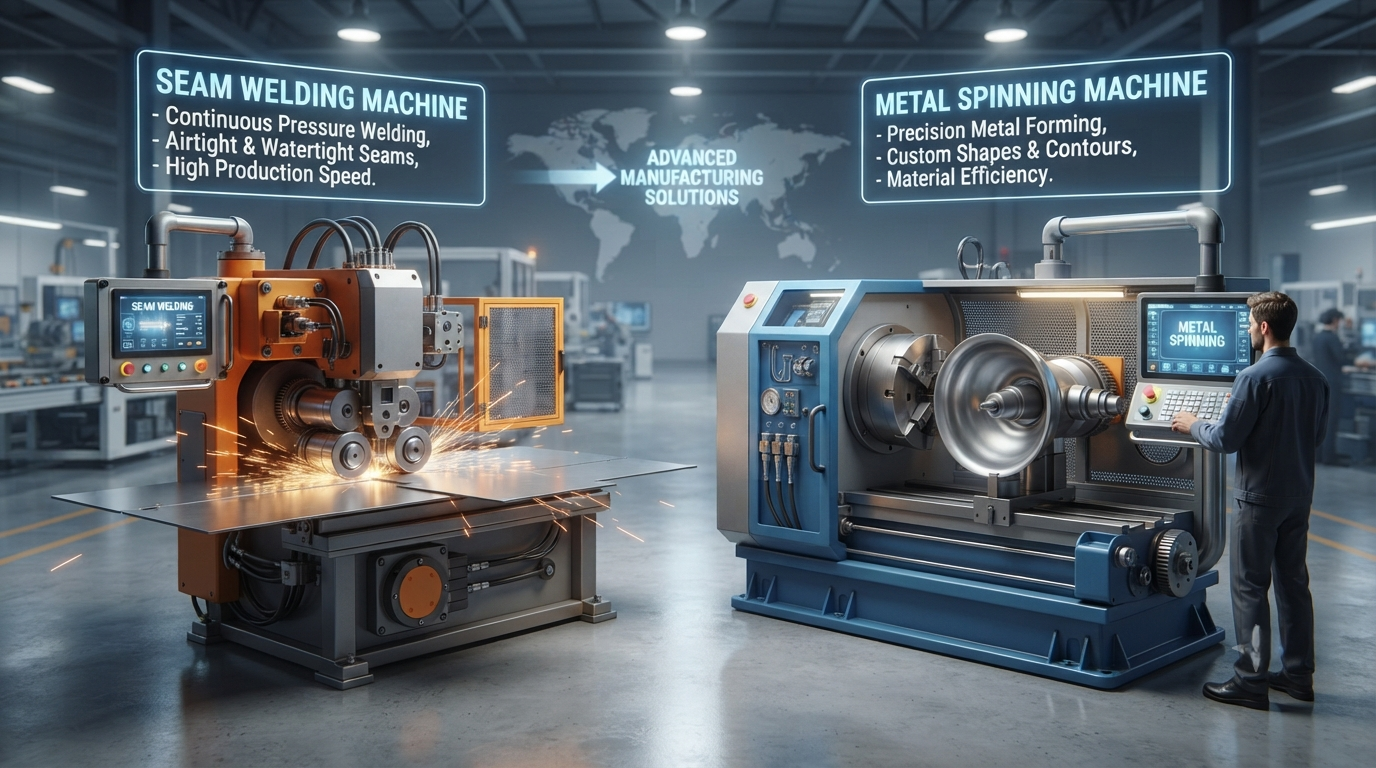
In metal manufacturing, precision and consistency are everything. A seam welding machine and a metal spinning machine are two highly valuable tools, but they perform very different jobs. One is designed to join metal sheets with a continuous weld, while the other is built to shape metal into round and symmetrical forms.
For factories, workshops, and custom fabricators, these machines can improve productivity, reduce waste, and deliver better finished products. Understanding how a seam welding machine and a metal spinning machine work helps buyers choose the right technology for their production goals.
What A Seam Welding Machine Is Used For
A seam welding machine creates a long, continuous weld along overlapping metal surfaces. Instead of producing separate weld points, it makes a sealed seam by using rotating electrodes, controlled pressure, and electrical current.
This process is especially useful when the finished product must be airtight, watertight, or strong enough to handle pressure and vibration. That is why seam welding is common in the production of fuel tanks, filters, drums, pipes, mufflers, and metal containers.
Advantages Of Seam Welding
A seam welding machine offers several important benefits:
- Produces a uniform and continuous weld line
- Supports high-speed production
- Improves sealing performance
- Reduces manual finishing work
- Delivers repeatable results in large batches
Because of these advantages, seam welding is widely used in industries such as automotive, HVAC, appliances, and industrial packaging.
What A Metal Spinning Machine Does
A metal spinning machine forms metal into circular, conical, or curved shapes by pressing a flat blank against a rotating mold or mandrel. The material is not cut away. Instead, it is shaped gradually as it rotates, which helps preserve strength while creating smooth, accurate forms.
This process is commonly used to make lighting reflectors, cookware, domes, cones, decorative items, aerospace parts, and custom industrial components. Metal spinning is especially valuable when a manufacturer needs a round part with a clean finish and efficient material use.
Advantages Of Metal Spinning
A metal spinning machine is popular for many reasons:
- Produces smooth and seamless shapes
- Reduces raw material waste
- Works well for custom and low-volume production
- Maintains good structural strength
- Can create complex round parts with precision
For companies that need flexibility and quality, metal spinning is often a practical and cost-effective choice.
Seam Welding Machine And Metal Spinning Machine Compared
Although both machines are used in metal fabrication, their functions are completely different. A seam welding machine joins metal. A metal spinning machine forms metal.
| Factor | Seam Welding Machine | Metal Spinning Machine |
| Main function | Joins overlapping sheets | Shapes flat blanks into forms |
| End result | Continuous welded seam | Round or curved component |
| Common output | Tanks, drums, filters, enclosures | Domes, bowls, cones, cylinders |
| Material focus | Steel, stainless steel, aluminum | Aluminum, brass, copper, stainless steel |
| Production benefit | Strong, sealed joints | Accurate, low-waste shaping |
| Best use | Repetitive assembly | Symmetrical forming |
This comparison makes it easier to see which machine fits which task. If the job is sealing or connecting metal, seam welding is the answer. If the job is shaping, metal spinning is the better choice.
How Manufacturers Choose The Right Machine
The right machine depends on the product design and performance needs. Manufacturers should ask a few practical questions before investing.
Key Factors To Evaluate
- Does the part need to be welded or formed?
- Is the metal thin, medium, or thick?
- Is high production speed more important than customization?
- Does the part need to be leak-resistant?
- Is surface quality a major concern?
A seam welding machine is ideal when the final product must be structurally secure and sealed. A metal spinning machine is ideal when the product must be shaped accurately with minimal waste.
Where Each Machine Is Commonly Used
A seam welding machine is often found in automotive plants, HVAC workshops, canning facilities, and metal container production lines. It is especially useful where leak prevention and seam strength are critical.
A metal spinning machine is commonly used in lighting, cookware, aerospace, defense, and decorative metal production. It also plays an important role in custom fabrication, where manufacturers need one-off parts or small production runs.
Why These Machines Support Better Production
Both technologies help manufacturers save time and improve quality. A seam welding machine improves joint consistency and reduces the chance of weak seams. A metal spinning machine helps create smooth shapes with less scrap and less tooling cost.
That combination of efficiency and reliability is important in today’s competitive manufacturing world. Customers expect products that are durable, neatly finished, and made with precision. These two machines help deliver exactly that.
Best Practices For Better Results
To get the most value from either machine, manufacturers should focus on training, setup, and maintenance.
Useful Operational Tips
- Match the machine to the part design before production begins.
- Keep welding electrodes and spinning tools in proper condition.
- Check alignment, pressure, and speed settings regularly.
- Inspect finished parts for seam quality, symmetry, and surface defects.
- Schedule routine maintenance to prevent downtime.
Following these steps can improve output, extend machine life, and reduce costly errors.
FAQ: Seam Welding Machine And Metal Spinning Machine
1. What does a seam welding machine do?
It joins overlapping metal sheets with a continuous welded seam.
2. What does a metal spinning machine do?
It shapes flat metal blanks into circular or curved forms.
3. Are these machines used for the same purpose?
No. One is for joining metal, and the other is for shaping metal.
4. Which industries use seam welding machines?
Automotive, HVAC, packaging, appliance, and tank manufacturing industries use them.
5. Which industries use metal spinning machines?
Lighting, cookware, aerospace, and custom fabrication industries use them.
6. Is seam welding good for sealed products?
Yes. It is often used for airtight and leak-resistant applications.
7. Does metal spinning create much waste?
No. It is known for efficient material use and low waste.
8. Can stainless steel be processed in both machines?
Yes. Stainless steel is commonly used in both seam welding and metal spinning.
9. Which machine is better for custom parts?
A metal spinning machine is often better for custom round parts.
10. Which machine is better for mass joining work?
A seam welding machine is better for repetitive joining and high-volume assembly.
Read more – https://newsgrow.blogspot.com/2026/08/seam-welding-machine-and-metal-spinning.html