
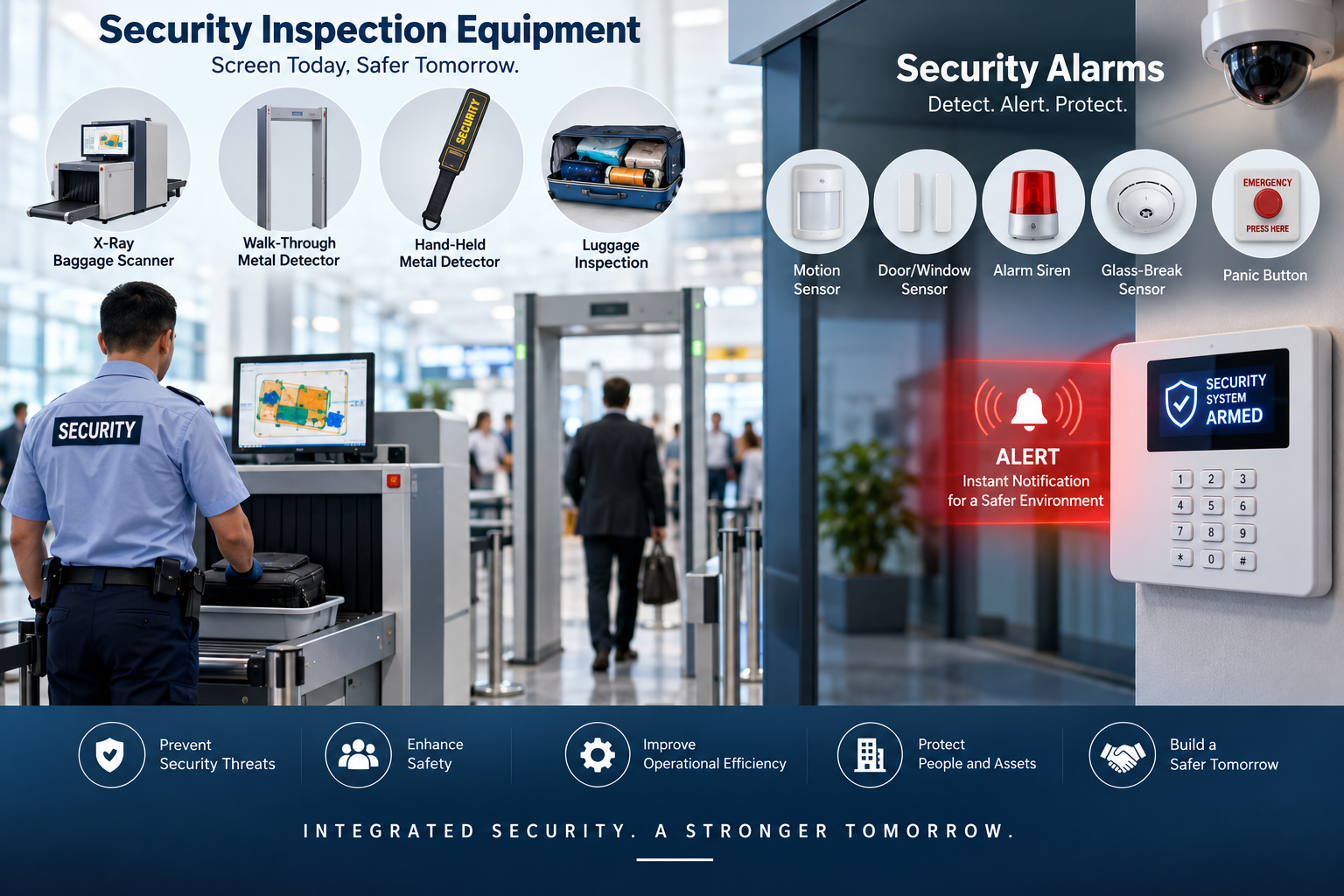
Modern security is no longer limited to guards, locks, and CCTV cameras. Airports, offices, factories, schools, hospitals, warehouses, shopping centres, transport facilities, and government buildings increasingly depend on advanced technologies that can identify risks early and support rapid response. Two important components of this approach are Security Inspection Equipment and Security Alarms.
Inspection systems help identify prohibited, suspicious, or potentially dangerous objects before they enter a protected location. Alarm systems provide immediate alerts when unauthorised entry, intrusion, or another security event occurs. Together, these technologies create a layered security environment designed around prevention, detection, and response.
Why Modern Facilities Need Layered Security
Security risks can include unauthorised entry, theft, concealed objects, vandalism, suspicious packages, and forced access. A single security device cannot effectively address every type of threat.
A layered security strategy may combine physical screening, CCTV surveillance, access control, perimeter protection, alarm systems, and trained personnel.
Security Inspection Equipment generally protects entrances and checkpoints, while Security Alarms continuously monitor doors, rooms, boundaries, and restricted areas.
Combining both solutions reduces security gaps and helps organisations establish clearer procedures for identifying and responding to incidents.
What Is Security Inspection Equipment?
Security Inspection Equipment refers to specialised devices used for screening people, luggage, parcels, cargo, vehicles, and other items for potential security threats.
The appropriate technology depends on the type of facility, number of visitors, required security level, and nature of potential threats.
Common equipment includes:
- X-ray baggage inspection systems
- Walk-through metal detectors
- Hand-held metal detectors
- Explosive trace detection equipment
- Under-vehicle inspection systems
- Cargo and parcel scanners
- Liquid inspection systems
- Advanced body screening equipment
These systems are particularly useful in environments where controlling what enters a facility is an important security requirement.
How Security Inspection Equipment Supports Prevention
The primary benefit of inspection technology is its ability to identify potential risks before an incident develops.
For example, an X-ray baggage scanner enables trained operators to examine the contents of bags without physically opening every item. Metal detection systems can identify metallic objects carried by individuals passing through controlled checkpoints.
Modern Security Inspection Equipment may include high-resolution imaging, automatic threat recognition, material identification, image enhancement, data recording, and network connectivity.
Importance of Professional Operators
Technology alone cannot create an effective security programme. Operators should receive appropriate training in equipment operation, image interpretation, suspicious-object identification, and emergency escalation procedures.
Routine calibration, testing, cleaning, and preventive maintenance are also important for maintaining consistent system performance.
What Are Security Alarms?
Security Alarms are electronic systems designed to detect specific events and provide immediate notification when a potential security breach occurs.
They are widely installed in offices, retail properties, warehouses, factories, financial institutions, educational facilities, residential buildings, and government locations.
Typical components include motion detectors, door sensors, window sensors, glass-break detectors, panic buttons, sirens, control panels, and communication modules.
Modern Security Alarms can also communicate with CCTV systems, access control platforms, remote monitoring centres, and mobile applications.
Different Types of Security Alarms
Security alarm requirements vary according to the property and risk level.
Common options include:
- Intruder alarms for detecting unauthorised entry.
- Perimeter alarms for fences, gates, and external boundaries.
- Panic alarms for requesting immediate assistance.
- Door alarms for monitoring restricted entrances.
- Glass-break sensors for protecting windows.
- Motion alarms for monitoring internal areas.
- Wireless alarms for flexible installations.
- Networked alarms for multi-building facilities.
Selecting the correct alarm system requires understanding the site’s operating hours, layout, movement patterns, valuable assets, and potential access points.
Security Inspection Equipment vs Security Alarms
| Feature | Security Inspection Equipment | Security Alarms |
| Main purpose | Identify suspicious or prohibited objects | Detect security breaches |
| Typical location | Entrances and checkpoints | Doors, rooms and perimeters |
| Operation | Primarily during screening | Continuous or scheduled |
| Human involvement | Often operator-assisted | Mostly automated |
| Key advantage | Early threat identification | Immediate security notification |
The two technologies should not be considered alternatives. They perform different security functions and are often more effective when incorporated into the same security strategy.
How Integrated Security Systems Work
An integrated system connects Security Inspection Equipment, alarms, CCTV cameras, and access control into a coordinated security process.
A visitor entering a facility, for example, may first pass through a screening checkpoint. Their identity or access credentials may then be verified electronically.
If someone later attempts to force open a restricted door, Security Alarms can immediately notify security personnel while CCTV cameras record or display the affected area.
Such integration provides security teams with better situational awareness and supports faster, more informed decisions.
Important Factors When Choosing Security Equipment
Before selecting a system, organisations should evaluate:
- Security risks and objectives
- Daily visitor volume
- Type of objects requiring inspection
- Required detection capabilities
- False alarm management
- Integration compatibility
- Operator usability
- Maintenance requirements
- Technical support availability
- Future expansion possibilities
The lowest-priced equipment is not automatically the most cost-effective choice. Reliability, after-sales service, staff training, maintenance, and expected equipment lifespan should also influence the decision.
Benefits of Combining Inspection Equipment and Alarm Systems
Combining Security Inspection Equipment with Security Alarms creates protection at different stages of facility security.
Screening technology controls what enters a location, while alarms monitor protected areas after access has been granted.
Major benefits include improved threat identification, stronger access control, quicker incident notification, better monitoring, improved incident records, reduced dependence on manual observation, and more consistent security procedures.
FAQs About Security Inspection Equipment and Security Alarms
1. What is security inspection equipment used for?
It is used to detect potentially dangerous, prohibited, or suspicious objects before they enter controlled locations.
2. Where is security inspection equipment commonly used?
It is commonly installed at airports, government buildings, factories, schools, events, logistics centres, hotels, and commercial properties.
3. What does an X-ray baggage scanner do?
It produces an image of a bag’s internal contents so trained operators can identify potentially suspicious objects without opening every bag.
4. What can security alarms detect?
Depending on their sensors, alarms can detect motion, forced entry, opened doors, broken glass, perimeter breaches, and panic-button activation.
5. Can security alarms integrate with CCTV?
Yes. Alarm events can be linked with cameras to display or record activity in the affected area.
6. Are wireless security alarms reliable?
Modern wireless systems can provide reliable performance when correctly installed, maintained, and monitored.
7. Does security inspection equipment require maintenance?
Yes. Regular inspection, calibration, cleaning, and scheduled servicing help maintain reliable performance.
8. Do inspection machines require trained operators?
Yes. Proper operator training is essential for accurate screening and appropriate responses to suspicious findings.
9. Can security alarms be monitored remotely?
Yes. Modern systems may connect to remote monitoring centres, control rooms, cloud platforms, or authorised mobile applications.
10. How should a business choose the right security solution?
A professional risk assessment should evaluate threats, access points, property layout, valuable assets, visitor movement, and emergency response requirements before equipment is selected.