
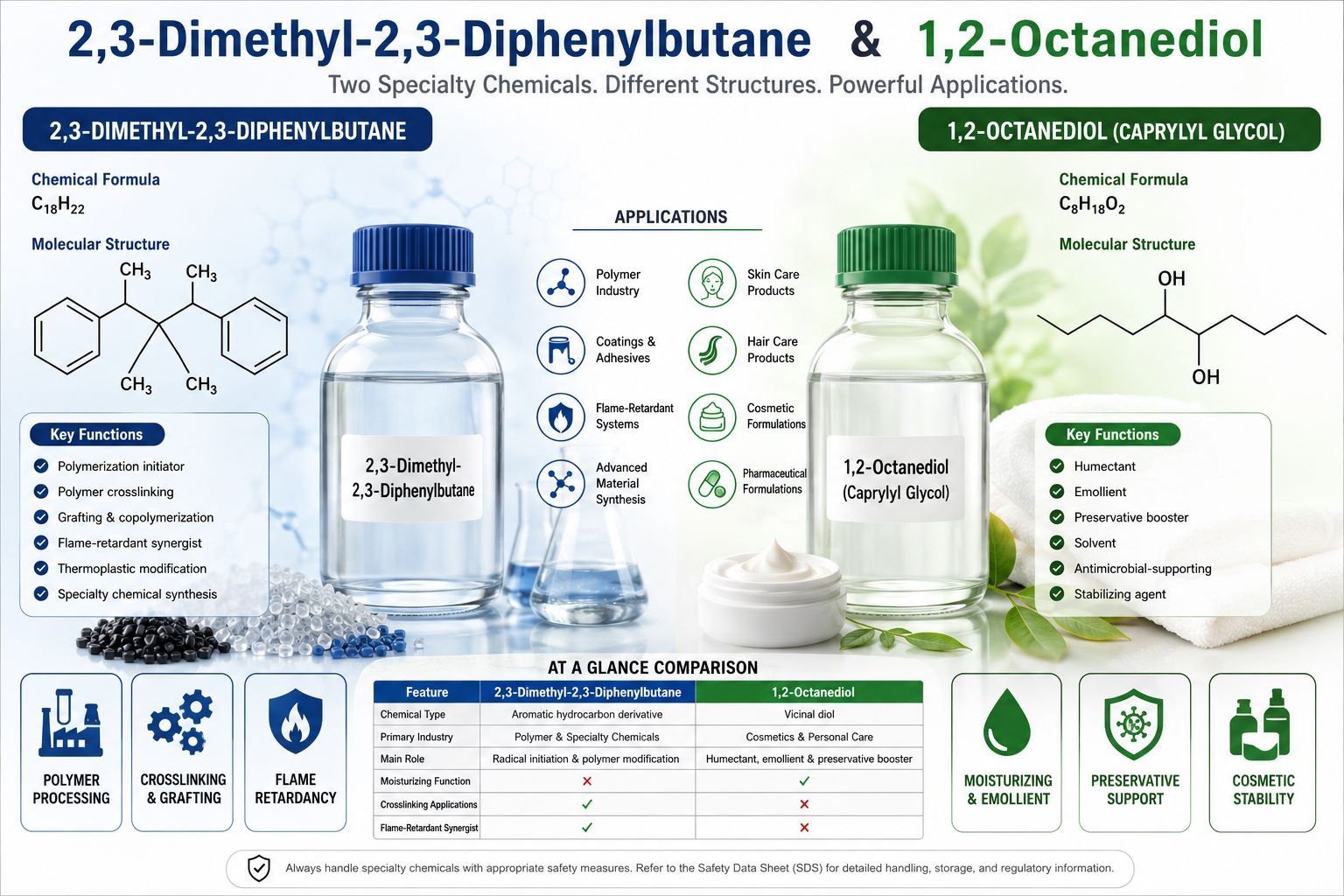
Specialty chemicals often perform behind-the-scenes roles that strongly influence the quality, stability, processing, and performance of finished products. Two interesting examples are 2,3-dimethyl-2,3-diphenylbutane and 1,2-octanediol. Although their structures and applications are very different, both compounds demonstrate how carefully selected chemical ingredients can solve specific industrial challenges.
2,3-dimethyl-2,3-diphenylbutane is associated mainly with polymer chemistry and free-radical processes, while 1,2-octanediol, commonly known in cosmetics as caprylyl glycol, has important functions in personal care, formulation, preservation support, and moisture management.
Understanding their characteristics helps manufacturers, formulators, researchers, and chemical buyers select materials more effectively.
Understanding 2,3-Dimethyl-2,3-Diphenylbutane
2,3-dimethyl-2,3-diphenylbutane is an organic compound with the molecular formula C18H22 and a molecular weight of approximately 238.37 g/mol. It is associated with carbon-centered free-radical chemistry and can participate in reactions relevant to polymer modification and processing.
Its molecular structure contains two phenyl groups along with substituted carbon centers. Under appropriate thermal conditions, the compound can generate radicals capable of initiating or supporting chemical transformations.
This characteristic makes it particularly interesting for specialized polymer applications where controlled radical generation is required.
Why Is It Important in Polymer Chemistry?
Manufacturers continually search for methods of improving polymer characteristics without completely redesigning the base resin. Radical chemistry offers one approach.
Potential applications involving 2,3-dimethyl-2,3-diphenylbutane include:
- Polymer modification
- Grafting reactions
- Crosslinking processes
- Free-radical polymerization
- Rheology modification
- Specialty plastics processing
- Research involving thermal radical generation
Modern patent literature also describes the compound as a carbon-based radical generator for polymeric materials such as polyolefins.
Importance of Controlled Radical Generation
The effectiveness of a radical initiator depends greatly on processing temperature, formulation composition, polymer type, and the desired final properties.
Controlled radical formation can help engineers modify molecular architecture or introduce functional groups into polymers. However, dosage and processing conditions should always be established through laboratory testing rather than assumptions.
Understanding 1,2-Octanediol
1,2-octanediol is a multifunctional organic compound with the molecular formula C8H18O2 and molecular weight of approximately 146.23 g/mol. Its CAS number is 1117-86-8.
In cosmetic applications, 1,2-octanediol is widely recognized by its INCI name, caprylyl glycol. PubChem identifies cosmetic functions including emollient, humectant, and hair-conditioning applications.
One reason the ingredient attracts formulators is its multifunctionality. Rather than contributing only one property, it can support several aspects of a formulation simultaneously.
Key Functions of 1,2-Octanediol
The performance of 1,2-octanediol makes it useful across different personal-care formulations.
Major functions include:
- Humectant properties: It can contribute to moisture retention and skin conditioning.
- Emollient performance: It supports a smoother and more pleasant skin feel.
- Preservation support: It is frequently incorporated as a preservative booster.
- Wetting ability: It can improve ingredient distribution in certain systems.
- Formulation support: It can function as a solvent or processing aid depending on the product.
It is found in formulations such as creams, lotions, facial products, shampoos, body washes, wipes, and other personal-care products.
Why Formulators Value Multifunctional Ingredients
Modern cosmetic development increasingly focuses on ingredient efficiency. Formulators want components capable of contributing several benefits while keeping ingredient lists manageable.
Using 1,2-octanediol may support moisturization, sensory performance, and preservation strategies simultaneously.
However, preservation effectiveness should never be assumed simply because the ingredient offers antimicrobial-supporting properties. Finished products should undergo appropriate stability, compatibility, and microbiological challenge testing.
Comparing the Two Specialty Chemicals
| Property | 2,3-Dimethyl-2,3-Diphenylbutane | 1,2-Octanediol |
| Molecular formula | C18H22 | C8H18O2 |
| Molecular weight | ~238.37 g/mol | ~146.23 g/mol |
| Primary field | Polymer chemistry | Cosmetics and formulation |
| Key role | Radical generation | Humectant and preservation support |
| Typical application | Polymer modification | Skin and hair care |
| Chemical class | Hydrocarbon compound | Diol |
| Processing focus | Thermal/radical reactions | Formulation performance |
Despite their differences, both chemicals illustrate the importance of choosing functional ingredients according to specific manufacturing objectives.
Industrial Selection and Quality Considerations
Chemical selection should extend beyond price alone.
Procurement teams and formulators should evaluate:
- Chemical purity
- Certificate of analysis
- CAS identification
- Technical specifications
- Storage requirements
- Regulatory status
- Supplier consistency
- Application-specific compatibility
- Safety data sheets
- Batch-to-batch consistency
For 2,3-dimethyl-2,3-diphenylbutane, thermal behavior and compatibility with the intended polymer system deserve particular attention.
For 1,2-octanediol, formulators should evaluate concentration, solubility, processing temperature, sensory performance, preservation strategy, and interactions with other ingredients.
Frequently Asked Questions
1. What is 2,3-dimethyl-2,3-diphenylbutane mainly used for?
It is primarily associated with specialty polymer chemistry, free-radical generation, polymer modification, grafting, and research applications.
2. What is the formula of 2,3-dimethyl-2,3-diphenylbutane?
Its molecular formula is C18H22.
3. Can 2,3-dimethyl-2,3-diphenylbutane generate radicals?
Yes. Under suitable thermal conditions, it can function as a carbon-centered radical generator.
4. What is 1,2-octanediol?
1,2-octanediol is an eight-carbon diol commonly used as a multifunctional ingredient in personal-care formulations.
5. Is 1,2-octanediol the same as caprylyl glycol?
Yes. Caprylyl glycol is the commonly used INCI name for 1,2-octanediol in cosmetic ingredient labeling.
6. What is the CAS number of 1,2-octanediol?
Its CAS number is 1117-86-8.
7. Is 1,2-octanediol a humectant?
Yes. It is used as a humectant and skin-conditioning ingredient in cosmetic formulations.
8. Does 1,2-octanediol support preservation?
Yes. It can enhance preservation systems, although appropriate microbiological testing remains essential.
9. Are these two chemicals interchangeable?
No. They have different molecular structures, functions, processing requirements, and industrial applications.
10. What should buyers check before purchasing specialty chemicals?
Buyers should verify purity, specifications, certificates of analysis, safety documentation, storage conditions, supplier reliability, and suitability for the intended application.
Future Importance of Functional Specialty Chemicals
Industries increasingly require materials that offer better performance with precise processing control. This trend creates demand for specialty ingredients designed to perform targeted functions rather than simply serving as bulk raw materials.
2,3-dimethyl-2,3-diphenylbutane represents the value of specialized radical chemistry in advanced polymer processing, while 1,2-octanediol demonstrates how multifunctional ingredients can improve modern cosmetic and personal-care formulations.