
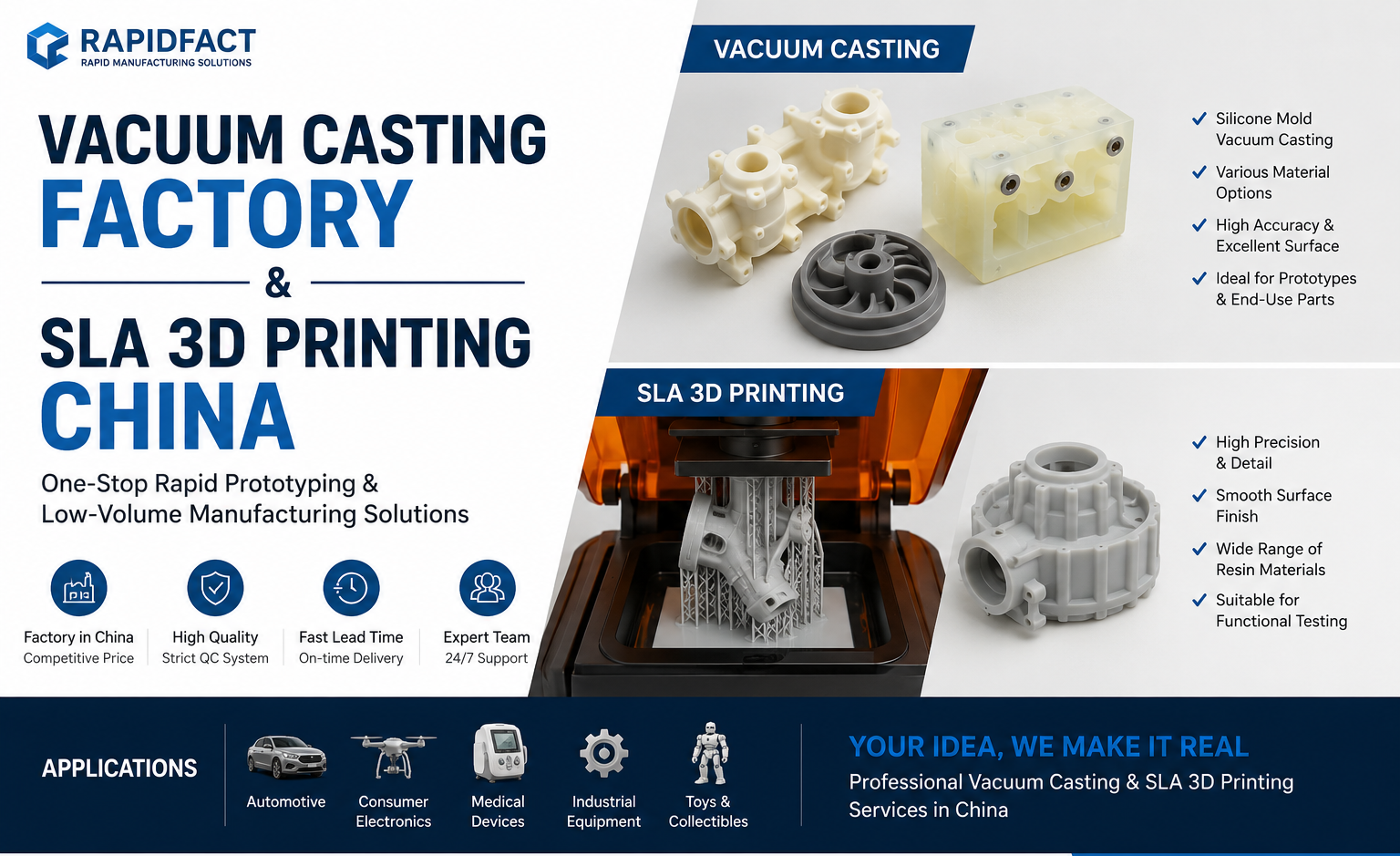
Developing a new physical product involves more than creating an attractive CAD model. Before committing to expensive production tooling, manufacturers need to check dimensions, appearance, assembly, ergonomics and functional performance. This is where an experienced vacuum casting factory and professional SLA 3D Printing China services can play an important role.
Both technologies are widely used in rapid prototyping and low-volume manufacturing. SLA creates detailed resin models directly from digital designs, while vacuum casting allows manufacturers to reproduce approved master models in small quantities using silicone moulds. When combined correctly, these processes provide a practical pathway between initial design development and full-scale manufacturing.
Understanding the Role of a Vacuum Casting Factory
A vacuum casting factory manufactures prototype and low-volume components by pouring liquid casting material into a silicone mould under controlled vacuum conditions.
The process begins with a highly accurate master pattern. This master may be manufactured using SLA 3D printing, CNC machining or another suitable rapid-prototyping technology.
Silicone is formed around the master to create a flexible mould. After curing, the master is removed, leaving a cavity that reproduces its shape and surface features.
Polyurethane or another suitable casting material can then be introduced into the mould. Vacuum conditions help minimise trapped air, improving the consistency and appearance of the finished component.
Where Does Vacuum Casting Add Real Value?
Ordering injection-mould tooling for a design that has not been fully validated can create unnecessary expense and delays.
A vacuum casting factory provides an alternative when relatively small quantities are required before mass production.
Typical requirements include:
- Pre-production samples
- Product demonstration models
- Engineering prototypes
- Functional testing parts
- Exhibition samples
- Marketing models
- Transparent prototype components
- Flexible or rubber-like parts
- Consumer-product housings
- Automotive interior prototypes
This makes the process particularly useful during design verification and market-testing stages.
What Makes SLA 3D Printing China Important?
SLA 3D Printing China services use stereolithography, a resin-based additive manufacturing process capable of producing intricate components with fine details and relatively smooth surfaces.
Instead of removing material from a solid block, SLA builds the component progressively from a digital 3D model. Liquid photopolymer resin is selectively cured using a light source, forming the required geometry layer by layer.
Once printing is complete, parts typically undergo washing, support removal, post-curing and finishing.
The technology is particularly attractive for prototypes where visual quality, detailed geometry and fast design iteration are important.
Key Benefits of SLA for Product Developers
High Level of Detail
SLA can reproduce fine features, small openings, complex contours and detailed surface geometry that may be difficult to achieve with some alternative rapid-prototyping technologies.
Smooth Prototype Surfaces
A major advantage of SLA 3D Printing China is its ability to create relatively smooth surfaces. Additional sanding, polishing, painting or coating can further improve the appearance when presentation-quality models are required.
Design Freedom
Complex internal and external shapes can often be manufactured without conventional tooling.
Rapid Design Changes
If engineers identify a problem during testing, the CAD model can be modified and another prototype produced without redesigning expensive production tooling.
How SLA and Vacuum Casting Work Together
Although these manufacturing processes can be used independently, combining them creates a useful low-volume production workflow.
Step 1: Prepare the Digital Design
Engineers create or optimise the CAD model and review critical dimensions, wall thicknesses, assembly points and surface requirements.
Step 2: Produce an SLA Master
The master component is manufactured using SLA 3D Printing China technology. Its surface can then be carefully finished because imperfections in the master may transfer to subsequent cast components.
Step 3: Manufacture the Silicone Mould
The prepared master is placed inside a moulding setup and surrounded by liquid silicone. After curing, the mould is carefully separated and the original master removed.
Step 4: Cast the Required Components
The vacuum casting factory prepares the specified casting resin and introduces it into the silicone mould under vacuum conditions.
Step 5: Complete Finishing and Inspection
After curing, the component is removed, trimmed and inspected. Painting, polishing, texturing or other finishing operations may be applied according to project requirements.
SLA 3D Printing vs Vacuum Casting
| Consideration | SLA 3D Printing | Vacuum Casting |
| Main purpose | Direct prototype manufacturing | Prototype replication |
| Tooling requirement | No conventional tooling | Silicone mould |
| Ideal quantity | One or a few parts | Small production batches |
| Design modifications | Relatively easy | May require a new master/mould |
| Materials | Photopolymer resins | Primarily casting resins |
| Complex geometry | Excellent capability | Depends on mould design |
| Surface finish | Fine and smooth | Replicates master surface |
| Typical application | Concept and visual prototypes | Production-like sample batches |
The correct technology should therefore be selected according to quantity, material behaviour, geometry and end-use expectations rather than price alone.
Industries Using These Manufacturing Technologies
Consumer Electronics
Companies developing electronic products can use SLA models to evaluate enclosure dimensions, button positions, assembly interfaces and overall appearance.
Vacuum casting can subsequently produce several presentation or testing units.
Automotive Industry
A vacuum casting factory can support the development of interior trims, control components, housings, lighting prototypes and other specialised parts.
Industrial Products
Manufacturers can prototype equipment covers, control housings, brackets, handles and specialised engineering components before final production.
Household and Consumer Products
SLA and vacuum casting are useful for evaluating products where shape, ergonomics, appearance and assembly quality are important before tooling investment.
What Should Buyers Check Before Selecting a Supplier?
Price should never be the only selection criterion when sourcing SLA 3D Printing China or vacuum casting services.
Buyers should evaluate:
- Engineering and design-review capabilities
- Available SLA equipment and materials
- Vacuum casting experience
- Master-pattern preparation standards
- Silicone mould manufacturing capabilities
- Dimensional inspection procedures
- Surface-finishing options
- Material documentation
- Production lead-time management
- Confidentiality and intellectual-property protection
Providing complete technical information at the quotation stage can also reduce misunderstandings later.
Information to Include in Your RFQ
For a more accurate manufacturing quotation, provide the supplier with:
- STEP, STP or another appropriate 3D CAD file
- Required quantity
- Material requirements
- Colour specification
- Surface texture or finish
- Critical dimensions
- Required tolerances
- Intended product application
- Assembly requirements
- Desired delivery schedule
Clear specifications help a vacuum casting factory recommend an appropriate production route rather than quoting solely from part geometry.
Frequently Asked Questions
What is vacuum casting used for?
Vacuum casting is primarily used to manufacture prototypes and small batches of production-like plastic components using silicone moulds.
Is SLA suitable for detailed prototypes?
Yes. SLA 3D Printing China is commonly selected when fine details and smooth surfaces are important.
Does vacuum casting require metal tooling?
No. It normally uses silicone moulds rather than conventional steel or aluminium injection moulds.
Can SLA be used to make a master model?
Yes. SLA is frequently used to manufacture master patterns for subsequent silicone mould creation.
Is vacuum casting the same as injection moulding?
No. Vacuum casting uses silicone tooling and casting resin, while injection moulding generally injects molten thermoplastic into production tooling.
Can transparent prototypes be vacuum cast?
Transparent casting materials are available, although final optical appearance depends on material selection, master quality, mould preparation and finishing.
Are SLA components suitable for functional testing?
Some SLA materials can support functional evaluation, but suitability depends on the required mechanical, thermal and environmental conditions.
How many components can one silicone mould produce?
There is no universal number. Mould life depends on component geometry, casting material, complexity and processing conditions.
Is vacuum casting suitable for low-volume manufacturing?
Yes. Small-volume production is one of the most common applications for a vacuum casting factory.
How do I choose between SLA and vacuum casting?
Choose SLA when you need individual prototypes or rapid design iterations. Consider vacuum casting when you need multiple similar parts with consistent appearance and production-like characteristics.
Read more – https://shopnets.com/china-cnc-custom-machining-how-to-choose-the-right-manufacturing-partner/
https://newsgrow.blogspot.com/2026/08/china-cnc-custom-machining-practical.html
https://newsgrow.blogspot.com/2026/08/china-cnc-machining-suppliers-and.html
https://newsgrow.blogspot.com/2026/08/sla-3d-printing-china-and-vacuum.html
https://newsgrow.blogspot.com/2026/08/vacuum-casting-factory-and-sla-3d.html