
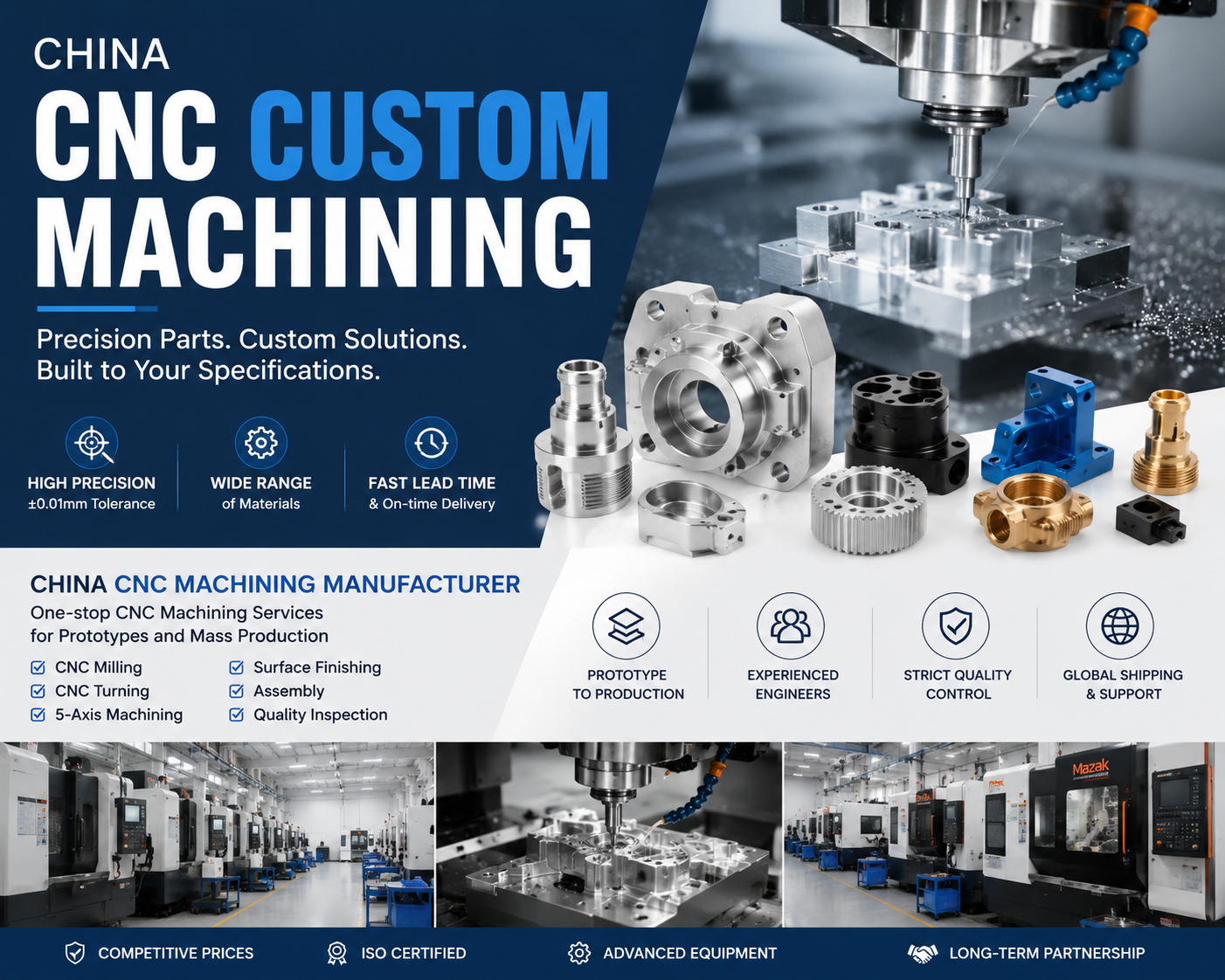
Turning a digital engineering design into a reliable physical component involves much more than loading a CAD file into a machine. In china cnc custom machining, material behaviour, cutting strategy, tooling, tolerances, workholding, inspection and finishing must all work together to produce a component that performs as intended.
For international buyers, choosing the right china cnc machining manufacturer is therefore an engineering and supply-chain decision—not simply a price comparison. A capable manufacturer should understand the functional purpose of a component, identify potential manufacturing problems and establish a repeatable production process before volume manufacturing begins.
How China CNC Custom Machining Works in a Real Production Environment
A typical project starts with a 3D model or technical drawing. Engineers review the component to determine whether its geometry can be machined efficiently and whether the specified dimensions and tolerances are realistic.
The manufacturing workflow generally follows:
- CAD drawing and specification review
- Material and machining-process selection
- CNC programming
- Raw-material preparation
- Machine setup and workholding
- Rough and finish machining
- Dimensional inspection
- Surface treatment, where required
- Final quality verification
- Cleaning, packaging and shipment
Each stage can influence the finished component. A reliable china cnc machining manufacturer should therefore maintain traceability and process control rather than inspecting parts only after production.
Engineering Review Before CNC Production
One of the most valuable services a machining supplier can provide happens before production begins.
Design for Manufacturability, commonly called DFM, identifies features that could increase manufacturing difficulty, cost or quality risk.
What Should Be Checked During DFM?
Engineers may review:
- Extremely deep pockets
- Thin walls
- Small internal radii
- Difficult tool-access areas
- Excessively tight tolerances
- Non-standard threads
- Complex undercuts
- Surface-finish requirements
- Material availability
Effective DFM does not mean changing the function of the product. Its purpose is to manufacture the required design more efficiently and consistently.
Choosing the Right CNC Process for Your Component
Not every component should be produced using the same CNC technology.
CNC Milling
CNC milling is commonly selected for housings, brackets, plates, mould components and parts containing pockets, holes or complex surfaces.
CNC Turning
Turning is more efficient for rotational components such as shafts, pins, bushings, threaded parts and cylindrical connectors.
5-Axis CNC Machining
For highly complex geometries, 5-axis machining provides greater cutting-tool access and can reduce the number of setups required.
A professional china cnc custom machining supplier may combine milling, turning, drilling and finishing operations to complete one component.
Material Selection Can Determine Project Success
Selecting material purely according to price can create problems later. Mechanical strength, operating temperature, corrosion exposure, weight and machinability should all be considered.
| Material | Key Advantage | Common Use |
| Aluminium | Lightweight and machinable | Housings, robotics, automotive |
| Stainless Steel | Strength and corrosion resistance | Industrial and medical equipment |
| Carbon Steel | Strength and affordability | Machinery components |
| Brass | Excellent machinability | Fittings and connectors |
| Copper | High conductivity | Electrical components |
| Titanium | Excellent strength-to-weight performance | Specialist engineering |
| POM | Dimensional stability | Gears and mechanical parts |
| Nylon | Lightweight and wear resistant | Bushings and guides |
A knowledgeable china cnc machining manufacturer should confirm the exact material grade rather than using a loosely defined equivalent without approval.
Why Tolerance Management Matters
A drawing may contain dozens of dimensions, but not every dimension needs the same level of precision.
Tighter tolerances generally require additional machining control, inspection and sometimes slower production.
Critical Dimensions Should Receive Priority
Particular attention may be required for:
- Bearing locations
- Mating surfaces
- Precision holes
- Sealing surfaces
- Alignment features
- Threaded connections
- Assembly interfaces
Avoid Over-Engineering the Drawing
Specifying unnecessarily demanding tolerances across an entire component can increase cost without improving its performance.
An experienced china cnc custom machining team should understand which dimensions are function-critical and establish appropriate inspection procedures.
Prototype First or Move Directly to Production?
For a new design, prototype machining is usually a sensible risk-control strategy.
A prototype enables engineers to evaluate assembly, dimensions, appearance and functionality before committing to a larger order.
Prototype evaluation may reveal:
- Interference between assembled parts
- Incorrect hole positions
- Insufficient clearances
- Difficult machining features
- Surface-finish problems
- Design improvements
After approval, the machining programme and manufacturing process can be refined for repeat production.
Quality Control Should Be Measurable
Claims such as “high precision” have limited value unless a manufacturer can demonstrate how accuracy is verified.
Depending on component requirements, inspection equipment can include:
- Coordinate Measuring Machine (CMM)
- Micrometers
- Digital callipers
- Height gauges
- Thread gauges
- Optical measuring systems
- Surface roughness testers
- Hardness testers
Buyers working with a china cnc machining manufacturer should clearly define inspection requirements before placing an order.
What Buyers Should Include in an RFQ
An incomplete Request for Quotation can result in inaccurate pricing or manufacturing misunderstandings.
A useful RFQ should contain:
- 2D technical drawing
- 3D CAD model
- Material and grade
- Required quantity
- Dimensional tolerances
- Surface roughness
- Surface treatment
- Critical dimensions
- Inspection requirements
- Packaging requirements
- Required delivery schedule
Providing complete information allows suppliers to quote the same manufacturing scope, making quotations easier to compare.
How to Compare CNC Manufacturers Beyond Price
Choosing the cheapest quotation can become expensive if components later require rework, replacement or repeated inspection.
When evaluating a china cnc machining manufacturer, consider technical capability alongside commercial terms.
| Evaluation Area | What to Check |
| Machinery | Milling, turning and multi-axis capabilities |
| Materials | Experience with required grades |
| Engineering | DFM and drawing-review capability |
| Quality | Inspection equipment and procedures |
| Capacity | Prototype and production capability |
| Finishing | Available secondary processes |
| Communication | Technical response quality |
| Delivery | Production and logistics planning |
Ways to Make CNC Components More Economical
Cost reduction should focus on manufacturing efficiency rather than simply requesting a lower unit price.
Useful approaches include:
- Use standard material sizes where practical.
- Avoid unnecessary deep cavities.
- Increase internal corner radii when functionality permits.
- Standardise hole and thread dimensions.
- Reduce unnecessary machining setups.
- Apply tight tolerances only to functional features.
- Consolidate orders where volume pricing is beneficial.
- Discuss alternative materials when engineering requirements allow.
These decisions can make china cnc custom machining more commercially efficient without compromising essential component performance.
Frequently Asked Questions
1. What information does a CNC manufacturer need for a quotation?
Usually a CAD model, technical drawing, material specification, quantity, tolerance requirements, finishing details and inspection expectations.
2. Can custom CNC machining be used for prototypes?
Yes. CNC machining is particularly suitable for functional prototypes because components can often be manufactured directly from CAD data without dedicated mould tooling.
3. What is the difference between CNC milling and turning?
Milling primarily uses rotating cutting tools against a secured workpiece, while CNC turning rotates the workpiece against cutting tools.
4. Why is DFM important?
DFM identifies features that may be difficult, expensive or risky to manufacture and suggests practical improvements before production.
5. Can one China CNC machining manufacturer handle different materials?
Many manufacturers process multiple metals and engineering plastics, but their experience with the specific material grade should always be confirmed.
6. Are tighter CNC tolerances always better?
No. Extremely tight tolerances should normally be specified only where required by the component’s function because they can increase manufacturing and inspection costs.
7. What surface finishes are available after CNC machining?
Options may include anodising, polishing, plating, powder coating, bead blasting, passivation and black oxide treatment.
8. How should CNC machined components be inspected?
The inspection method depends on the drawing. Tools may range from micrometers and gauges to CMM and optical measurement systems.
9. Should buyers order a prototype before bulk production?
For new or complex components, prototypes can help verify dimensions, fit and function before larger quantities are manufactured.
10. How can I reduce CNC machining costs?
Simplify difficult features, use practical tolerances, select machinable materials, standardise dimensions and discuss production quantities with the supplier.
Read more – https://shopnets.com/china-cnc-custom-machining-how-to-choose-the-right-manufacturing-partner/
https://newsgrow.blogspot.com/2026/08/china-cnc-custom-machining-practical.html