
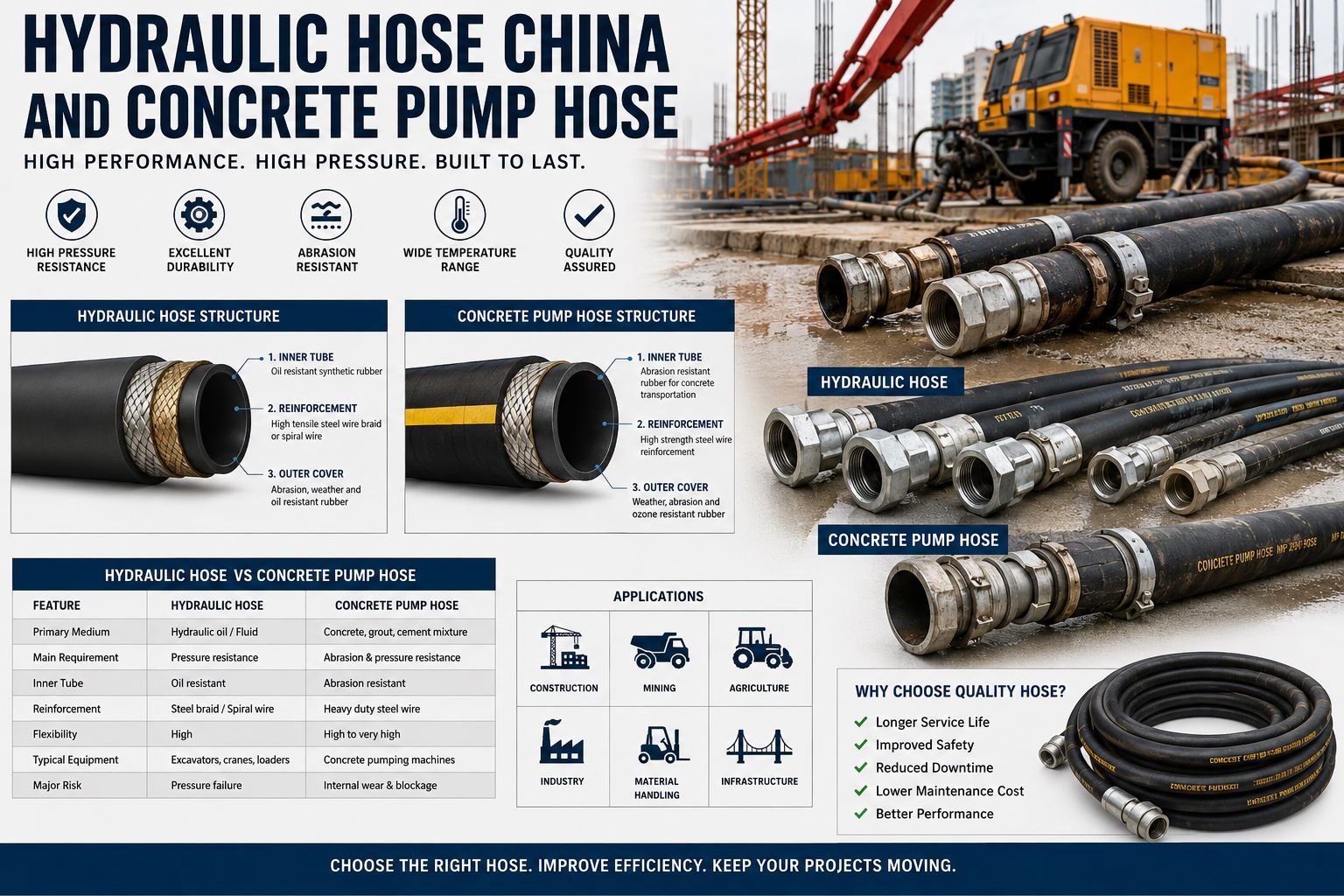
Hydraulic systems and concrete pumping equipment work under demanding conditions where hose quality affects safety, productivity, and maintenance. Buyers searching for Hydraulic Hose China suppliers typically want broad product availability, customization, consistent manufacturing, and reliable testing. Meanwhile, a Concrete Pump Hose must handle abrasive concrete, pressure pulsation, bending, and repeated job-site movement.
Understanding their differences helps buyers select the right construction, reinforcement, fittings, and testing requirements.
What Makes Hydraulic Hose China an Important Sourcing Category?
China has a large supply chain for hydraulic components, including rubber compounding, wire reinforcement, hose braiding, spiraling, fittings, and testing. Buyers can source hoses for construction, agriculture, mining, material handling, manufacturing, and mobile machinery.
A professional Hydraulic Hose China manufacturer should provide more than a catalogue. Buyers should examine traceability, pressure testing, dimensional consistency, impulse performance, fitting compatibility, and quality controls.
Hydraulic Hose Construction and Performance
A typical hydraulic hose has three layers. The inner tube carries fluid, reinforcement provides pressure strength, and the outer cover protects against abrasion, weather, ozone, and job-site damage.
Reinforcement Matters
Braided hoses are often suitable for medium-to-high pressure applications requiring flexibility. Spiral-wire hoses are generally selected for severe pressure, pressure surges, and demanding heavy equipment.
Never Select by Pressure Alone
Working pressure is important, but engineers should also consider hose size, bend radius, temperature, fluid compatibility, impulse requirements, environmental exposure, and fitting design. A hose that technically meets pressure requirements can still fail prematurely if routing creates excessive bending, twisting, rubbing, or heat exposure.
What Is a Concrete Pump Hose?
A Concrete Pump Hose is designed to transport wet concrete from pumping equipment toward the placement point. Unlike ordinary hydraulic hose, its inner tube must tolerate highly abrasive material containing cement, sand, aggregates, and water.
Concrete pumping creates dynamic loads, so hose construction must balance pressure resistance, abrasion durability, flexibility, and secure end connections. Typical uses include boom pumps, line pumps, foundations, slabs, tunnels, bridges, and high-rise projects.
Hydraulic Hose vs Concrete Pump Hose
| Feature | Hydraulic Hose | Concrete Pump Hose |
| Main medium | Hydraulic oil or compatible fluid | Wet concrete and cementitious mixtures |
| Primary challenge | Fluid pressure and impulse cycles | Pressure plus severe internal abrasion |
| Inner tube | Oil-resistant synthetic rubber | Thick abrasion-resistant rubber |
| Reinforcement | Textile, braided wire, or spiral wire | Heavy-duty reinforcement for pumping loads |
| Typical equipment | Excavators, cranes, presses, loaders | Concrete pumps and placement systems |
| Selection focus | Pressure, fluid, temperature, routing | Pressure, abrasion, flexibility, coupling security |
Similar dimensions do not make the two hose types interchangeable.
How to Select a Reliable Hydraulic Hose China Supplier
Industrial buyers should evaluate the manufacturer as carefully as the hose specification. Important checkpoints include:
- Confirm applicable hose specifications and requested test documentation.
- Ask about rubber compounds, reinforcement construction, and operating temperature.
- Verify working pressure, proof pressure, burst performance, and impulse testing.
- Review hose-to-fitting compatibility and assembly procedures.
- Request batch identification or traceability where critical.
- Assess production capacity, lead time, packaging, and export experience.
- Obtain samples for validation before large-volume purchasing.
Prioritize manufacturing consistency rather than selecting a supplier only on unit price.
How to Choose the Right Concrete Pump Hose
Match the hose to the pumping system. Confirm internal diameter, length, working pressure, connection type, bend requirements, mixture characteristics, and abrasion conditions.
Inspect hoses frequently for cuts, exposed reinforcement, soft spots, bulges, coupling movement, cover wear, or deformation. Damaged assemblies should be removed according to equipment safety guidance.
Reducing Hose Failure and Downtime
Correct installation influences service life. Avoid twisting, excessive bending, rubbing against sharp surfaces, and unprotected exposure to high heat.
For hydraulic systems, contamination control matters because dirty fluid damages components. For concrete pumping, proper cleaning helps prevent hardened material and flow restrictions.
Record installation dates, inspections, replacements, and recurring failure locations to identify problems involving hose quality, routing, fittings, or operating conditions.
Frequently Asked Questions
1. What does Hydraulic Hose China mean for buyers?
It generally refers to hydraulic hoses manufactured or sourced from Chinese producers for domestic or international industrial applications.
2. Are all Chinese hydraulic hoses the same quality?
No. Quality varies by manufacturer, materials, process control, testing capability, and compliance with the buyer’s specification.
3. What is a Concrete Pump Hose used for?
It carries pumped concrete between pumping equipment and the required placement location.
4. Can hydraulic hose carry concrete?
Ordinary hydraulic hose should not be used as a substitute. Concrete pumping requires a hose specifically designed for abrasive concrete service and relevant operating loads.
5. What causes hydraulic hose failure?
Common factors include abrasion, excessive bending, twisting, heat, incorrect fittings, pressure spikes, chemical incompatibility, ageing, and poor installation.
6. Why is abrasion resistance important in concrete hoses?
Concrete contains abrasive particles that continuously wear the hose’s inner tube as material moves through the assembly.
7. Should I choose braided or spiral hydraulic hose?
The correct choice depends on pressure, impulse conditions, flexibility, equipment requirements, and the applicable hose specification.
8. How should hoses be inspected?
Check the cover, fittings, reinforcement exposure, deformation, leaks, abrasion, coupling condition, and any changes from the hose’s normal appearance.
9. Is the cheapest hose the best purchasing option?
Usually not. Total value should consider reliability, service life, testing, consistency, downtime risk, delivery performance, and technical support.
10. Can a Hydraulic Hose China manufacturer customize products?
Many manufacturers offer custom dimensions, covers, markings, colors, fittings, packaging, and assemblies, but capabilities should be verified directly before ordering.