
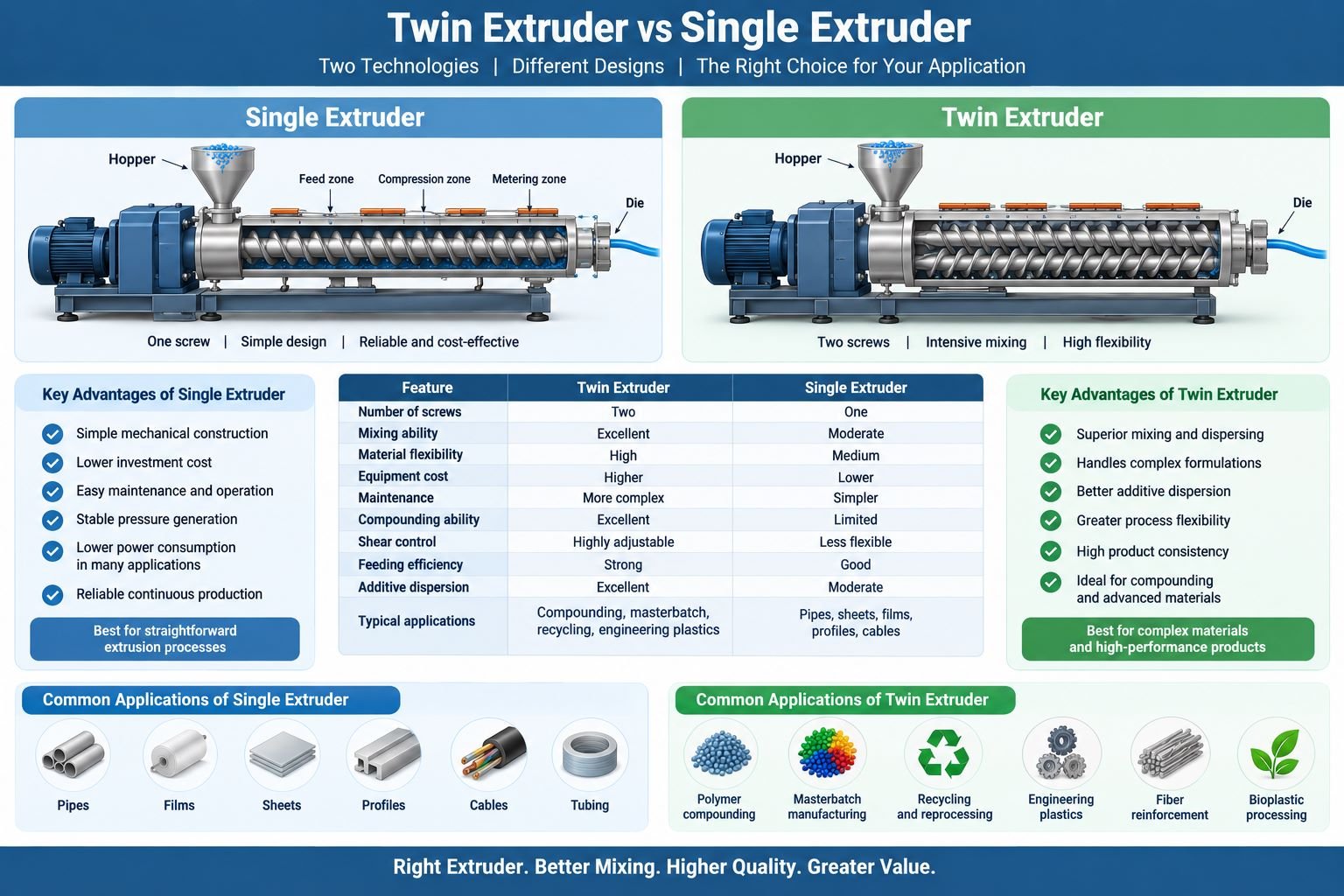
Extrusion is one of the most important processing technologies used in plastics, polymers, food production, chemicals, masterbatch manufacturing, and compound processing. At the centre of every extrusion line is the extruder, a machine responsible for conveying, melting, mixing, and shaping material under controlled conditions.
Two widely used configurations are the twin extruder and single extruder. Although both perform extrusion, their internal design, mixing capability, operating flexibility, maintenance needs, and suitable applications can differ considerably.
Choosing between them should therefore depend on the material, desired output, formulation complexity, processing temperature, and final product requirements rather than simply comparing machine prices.
How an Extruder Works
An extruder normally feeds raw material into a heated barrel containing one or more rotating screws. As the screw moves material forward, heat from barrel heaters and mechanical shear softens or melts it.
The processed material is then pushed through a die that determines the required shape or directs the material toward downstream equipment.
Important operating variables include screw speed, barrel temperature, feed rate, pressure, residence time, torque, and cooling conditions. Proper control of these parameters is essential for consistent product quality.
What Is a Single Extruder?
A single extruder, commonly called a single-screw extruder, contains one rotating screw inside the barrel. Its relatively straightforward construction makes it one of the most established extrusion technologies in polymer processing.
The machine is particularly suitable when the raw material has already been formulated and intensive mixing is unnecessary.
Single-screw extrusion is widely associated with applications such as pipes, films, sheets, profiles, cables and certain pellet-processing operations.
Its major advantages include comparatively simple operation, easier maintenance, dependable conveying performance and potentially lower initial investment.
However, a single extruder may provide less intensive distributive and dispersive mixing than a twin-screw configuration. This distinction becomes important when manufacturers process formulations containing several additives, fillers, pigments or incompatible ingredients.
What Is a Twin Extruder?
A twin extruder uses two screws rotating inside the barrel. Depending on machine design, the screws may rotate in the same direction or opposite directions and may be intermeshing or non-intermeshing.
The major strength of twin-screw technology is its ability to provide controlled conveying combined with strong mixing.
A twin extruder can therefore be particularly useful for polymer compounding, masterbatch production, filler incorporation, reactive extrusion, devolatilisation and formulations involving several ingredients.
Modern twin-screw machines may also incorporate modular screw elements. Manufacturers can configure conveying, kneading and mixing sections according to specific processing objectives.
This flexibility enables processors to design an extrusion process around the behaviour of the formulation rather than relying on one fixed screw geometry.
Twin Extruder vs Single Extruder
Understanding their fundamental differences makes machine selection considerably easier.
| Feature | Twin Extruder | Single Extruder |
| Screw arrangement | Two screws | One screw |
| Mixing capability | High | Moderate |
| Compounding suitability | Excellent | Limited to moderate |
| Machine complexity | Higher | Lower |
| Maintenance | More specialised | Generally simpler |
| Additive dispersion | Strong | Application-dependent |
| Process flexibility | High | Moderate |
| Typical investment | Usually higher | Usually lower |
| Best suited for | Complex formulations | Straightforward extrusion |
Neither technology is universally better. The correct machine is the one whose processing characteristics match the material and production objective.
Why Manufacturers Choose a Twin Extruder
Complex formulations often require more than simple melting and conveying. Fillers, reinforcing materials, pigments, stabilisers and other additives must sometimes be distributed uniformly throughout a polymer matrix.
A twin extruder provides greater control over these operations.
Its advantages can include stronger mixing, improved dispersion, effective feeding of multiple ingredients, controlled residence time and efficient removal of moisture or volatile components.
For example, a compound containing polymer resin, mineral filler and additives requires each component to be distributed consistently. Appropriate twin-screw elements can generate the mixing action required to create a more homogeneous compound.
Why a Single Extruder Remains Important
More advanced machinery is not automatically the most economical solution.
For comparatively uncomplicated extrusion processes, a single extruder can offer excellent reliability and productivity without introducing unnecessary mechanical complexity.
Its simpler structure can make operator training, cleaning, troubleshooting and routine maintenance easier.
Single-screw machines are especially practical where stable raw materials primarily require melting, pressurising and forming rather than intensive compounding.
Selecting a twin-screw system for an application that does not require sophisticated mixing could increase equipment and maintenance costs without producing meaningful manufacturing benefits.
How to Select the Correct Extruder
Machine selection should begin with the process rather than the equipment catalogue.
Manufacturers should evaluate:
- Raw-material characteristics and bulk density.
- Required production capacity.
- Number and type of additives or fillers.
- Mixing and dispersion requirements.
- Heat sensitivity of the material.
- Required screw diameter and length-to-diameter ratio.
- Motor power and torque.
- Venting or devolatilisation requirements.
- Downstream equipment compatibility.
- Cleaning, maintenance and changeover frequency.
Pilot trials are particularly valuable for challenging formulations because actual processing behaviour can reveal requirements that theoretical calculations alone may not identify.
Screw Design and Process Performance
Screw geometry directly influences extrusion performance.
In a single extruder, the screw generally contains zones responsible for feeding, compression or transition, and metering. Screw dimensions and channel geometry affect melting, pressure development and material throughput.
A twin extruder can provide considerably more configuration flexibility. Conveying elements move material forward, while kneading and specialised mixing elements influence dispersion and distributive mixing.
The ideal configuration should balance mixing intensity against excessive shear. Too little mixing may produce an inconsistent product, while excessive mechanical energy can damage heat-sensitive polymers.
Energy Efficiency and Production Economics
Purchase price should never be the only financial consideration.
Processors should evaluate total operating cost, including energy consumption, production rate, labour, maintenance, downtime, scrap generation and product consistency.
A single extruder may offer attractive economics for high-volume, straightforward production.
Conversely, a twin extruder may justify its higher investment when formulation flexibility, efficient compounding or improved process control creates greater overall manufacturing value.
The best economic decision is therefore application-specific.
Applications Across Different Industries
Both technologies support numerous industrial processes. A single extruder is commonly considered for polymer products requiring continuous shaping and stable melt delivery.
A twin extruder is frequently selected for engineering plastics, colour masterbatch, filled compounds, polymer blends and speciality formulations.
Extrusion technology is also used outside conventional plastics manufacturing, including selected food, pharmaceutical and chemical-processing applications. Machine construction must always suit the relevant material, hygiene, safety and process requirements.
Frequently Asked Questions
What is the main difference between twin and single extrusion?
The primary difference is the number of screws. Twin-screw machines generally provide stronger mixing and greater processing flexibility.
Is a twin extruder always better?
No. Its advantages are valuable mainly when an application requires enhanced mixing, compounding or ingredient control.
When should I choose a single extruder?
Consider it for relatively straightforward processes requiring efficient melting, conveying and shaping.
Can twin extruders process fillers?
Yes. They are widely suitable for incorporating many fillers into polymer formulations when configured correctly.
Which machine is easier to maintain?
Single-screw systems are generally mechanically simpler and may therefore be easier to maintain.
Which extruder is suitable for masterbatch?
Twin-screw extrusion is commonly preferred because masterbatch production often requires strong pigment or additive dispersion.
Does screw speed affect product quality?
Yes. Screw speed influences throughput, shear, mixing, temperature and residence behaviour.
Can a single extruder deliver high output?
Yes. Properly designed single-screw equipment can provide high throughput for suitable applications.
What is L/D ratio?
It represents the relationship between screw length and screw diameter and is an important extrusion design parameter.
How should an extruder manufacturer be selected?
Evaluate application engineering capability, machine construction, component quality, process support, spare-parts availability and after-sales service.