
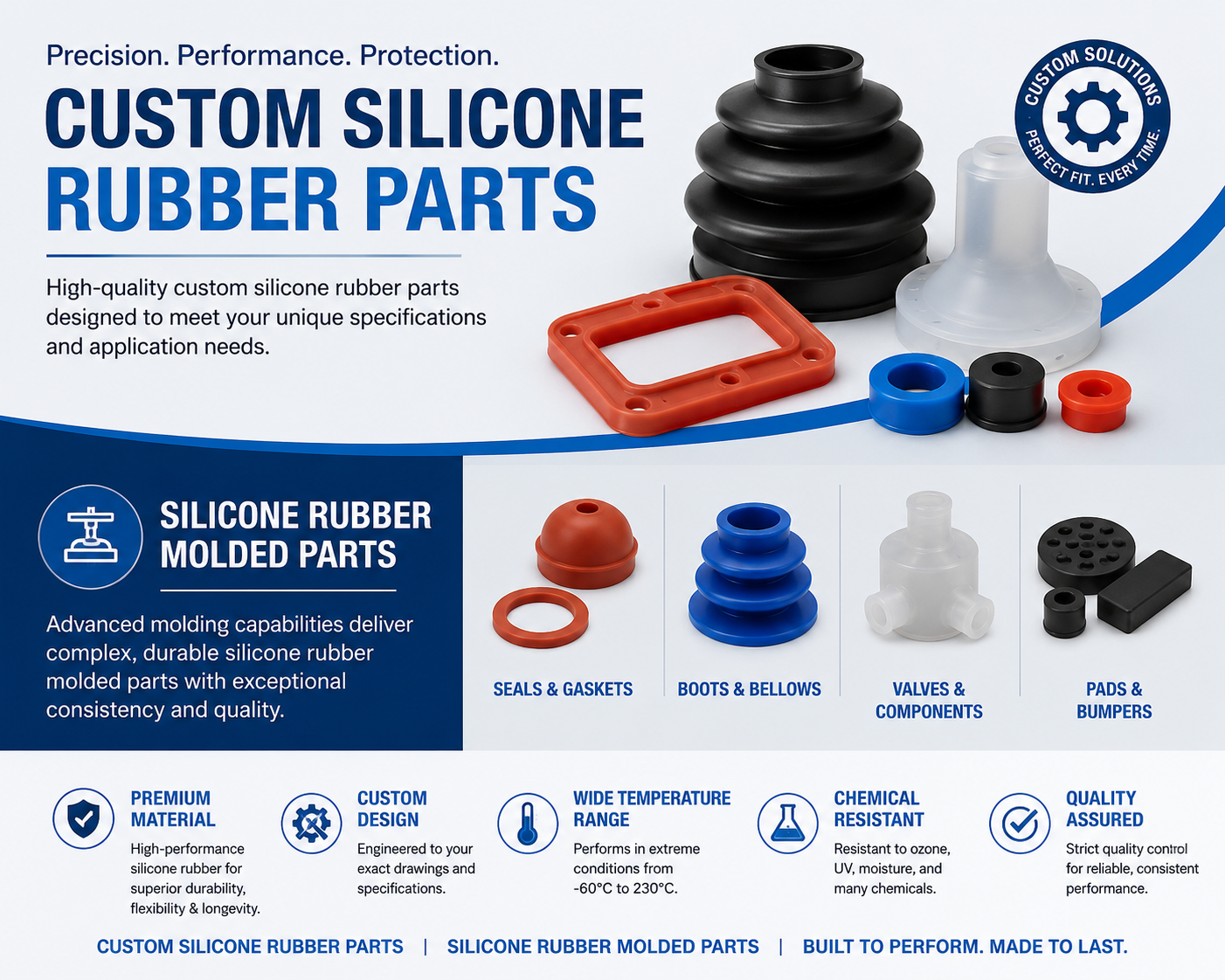
Manufacturers today in automotive, electronics, medical equipment, appliances, industrial machinery, and consumer products use silicone because it combines flexibility, temperature resistance, sealing performance, and durability. When standard components cannot meet a specific requirement, custom silicone rubber parts provide a solution for dimensions, hardness, colours, and tolerances. Meanwhile, silicone rubber molded parts offer consistency for prototype, small-batch, and high-volume production.
Why Silicone Rubber Works Well for Custom Components
Silicone performs reliably in environments where ordinary elastomers may crack, soften, or lose sealing ability. Depending on the formulation, it can resist temperature variation, moisture, UV exposure, ozone, and repeated compression.
Key benefits include:
- Flexible design for complex shapes
- Reliable sealing and cushioning
- Good resistance to weathering and ageing
- Electrical insulation properties
- Wide hardness options
- Food-contact and medical-grade material choices
- Stable performance in demanding conditions
How Silicone Rubber Molded Parts Are Manufactured
Silicone rubber molded parts are commonly produced through compression molding, transfer molding, or liquid silicone rubber injection molding.
Compression Molding
Compression molding places uncured silicone into a heated mould, which closes under pressure until the material fills the cavity and cures. It is often suitable for simpler designs, larger parts, or moderate production volumes.
Transfer Molding
Transfer molding pushes silicone from a chamber into the mould cavity. It can handle more detailed shapes and may provide improved dimensional control for certain components.
Liquid Silicone Rubber Injection Molding
Liquid silicone rubber, or LSR, is injected automatically into precision moulds. It is widely used for complex shapes, thin sections, tight tolerances, and larger production runs.
Choosing the Right Process
The final choice should consider annual quantity, part complexity, tolerance, tooling investment, expected service conditions, and target unit cost.
Custom Silicone Rubber Parts Versus Standard Parts
Standard parts work when dimensions and performance requirements are common. Custom manufacturing becomes more valuable when products need special profiles, unusual sealing surfaces, integrated features, or specific material properties.
| Factor | Standard Parts | Custom Silicone Rubber Parts |
| Dimensions | Predefined | Made to specification |
| Material | Limited choices | Multiple formulations |
| Colour | Standard | Customisable |
| Fit | General-purpose | Application-specific |
| Tooling | Usually none | Normally required |
| Performance | Standardised | Optimised for use |
Important Design Factors Before Ordering
A reliable silicone component starts with accurate engineering information. Buyers should provide:
- Part drawing or 3D model
- Dimensions and tolerances
- Required Shore A hardness
- Operating temperature
- Chemical or fluid exposure
- Compression requirements
- Colour and surface finish
- Regulatory requirements
- Estimated quantity
- Inspection expectations
Material Selection Matters
Not every silicone compound behaves the same way. General-purpose silicone may suit industrial applications, while specialised formulations may be needed for flame resistance, conductivity, food contact, medical use, extreme temperatures, or improved tear strength.
A qualified supplier should recommend material according to the actual environment rather than selecting only by price.
Quality Control for Silicone Rubber Molded Parts
Consistent silicone rubber molded parts depend on controlled tooling, curing, material quality, and inspection. Small dimensional variations can affect sealing pressure or assembly performance.
Common checks include dimensional inspection, hardness testing, visual inspection, compression evaluation, colour verification, and batch traceability. For critical applications, buyers should also ask about material certificates, sample approval, inspection reports, and documented quality procedures.
Common Applications Across Industries
Custom silicone rubber parts are used in automotive systems, electronics, lighting products, home appliances, medical equipment, food-processing machinery, renewable energy equipment, industrial controls, telecommunications, and consumer products.
How to Choose a Reliable Manufacturer
Selecting a supplier involves more than comparing price. A capable manufacturer should understand silicone compounds, mould design, tolerances, curing, inspection, and production scalability.
Look for a company that can review drawings, recommend suitable materials, support prototypes, explain tooling options, provide realistic tolerance guidance, and maintain repeatable production.
Frequently Asked Questions
What are custom silicone rubber parts?
They are silicone components manufactured according to specific drawings, dimensions, materials, colours, hardness, and functional requirements.
What are silicone rubber molded parts?
They are parts formed by curing silicone inside a mould using compression, transfer, or injection molding.
Are silicone parts suitable for high temperatures?
Many silicone formulations perform well at elevated temperatures, although the exact range depends on the selected compound.
Can silicone parts be made in custom colours?
Yes. Manufacturers can usually produce standard or customised colours according to project requirements.
What hardness options are available?
Silicone is available across a broad range of Shore A hardness levels, from soft and flexible to relatively firm.
Can logos or text be molded into parts?
Yes. Logos, symbols, textures, and lettering can often be incorporated directly into the mould.
Is silicone suitable for outdoor applications?
Silicone generally provides good resistance to UV, ozone, moisture, and weathering.
What information is required for a quotation?
Suppliers usually need drawings, material requirements, hardness, quantities, colours, tolerances, and application details.
Can prototypes be produced before mass production?
Yes. Many suppliers offer prototype tooling or sample production to verify fit and performance.
How can silicone part costs be reduced?
Costs can often be lowered by simplifying geometry, using practical tolerances, selecting the right molding process, and planning economical production quantities.