
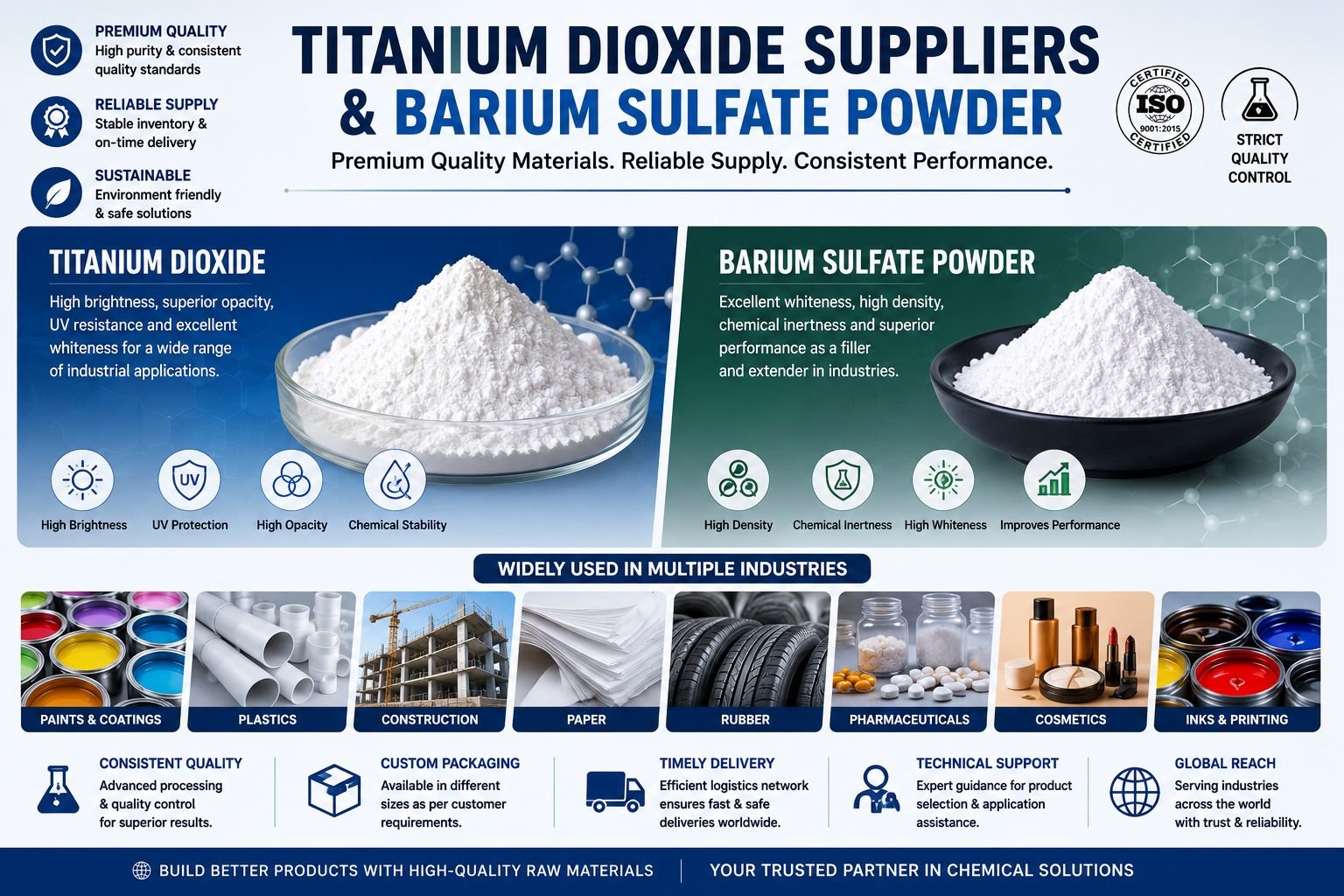
Industrial manufacturers depend on consistent raw materials to protect product quality and production efficiency. Two widely used mineral ingredients are titanium dioxide and barium sulfate powder. Although they serve different purposes, both are important in paints, coatings, plastics, rubber, inks, masterbatches, and construction materials.
Finding dependable Titanium Dioxide Suppliers and selecting the right Barium Sulfate Powder involves understanding purity, particle size, dispersion, whiteness, stability, documentation, and supply reliability.
Understanding Titanium Dioxide in Industrial Applications
Titanium dioxide, commonly known as TiO2, is a white inorganic pigment valued for its high refractive index, brightness, hiding power, and resistance to discolouration. It is commonly available in rutile and anatase grades.
Rutile titanium dioxide is frequently preferred for exterior coatings and plastics where weather resistance matters. Anatase grades may suit products requiring whiteness and specific processing characteristics.
Reliable Titanium Dioxide Suppliers usually offer grades designed for different industries rather than one universal product. Surface treatments using alumina, silica, or organic agents may improve dispersion, durability, gloss, and compatibility.
Why Grade Selection Matters
Choosing TiO2 only by price can create hidden costs. Poor dispersion may increase pigment consumption or reduce gloss. A suitable grade should match the formulation, resin system, opacity requirement, and final environment.
Key Properties Buyers Should Review
Important specifications include:
- TiO2 content and pigment purity
- Rutile or anatase crystal structure
- Particle size and distribution
- Whiteness and tinting strength
- Oil absorption
- Surface treatment
- Dispersion performance
- Weather and heat resistance
- Moisture content
- Batch consistency
What Is Barium Sulfate Powder?
Barium Sulfate Powder is an inorganic mineral material known for high density, chemical inertness, low oil absorption, good whiteness, and useful filling properties. Natural grades are often produced from barite, while precipitated barium sulfate is manufactured to achieve controlled purity and particle characteristics.
In coatings and plastics, Barium Sulfate Powder can work as a functional extender or filler. It may support surface smoothness, dimensional stability, chemical resistance, gloss control, and formulation economics depending on the selected grade.
Fine grades are useful where manufacturers need smooth finishes and controlled distribution.
Titanium Dioxide and Barium Sulfate Powder Compared
| Property | Titanium Dioxide | Barium Sulfate Powder |
| Main role | White pigment and opacifier | Functional filler and extender |
| Key benefit | High hiding power | Density, stability, and filling performance |
| Common industries | Paint, plastics, inks, coatings | Paint, plastics, rubber, coatings |
| Oil absorption | Depends on grade | Generally low |
| Weather resistance | Strong in suitable rutile grades | Chemically stable |
| Cost role | Premium performance pigment | Supports formulation economy |
The materials are not direct substitutes. Formulators may use them together to balance opacity, texture, density, mechanical properties, and production cost.
Where These Materials Are Commonly Used
Common applications include:
- Architectural and industrial paints
- Powder coatings
- PVC and engineering plastics
- Masterbatch production
- Printing inks
- Rubber products
- Adhesives and sealants
- Construction compounds
- Automotive coatings
- Decorative finishes
Manufacturers should validate performance through laboratory testing before changing grades or suppliers.
How to Evaluate Titanium Dioxide Suppliers
A dependable supplier should provide more than an attractive quotation. Consistency, traceability, and technical support matter.
Look for Titanium Dioxide Suppliers that provide technical data sheets, safety documentation, certificates of analysis, packaging information, recommended applications, and sample support.
Buyers should review batch consistency. Significant variation may lead to colour correction, higher dosage, production delays, or rejected goods.
How to Select the Right Barium Sulfate Powder
Choosing Barium Sulfate Powder starts with required particle size, whiteness, density, purity, moisture level, and compatibility with the formulation.
For high-end coatings, a finer or precipitated grade may improve smoothness. For general filling applications, processed natural barite may balance performance and cost.
Before placing a large order, buyers should conduct dispersion, viscosity, gloss, mechanical, colour, and stability tests under actual production conditions.
Quality Documentation You Should Request
Professional sourcing should include documentation that helps verify safety and product consistency:
- Technical Data Sheet
- Safety Data Sheet
- Certificate of Analysis
- Product specification sheet
- Batch traceability
- Regulatory declarations
- Packaging and storage guidance
Confirm packaging, lead time, shipping conditions, and documentation before shipment.
Frequently Asked Questions
1. What does titanium dioxide do in paint?
It provides whiteness, brightness, and opacity, helping coatings cover underlying surfaces effectively.
2. Is rutile better than anatase titanium dioxide?
Neither is universally better. Rutile is often selected for durability, while anatase suits certain indoor or specialised applications.
3. What is Barium Sulfate Powder mainly used for?
It is commonly used as a functional filler or extender in coatings, plastics, rubber, inks, and related materials.
4. Can barium sulfate replace titanium dioxide?
Not directly. Titanium dioxide provides strong opacity, while barium sulfate contributes filling, density, stability, and formulation benefits.
5. Why is particle size important?
Particle size influences dispersion, finish, viscosity, gloss, reinforcement, and processing behaviour.
6. What should buyers ask Titanium Dioxide Suppliers?
Ask about grade suitability, surface treatment, specifications, certificates, consistency, samples, packaging, lead time, and technical support.
7. What is precipitated barium sulfate?
It is a manufactured form produced under controlled conditions to achieve high purity and specific particle characteristics.
8. How should these powders be stored?
Keep bags sealed in a dry, covered area and protect them from moisture, contamination, and damaged packaging.
9. Should manufacturers test samples first?
Yes. Laboratory and production trials help confirm compatibility before full-scale purchasing.
10. Can supplier consistency affect finished product quality?
Yes. Variations in whiteness, particle size, moisture, or surface treatment can influence colour, dispersion, viscosity, gloss, and processing.