
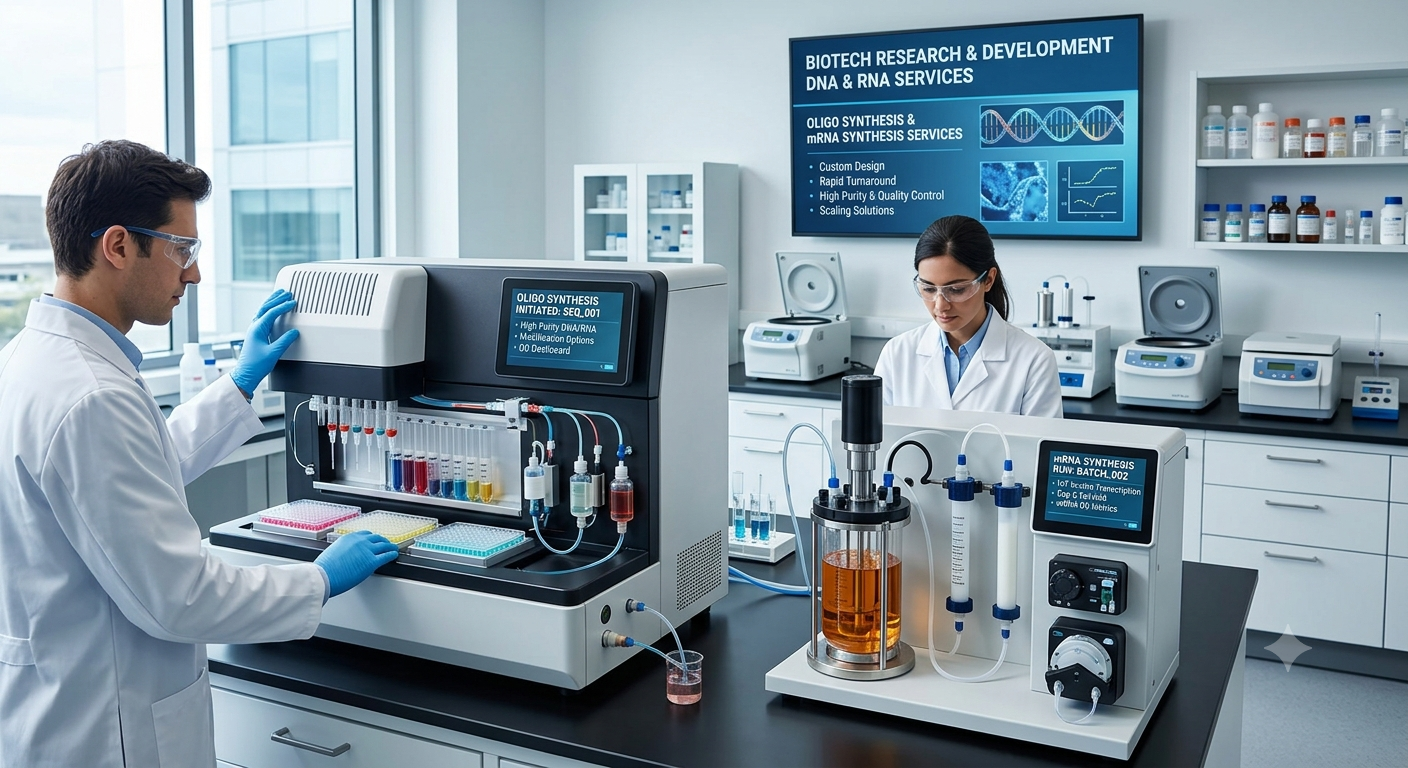
Two technologies playing an important role in this progress are oligo synthesis and mRNA synthesis services. Although they involve different types of nucleic acids, both help researchers obtain customized molecular tools without developing every production process internally.
From primers used in PCR experiments to messenger RNA designed for protein-expression studies, professional synthesis services can improve consistency, scalability, and experimental efficiency. Understanding how these technologies differ—and where they complement each other—can help laboratories choose the right approach for their scientific objectives.
What Is Oligo Synthesis?
Oligo synthesis is the controlled production of short sequences of nucleic acids, generally DNA or RNA oligonucleotides. Researchers specify the nucleotide sequence they require, and the oligonucleotide is chemically synthesized according to those specifications.
Synthetic oligonucleotides have become essential tools across molecular biology because they can be designed for highly specific experimental purposes.
Common applications include:
- PCR and quantitative PCR primers
- DNA sequencing workflows
- Hybridization probes
- Gene assembly
- CRISPR research
- Antisense studies
- RNA interference research
- Molecular diagnostics
- Synthetic biology
Modern oligonucleotide production may also incorporate modifications such as fluorescent labels, phosphorylation, linkers, modified bases, or chemical groups designed for particular experimental applications.
Why Custom Oligonucleotides Matter
Off-the-shelf molecular reagents cannot address every research question. Custom oligo synthesis enables scientists to determine sequence length, composition, purification requirements, modifications, and production scale.
This flexibility is particularly useful when researchers are developing novel assays or investigating new biological targets.
Understanding mRNA Synthesis Services
Messenger RNA carries genetic instructions that cellular machinery can translate into proteins. mRNA synthesis services provide researchers with customized messenger RNA molecules designed around specified sequences and experimental requirements.
Instead of producing RNA internally through multiple preparation and purification stages, laboratories can outsource the manufacturing process to specialized providers.
Custom mRNA may support:
- Protein-expression research
- Vaccine development studies
- Functional genomics
- Cellular engineering
- Immunology research
- Gene regulation studies
- Therapeutic discovery
- Reporter assays
How Synthetic mRNA Supports Research
Synthetic mRNA offers researchers a temporary method of introducing instructions for protein production into cells. Because the RNA itself does not need to permanently alter cellular DNA, it has become an important research platform across biotechnology and pharmaceutical development.
Professional mRNA synthesis services can also provide options involving sequence optimization, untranslated regions, poly(A) characteristics, nucleotide modifications, purification, and quality analysis.
Oligo Synthesis vs. mRNA Synthesis Services
Although both technologies involve customized nucleic acids, their characteristics and applications differ considerably.
| Feature | Oligo Synthesis | mRNA Synthesis Services |
| Primary product | Short DNA or RNA sequences | Messenger RNA molecules |
| Typical applications | PCR, probes, sequencing, gene assembly | Protein expression, vaccine and therapeutic research |
| Production approach | Commonly chemical synthesis | Commonly template-based RNA production |
| Sequence length | Usually relatively short | Often significantly longer |
| Customization | Labels, bases and chemical modifications | Sequence, UTRs, nucleotide modifications and other design parameters |
| Research role | Molecular recognition or assembly | Cellular protein-expression instructions |
Neither technology replaces the other. Researchers often use them together within broader molecular biology workflows.
Important Factors When Selecting Oligo Synthesis
Choosing an oligo synthesis provider should involve more than comparing price.
Sequence Accuracy
High sequence fidelity is important because unwanted sequence variants can affect downstream experiments.
Purification
Different applications require different purity levels. Purification options may include desalting, cartridge-based purification, HPLC, or PAGE depending on sequence characteristics and experimental needs.
Modification Capabilities
Researchers may require fluorescent dyes, spacers, modified nucleotides, biotin, phosphorylation, or other functional groups.
Production Scale
Providers should offer quantities appropriate for early research as well as larger experimental programmes.
What to Evaluate in mRNA Synthesis Services
Selecting mRNA synthesis services requires attention to both molecular design and manufacturing quality.
Researchers should consider:
- Sequence design capabilities
- RNA purity and integrity
- Available nucleotide modifications
- Quality-control documentation
- Production scalability
- Delivery format
- Technical support
- Project confidentiality
Quality becomes particularly important when RNA will be used in sensitive cellular experiments where impurities or degraded material may influence biological responses.
Quality Control in Nucleic Acid Manufacturing
Reliable nucleic acid synthesis requires appropriate analytical testing. Depending on the product and intended use, manufacturers may evaluate identity, purity, concentration, molecular integrity, and other characteristics.
Quality Considerations for Oligonucleotides
Analytical methods can help confirm whether synthesized oligonucleotides meet expected specifications before they enter downstream experiments.
Quality Considerations for mRNA
RNA molecules are particularly vulnerable to degradation. Careful production, purification, storage, handling, and transportation therefore contribute significantly to maintaining RNA integrity.
Documentation and Traceability
Researchers working in regulated or advanced development environments may also require batch documentation, certificates of analysis, or detailed quality records.
Benefits of Outsourcing Nucleic Acid Synthesis
Using specialized synthesis providers can reduce the technical burden placed on internal laboratory teams.
Potential benefits include:
- Access to specialized manufacturing expertise
- Consistent production processes
- Advanced purification technologies
- Greater customization
- Scalable manufacturing capacity
- Reduced internal equipment requirements
- Faster transition between research stages
Outsourcing also allows scientists to concentrate more resources on experimental design, biological interpretation, and product development.
Applications Across Biotechnology
The combination of oligo synthesis and mRNA synthesis services supports several rapidly developing areas of life sciences.
In molecular diagnostics, custom oligonucleotides can function as primers and probes for detecting specific genetic sequences. In synthetic biology, oligos contribute to DNA assembly and genetic engineering workflows.
Meanwhile, custom mRNA supports protein-expression experiments and research into RNA-based therapeutics. Pharmaceutical researchers may use synthetic mRNA to evaluate biological targets, investigate immune responses, or explore potential therapeutic mechanisms.
Together, these technologies provide flexible molecular building blocks for increasingly sophisticated research programmes.
Frequently Asked Questions
1. What is oligo synthesis?
It is the production of customized short DNA or RNA sequences for research, diagnostic, and biotechnology applications.
2. What are synthetic oligonucleotides used for?
They are commonly used for PCR, sequencing, probes, gene assembly, CRISPR research, diagnostics, and synthetic biology.
3. What are mRNA synthesis services?
They provide customized messenger RNA molecules manufactured according to specified sequence and research requirements.
4. Why outsource mRNA production?
Outsourcing can provide access to specialized manufacturing, purification, analytical testing, and scalable production capabilities.
5. Can oligonucleotides include modifications?
Yes. Many synthesis platforms support fluorescent labels, modified bases, linkers, phosphorylation, and other chemical modifications.
6. Are synthetic mRNA and oligonucleotides the same?
No. Oligonucleotides are generally shorter nucleic acid sequences, while messenger RNA is typically longer and designed to direct protein expression.
7. How should researchers select a synthesis provider?
Evaluate quality systems, customization capabilities, purification, analytical testing, scalability, technical support, and documentation.
8. Why is mRNA purity important?
Impurities or degradation can interfere with sensitive biological experiments and affect reproducibility.
9. Can synthesis services support different project scales?
Many providers support requirements ranging from early-stage research quantities to larger development programmes.
10. Can oligo synthesis and mRNA synthesis be used together?
Yes. They may support different stages of the same molecular biology, diagnostic, synthetic biology, or therapeutic research programme.