
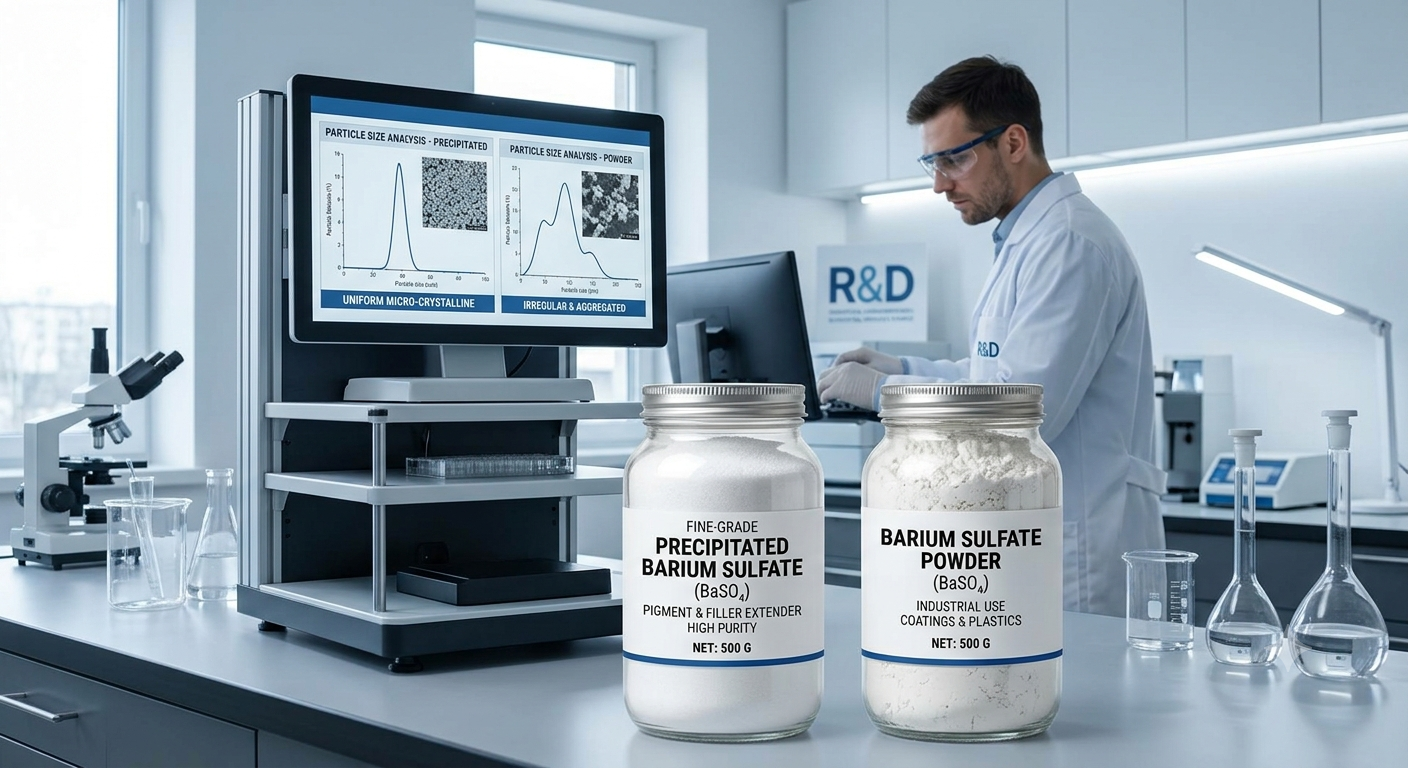
Barium sulfate is an important inorganic material used across coatings, plastics, rubber, inks, chemicals, and several specialised industrial applications. Two commonly discussed forms are Precipitated Barium Sulfate and Barium Sulfate Powder. Although both contain barium sulfate as their main chemical component, differences in manufacturing method, particle size, purity, brightness, and surface characteristics can influence how they perform in specific applications.
Understanding these differences helps manufacturers choose a suitable grade for improving product quality, processing efficiency, surface appearance, density, and overall formulation performance.
What Is Precipitated Barium Sulfate?
Precipitated Barium Sulfate is a highly refined synthetic form of barium sulfate, commonly represented by the chemical formula BaSO₄. It is produced through a controlled chemical precipitation process rather than simply grinding naturally occurring barite.
The controlled production process allows manufacturers to achieve consistent characteristics such as:
- Fine and uniform particle distribution
- High chemical purity
- Excellent whiteness
- Low oil absorption
- Good chemical stability
- Controlled particle size
- Strong resistance to acids and alkalis
- Excellent dispersibility in compatible formulations
Because of these properties, precipitated grades are widely selected for applications where appearance, consistency, and formulation performance are particularly important.
What Is Barium Sulfate Powder?
Barium Sulfate Powder generally refers to powdered barium sulfate used as a functional mineral filler or extender in industrial formulations.
Depending on its source and manufacturing process, the powder may be produced from processed natural barite or through synthetic methods.
Natural grades are generally manufactured through processes such as:
- Mineral selection
- Crushing
- Grinding
- Classification
- Purification
- Particle-size control
Barium sulfate powder is valued for its relatively high density, chemical stability, low solubility, and usefulness as a functional filler.
Precipitated Barium Sulfate vs Barium Sulfate Powder
Selecting between the two materials depends on the technical requirements of the finished product.
| Property | Precipitated Barium Sulfate | General Barium Sulfate Powder |
| Production | Chemical precipitation | Often mineral grinding or processing |
| Purity | Typically very high | Depends on mineral and processing |
| Particle size | Fine and controlled | Available in multiple particle sizes |
| Whiteness | Excellent | Grade dependent |
| Distribution | Highly consistent | Depends on classification |
| Surface quality | Suitable for demanding finishes | Suitable for general filling applications |
| Cost | Usually higher | Often more economical |
| Typical use | Premium coatings, plastics, inks | Coatings, rubber, plastics, industrial fillers |
Neither material is automatically better for every application. The appropriate choice depends on formulation requirements, desired finish, processing method, specifications, and budget.
Important Properties of Barium Sulfate
One reason barium sulfate is widely used is its combination of useful physical and chemical characteristics.
High Density
Barium sulfate has a comparatively high density, making it valuable where formulation weight or density modification is required.
Chemical Resistance
It provides strong chemical stability under many industrial conditions and is resistant to numerous acids and alkalis.
Low Solubility
Barium sulfate is extremely poorly soluble in water, helping it remain stable in many formulations.
Good Whiteness
High-quality Barium Sulfate Powder can provide good brightness and whiteness, while precipitated grades are particularly suitable where consistent colour characteristics are required.
Low Oil Absorption
Suitable grades can help formulators maintain desirable rheological and processing characteristics without requiring excessive amounts of binder.
Applications of Precipitated Barium Sulfate
The controlled properties of Precipitated Barium Sulfate make it useful across numerous industries.
Paints and Coatings
It can be incorporated into industrial paints, powder coatings, automotive coating systems, primers, and decorative formulations.
Its benefits may include:
- Improved surface smoothness
- Better filling properties
- Improved hardness
- Controlled gloss
- Good dispersion
- Enhanced coating consistency
Fine-particle grades are particularly valuable when manufacturers need an even surface finish.
Plastics and Masterbatch
Barium sulfate is commonly used as a functional filler in thermoplastic and polymer formulations.
Depending on the polymer system and grade, it can contribute to:
- Higher density
- Dimensional stability
- Surface smoothness
- Improved appearance
- Controlled processing characteristics
Applications may include polypropylene, polyethylene, engineering polymers, masterbatch, and compounded plastic materials.
Rubber Products
Barium Sulfate Powder is also used in selected rubber compounds where manufacturers require a stable mineral filler.
Possible applications include:
- Industrial rubber components
- Sealing materials
- Rubber sheets
- Technical moulded products
- Synthetic rubber formulations
Correct particle size and compatibility should always be considered during formulation development.
Printing Inks
Fine precipitated grades can be used in certain printing ink formulations because their controlled particle characteristics can support dispersion and consistency.
Material selection may depend on the ink system, printing method, viscosity requirements, colour strength, and desired finished appearance.
Powder Coatings
Precipitated barium sulfate is particularly useful in powder coating formulations. Its particle characteristics can support smooth film formation while providing useful filling and performance properties.
Manufacturers should evaluate particle size distribution, purity, moisture, whiteness, and compatibility when selecting a powder coating grade.
How to Choose the Right Barium Sulfate Grade
Choosing a material based only on price can result in inconsistent production or undesirable finished-product characteristics.
Consider the following factors:
- Purity: Higher-purity material is preferable for technically demanding applications.
- Particle size: Fine particles may provide smoother surfaces and more consistent dispersion.
- Whiteness: Important for light-coloured coatings and polymers.
- Moisture content: Excess moisture may create processing difficulties.
- Oil absorption: Particularly relevant to paints, coatings, and printing formulations.
- Density: Consider the desired final formulation weight and performance.
- Dispersion: Poor dispersion can negatively affect appearance and processing.
- Application compatibility: Always select a grade designed for the intended formulation.
Requesting a technical data sheet and conducting production trials are sensible steps before making large-volume purchasing decisions.
Advantages of Using Barium Sulfate Powder
When the appropriate grade is selected, Barium Sulfate Powder can offer several practical advantages.
Key benefits include:
- Good chemical stability
- High density
- Low water solubility
- Useful filling performance
- Good weather resistance
- Availability in different particle sizes
- Compatibility with numerous industrial formulations
- Potentially cost-effective formulation optimisation
However, actual performance depends strongly on grade quality, processing conditions, formulation design, and end-use requirements.
Frequently Asked Questions
1. What is precipitated barium sulfate?
It is a synthetic form of BaSO₄ manufactured through a controlled chemical precipitation process to achieve high purity, fine particles, and consistent physical properties.
2. Is precipitated barium sulfate different from natural barium sulfate?
Yes. Natural material is generally obtained from barite mineral, while precipitated material is chemically manufactured under controlled conditions.
3. Where is barium sulfate powder commonly used?
It is commonly used in coatings, plastics, rubber products, printing materials, powder coatings, and other industrial formulations.
4. Why is particle size important?
Particle size can influence dispersion, surface finish, processing performance, gloss, viscosity, and the mechanical characteristics of a formulation.
5. Is barium sulfate soluble in water?
Barium sulfate has extremely low water solubility, which contributes to its stability in many industrial applications.
6. Can it be used in plastic manufacturing?
Yes. Suitable grades are used as functional fillers in several plastic and masterbatch applications.
7. Why is precipitated barium sulfate used in coatings?
Its high purity, controlled particle distribution, whiteness, and filling characteristics make it valuable for high-quality coating formulations.
8. How should manufacturers select a supplier?
Evaluate product specifications, quality consistency, particle-size distribution, purity, technical documentation, batch control, packaging, and reliable supply capability.
9. Is every barium sulfate powder the same?
No. Grades can vary significantly in purity, whiteness, particle size, moisture, density, surface treatment, and manufacturing method.
10. Should a product trial be conducted before bulk purchasing?
Yes. Laboratory evaluation and production trials help confirm compatibility with the actual formulation and processing equipment.