
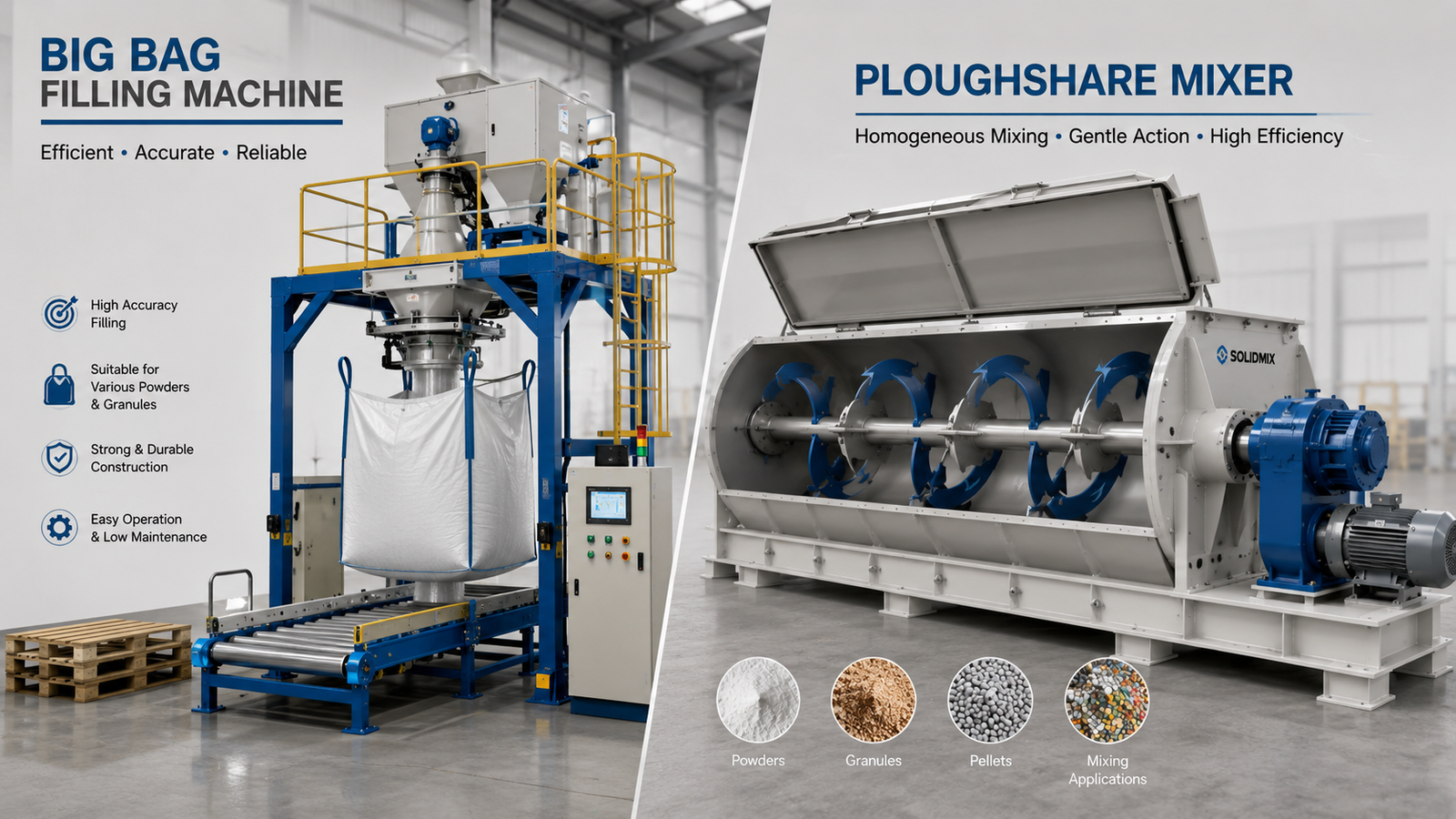
A ploughshare mixer is primarily designed to create fast, uniform mixtures of powders, granules, and other bulk solids. A big bag filling machine, on the other hand, transfers processed material into large flexible bulk containers for storage, transportation, or distribution.
Industries dealing with chemicals, minerals, building materials, fertilizers, food ingredients, animal feed, and industrial powders can benefit significantly from selecting the right combination of mixing and filling equipment.
Understanding a Big Bag Filling Machine
A big bag filling machine is an industrial system developed for filling Flexible Intermediate Bulk Containers, commonly called FIBCs, bulk bags, jumbo bags, or big bags.
Instead of manually handling large quantities of powder or granular products, manufacturers can use automated or semi-automated filling equipment to achieve controlled material transfer.
A typical system may incorporate:
- Bag supporting and suspension arrangements
- Filling spout and bag connection system
- Weighing or load-cell technology
- Material feeding mechanism
- Dust extraction connection
- Bag inflation functionality
- Vibration or densification equipment
- Control panel and automation components
The configuration varies according to the material characteristics, required filling capacity, bag dimensions, weighing accuracy, and plant environment.
How a Big Bag Filling Machine Works
The operating cycle generally starts by positioning an empty bulk bag underneath the filling head. The operator connects the bag inlet to the filling spout and secures the lifting loops to the supporting mechanism.
Material is then transferred from an upstream hopper, silo, conveyor, feeder, or processing machine.
When weighing technology is integrated, load cells continuously monitor the amount of product entering the bag. Material feeding can slow as the target weight approaches, helping improve filling accuracy.
After the predetermined quantity has been reached, material flow stops. Depending on the system, vibration or bag conditioning may help settle the material and produce a more stable package.
The filled bag can then be released and transferred using a pallet, forklift, conveyor, or other material-handling equipment.
Major Benefits of Big Bag Filling Technology
An appropriately designed big bag filling machine can make bulk packaging more efficient and controlled.
One major advantage is productivity. Filling hundreds of kilograms of material manually would require considerable labor and time. Mechanized equipment allows companies to handle large quantities more consistently.
Other potential benefits include:
- Better filling-weight consistency
- Reduced manual material handling
- Cleaner working conditions with suitable dust control
- Faster bulk packaging operations
- Improved bag stability through material densification
- Easier integration with upstream equipment
- Reduced product spillage and material loss
- Better production data when automation is incorporated
The actual benefits depend heavily on equipment configuration and the properties of the product being handled.
What Is a Ploughshare Mixer?
A ploughshare mixer is an industrial mixing machine commonly used for intensive blending of dry powders, granules, fibers, and certain products requiring liquid addition.
Inside its horizontal mixing chamber is a rotating shaft fitted with specially designed plough-shaped mixing elements. As these elements rotate, they lift and move material throughout the chamber.
Rather than relying only on gentle tumbling, a ploughshare system creates intensive three-dimensional movement. This makes the technology useful when rapid distribution of different ingredients is required.
Depending on the application, high-speed choppers can also be installed to break agglomerates or assist with dispersion.
How a Ploughshare Mixer Produces Uniform Blends
The effectiveness of a ploughshare mixer comes from the movement generated inside its mixing chamber.
Rotating plough elements continuously lift bulk material away from the vessel wall and distribute it throughout the active mixing zone. Individual particles move in different directions, encouraging rapid interaction between ingredients.
This intensive mechanical action can be especially valuable when a formulation contains ingredients with different particle sizes, densities, or concentrations.
Optional liquid injection systems can introduce controlled amounts of additives during mixing. Choppers may provide additional shear where lump breaking or improved dispersion is required.
However, mixer performance depends on several factors, including filling level, rotational speed, ingredient properties, mixing time, and formulation requirements.
Applications Across Industrial Processing
Both technologies have applications across diverse industries.
A ploughshare mixer may be used for processing:
- Fertilizers and agricultural formulations
- Cement-based products and dry mortar
- Chemical powders
- Mineral mixtures
- Food ingredients
- Animal feed additives
- Pigments and colorants
- Detergent formulations
- Plastic and polymer additives
A big bag filling machine can subsequently package compatible finished materials into large bulk containers.
This makes the combination particularly useful for manufacturers that blend powders or granules before shipping them in industrial quantities.
Big Bag Filling Machine vs Ploughshare Mixer
| Factor | Big Bag Filling Machine | Ploughshare Mixer |
| Primary purpose | Bulk bag filling | Intensive material mixing |
| Production stage | Packaging | Processing |
| Typical materials | Powders and granules | Powders, granules and formulations |
| Main objective | Controlled filling | Homogeneous blending |
| Weighing system | Frequently available | Not normally its primary function |
| Dust control | Important during filling | Important during charging/discharging |
| Automation | Manual to fully automated | Manual control to automated |
| Integration | Silos, feeders and conveyors | Feeding and downstream packaging systems |
These machines should therefore not be viewed as competing technologies. They solve different problems within a bulk-material production process.
Integrating Mixing and Big Bag Filling
A production line can be designed so that raw ingredients first enter the ploughshare mixer. After completing the required mixing cycle, the finished blend is discharged into downstream handling equipment.
The product may pass through a buffer hopper, screw conveyor, rotary valve, gravity chute, or another suitable feeding mechanism before reaching the big bag filling machine.
An integrated workflow can follow this sequence:
Raw material feeding → Mixing → Discharge → Intermediate storage → Controlled feeding → Weighing → Big bag filling → Finished bag handling.
Automation can coordinate these stages and reduce unnecessary manual intervention.
Choosing the Right Big Bag Filling Machine
Machine selection should begin with the product rather than filling speed alone.
Manufacturers should evaluate bulk density, flowability, particle size, dust generation, moisture sensitivity, aeration characteristics, required bag weight, bag dimensions, and production capacity.
For dusty powders, an effective sealing and extraction arrangement becomes particularly important. Products containing significant air may require vibration or densification before bags can achieve stable dimensions.
Also consider weighing tolerance, cleaning requirements, available installation height, operator accessibility, and future automation plans.
A well-specified big bag filling machine should fit the entire material-handling process rather than operate as an isolated piece of equipment.
Choosing an Appropriate Ploughshare Mixer
Selecting a ploughshare mixer also requires careful product evaluation.
Important considerations include:
- Required batch volume
- Bulk density
- Particle characteristics
- Desired mixing uniformity
- Mixing cycle duration
- Liquid-addition requirements
- Abrasiveness of ingredients
- Cleaning requirements
- Discharge characteristics
- Need for high-speed choppers
Materials used in food or sensitive chemical applications may require special construction materials, surface finishes, sealing arrangements, and hygienic design.
Testing representative material before final equipment selection can provide valuable information about mixing time, discharge behavior, power requirements, and product quality.
Improving Safety and Maintenance
Industrial equipment should be operated according to the manufacturer’s instructions and applicable workplace safety requirements.
Regular inspection of seals, bearings, drives, load cells, filling connections, mixing elements, sensors, and electrical components helps maintain reliable operation.
Preventive maintenance is particularly important when processing abrasive or dusty materials.
Operators should also receive appropriate training for equipment startup, shutdown, cleaning, emergency procedures, and material-specific hazards.
Dust-producing materials may require properly engineered extraction, containment, grounding, or explosion-protection measures based on the properties of the product and the facility’s risk assessment.
FAQ About Big Bag Filling Machine and Ploughshare Mixer
1. What is a big bag filling machine used for?
It is used to fill large flexible bulk bags with powders, granules, and other suitable free-flowing or semi-flowing bulk materials.
2. What is the main purpose of a ploughshare mixer?
A ploughshare mixer provides intensive mixing to distribute ingredients throughout a bulk formulation.
3. Can both machines work in one production line?
Yes. Material can be blended in the mixer and subsequently transferred to the filling system for bulk packaging.
4. Can a big bag filling machine weigh products?
Many systems incorporate load cells or other weighing technology for controlled filling.
5. Can liquids be added in a ploughshare mixer?
Certain configurations support liquid injection, provided the mixer is properly designed for the formulation.
6. Is a ploughshare mixer suitable for powders?
Yes. Powder and granular material processing represents an important application for this type of mixer.
7. How can dust be controlled during big bag filling?
Suitable filling-head sealing, extraction systems, enclosed transfer arrangements, and properly designed connections can reduce dust release.
8. What determines big bag filling capacity?
Capacity depends on material flow characteristics, target weight, feeding method, bag handling, automation level, and upstream supply.
9. Does a ploughshare mixer require regular maintenance?
Yes. Mixing tools, seals, bearings, drives, choppers, and other components should be inspected according to the manufacturer’s maintenance schedule.
10. How should manufacturers select these machines?
Selection should be based on actual material properties, required throughput, process objectives, accuracy, safety requirements, cleaning needs, automation, and plant layout.